Restingmotion

  • Five Things That Made Me Happy Over My Birthday Weekend. And a Picture

    Back Deck 3.0  Until this past week, the deck had been a weight around my neck, an unfurnished waste land that reminded me every day of all the things I had not done, and empty void that fed my doubts and really accomplished nothing except to fuel my doubts.  Last week however, instead of pulling weeds, I spent some time scrubbing built up pollen, mildew and various seasonal stains off the outdoor furniture.  Then I moved the furniture that has been here and there and everywhere, most recently on the slate patio, to the deck, the space on the deck that had once held the outdoor dining table, but that too was relocated (deck 2.0).  I’d been looking at deck furniture for years, but nothing clicked.  Then, at a friend’s house, I realized I had been asking the wrong question.  I had the furniture I wanted for the deck, I just had it in the wrong place.  

     Another corner of the deck.  These chairs have been here a couple of years.  The pillows were meant for the furniture above, but didn’t work there and make this corner more cozy.   The brick pieces came with me from Hyde Park, were rescued from the original Vassar Brothers Hospital when it was torn down, and moved by me to this location last summer.  I sat in these chairs enjoying my birthday breakfast, looking out at a deck that no longer looked like a barren wasteland of empty promises.


    Savory Pastry: I made an onion tart, with local onions, cream and eggs.  Creamier than a quiche, more custardy, it was light and delicious.  I didn’t have the right size tart pan for the recipe though, so I actually made several smaller tarts, in a mixture of sizes, some more successful than others.  I enjoyed working with pie pastry, I enjoyed the process of making the tarts.   This particular tart was too shallow; the deeper ones, with more filling, are more appealing. But again these are minor details.   I feel inspired to go through the boxes of baking supplies which have been languishing, unopened, since George died in 2012.  


    Farmers Market Saturdays.  I have always loved farmers market days.  It is more than just shopping for me.  I like to wander around once, then come back and make my choices, although sometimes I just have to grab things when I see them.  I love talking to the farmers and makers.  I love the process of imagining what I can make.  I love coming home and planning, dreaming of food and future meals either alone or with friends.  Market days are imagination days, creative days, and this year especially, when I do not have my own garden, they are all the more necessary.  I miss my vegetable garden, even as I know I don’t yet know how to work out the details of resurrecting it.  That will come in time.   In the meantime I still have the market, always have the market.  I never had a large garden.  I’ve never wanted to not go to the market.  I want my Saturdays to revolve around this, what is local, what is here.  For me, life has always, at least as long as I remember, revolved around food.  What we eat, how and why we eat it, is a large part of what makes us human, and what brings us together as a community, connects us to each other and the world in which we live.  Increasingly I reject the commodification of food because it feels like the commodification of life, and we are all more than that.


    This week at the market I was cautious.  I avoided buying too many peaches even though I dream of making peach butter.  I knew I didn’t (don’t still) have the energy to make peach butter now, but I might one week.  I did buy shishito peppers because I don’t have peppers in my non-existent garden. I blistered them in a hot skillet early the next morning, and they sit on the counter, there for the taking and noshing.  

    Macarons:   On my way out of the market I bought a chocolate lavender macaron and I ate it while I cooled down in my car.  Pure bliss.


    Limelight Hydrangeas:   The limelight hydrangeas are just beginning to open.  Really, is there anything more to say?


    And I promised a picture.  

    This is what 67 looks like, looking forward to a sixty-eighth year filled with hope.  I feel hopeful, like my current self is more in touch with both the promise of my youthful self and the acceptance of limitations of my older self than she has been in a while.  Odd talking about myself as an other, or even a group of others.  Well, none of us are mono-dimensional after all.  I am a universe of cells and ideas and thoughts and dreams.   


  • Summer Garden Update

    The garden was beautiful this spring, bursting with flowers.  But did I take pictures? No.  Did I write? No.  I was still too busy beating myself up over all the things I had not yet done, and was not doing, to truly celebrate the beauty of all I have accomplished.  

     That is not really the best place to be, berating oneself for perceived failures.  Sometimes my inner voice, that persistent echo of years of early training in the school of “not good enough”, gets the better of me.  I know this voice is a false idol, something that attempts to lure me away from what is truly important in life.  But sometimes I succumb. 

    As an antidote of sorts, I am posting pictures of the late June Garden. The June garden lacks the riot of color seen in early spring, and it is more overgrown with weeds, but at least those weeds are green.  I am learning to accept that my dreams are far bigger than my energy levels, and, thankfully, Mother Nature will happily fill the gap.  Better weeds than dead lifeless soil.  What is a weed anyway but an arbitrary designation, a plant that is growing where a human does not want it?  Although I have to work to pull them out, those weeds help the soil, help build an ecosystem and haven for smaller creatures, and will eventually become compost.

    Two summers ago, the bed to the south and east of the hydrangeas above (two above photos) were empty, mostly home to grassy weeds.   There are still some creeping grassy weeds in there, but it is not nearly as big a problem, and more importantly the perennials, which I felt I spent much of last summer just keeping alive, are thriving now.  There are even some echinacea, even though rabbits consistently ate them to the ground before they ever grew tall last summer. Apparently a few of them survived long enough to nourish roots.  This too gives me hope.

    That bed has evolved, some plants I planted there have not thrived and have already been moved, others did better than expected and have led me to rethink the ways I will be expanding and finishing out the beds around the upper circle.  That is one of the good  things about gardening, as frustrating as it is. Gardens are centering, calming, and also humbling. I am constantly reminded that control itself, as much as I yearn for it, is a myth, a false construct.  My garden will show me the way, slow as I might be to absorb its lessons.

    This is one of the first beds I planted in the garden after moving back into the house and it remains one of my favorites.   There are two narrow beds like this, flanking steps up to the circle lawn.  I had envisioned matching beds, but that hasn’t worked quite according to my plan. The beds are similar, balanced, but not symmetrical or mirror-images. The light at the far east end of the two beds is far different from the light on the western end.  I have to think about these beds more as a continuum or scale rather than as separate symmetrical static objects.

    Progress is also being made on the shady side of the garden, but that tends to be more spotty.  Some areas have thrived, others are more hit and miss; once again, a constant learning experience.  

    The chaste tree (with the purple blossoms) struggled the first 5 years of its life.  Planted in 2018, it was battered, tipped over, and twisted by winds in storms.  I wondered if it would survive, and then last summer it finally got its bearings and started to thrive, filling out like crazy just as I was giving up hope. The wattle fence around the small front yard, which was, for me, a defining feature, has fallen down.  Knoxville has gotten even rainier than when I moved here, and although I’ve been in contact with the man who made it, getting it repaired or replaced has proven problematic.  I am pondering alternatives, or if I even need a fence.  That is something that is not going to be resolved this year, and inaction itself may prove to be the solution.    It seems nothing is ever finished.  No, that statement is both correct and incorrect.  The goals are always moving, and very often the initially perceived finish line is but a bend in the road, leading us on to new ideas, new realities, new growth.

    Much of the back is still wild and wooly, with more weed than garden, although I have made progress there as well.  My vegetable garden is inactive this season.  Last year I lost it to the bunnies, deer, heat, and inattention as I tried to make progress up front. I’m still thinking about long term plans, and focusing on what I can accomplish more immediately instead.  Isn’t this always the way?  At some point I felt as if I had hit a wall, and then suddenly one small change and whole new vistas and ideas open up.  I am hopeful again, although I am still looking at the garden as part of a 10-year plan.  Well, it is always a 10-year plan, even though I started it 5 years ago; why don’t admit it is part of my life plan.  As long as I am here, my life and the space I occupy in that life is a work in progress.


    There are always more things that I dream of doing than I can do.  In fact I it seems I can accomplish merely a fraction of what I plan.  That has been the curse of this garden in some ways.  I took on a grand plan, and life threw in too many hiccups.  My body rebelled.  I hoped to do more this past spring, but,  this past spring  the act of simply standing up straight and moving proved to be bigger challenge.  I was, in fact struggling far more than I was willing to admit, and chaos was piling up around me.  I’m still working on that, but I’m making progress.  I am gaining strength and mobility, which gives me hope and fuels my dreams further. I’m still far too pig-headed to admit defeat.  Dreams are good.  Plans are good.  Hope is even better.  The same for accepting limitations. It is not so much what you do, what your are given, or even what happens, either good or bad, that is important in life, but what you make of the life you live.  The important thing is who you are, not what you do, although one may well inform the other.


    Sometimes the best thing to do is to sit in the garden with a cup of tea or a glass of wine, admiring the garden, admiring the frolicking of birds, squirrels, and even rabbits. When I sit I realize how my failure to keep up to my own plan has created this haven.  I glance benignly at the weeds, thinking:  “Perhaps I’ll pull you another day”.  

  • Playing with My Food, 250601

    When I first opened Kristina Cho’s Book, Chinese Enough, one of the first things I wanted to make was Kohlrabi and Radish Salad with Chili Crunch.   It was not the first thing I made from this book, although it is the first dish I will write about in this post.

    What attracted me to this dish?  First of all,  love kohlrabi, and very nice kohlrabi is often available at my local Asian Market, Sunrise Supermart.   I don’t recall eating kohlrabi much growing up, but it is common in German and Austrian cooking, and it was the favorite vegetable of my late husband, who was born in Austria.   I also love Chinkiang Vinegar, which is one variety of Chinese black vinegar. It is made from fermented glutinous rice, and although there are many bottles and brands that add wheat, it is not difficult to find Chinkiang Vinegar with no wheat added, at least if one has a good Chinese or Asian market nearby and is willing to spend time reading labels.  But having celiac disease taught me that taking time to read labels is a good idea, and I have come to embrace that idea on a broader scale, meaning I like knowing exactly what is going into my food..  

    But let’s return to that salad. First I made the chili crunch. I’ve made nearly every chili crunch from nearly every cookbook I own which has oe, and this was good but I am not certain it is my favorite. I would have liked more heat, but that was my fault as I was out of hot red pepper flakes when I made it and was too lazy to run to the store. I used mildish Korean gochugaru instead. Were I to make this again, I would use hot Chinese chiles.

    Although the recipe called for watermelon radishes, I was planning to use regular radishes, simply because I don’t often find watermelon radishes. However fate was on my side and I found some in the farmer’s market that week. They proved to be the weak part in an otherwise lovely salad. I admit to knowing little about watermelon radishes and I suspect these were too large and not particularly tender. Even thought I sliced the reddish very thinly on a mandolin, they were more woody than crisp.

    I loved the flavors of the salad; it was bright, tart from the vinegar, but with a slightly funky, nutty, oily heat that did not dominate but softened and rounded out the flavors of the vegetables.  However, due to the radishes, I realized I was unlikely to finish the salad, despite the fact that the author says it keeps five days.

     Then I had a thought.  


    I had some leftover roast chicken in the fridge and a partial bottle of heavy cream.  I wondered if I could turn the kohlrabi/radish salad into a kind of gratin with the leftover chicken.  I knew kohlrabi bakes well; I’ve made kohlrabi gratins.  Radishes of all varieties steam well, so it seemed logical that it would also work in a gratin, so I proceeded.  First I drained the vegetables because the vinegar would not help.  I had about 6 cups of thinly sliced vegetables, and about 3 cups of shredded chicken.  I also had two medium-sized russet potatoes in the pantry, and since I was about to go out of town I thought I would use those as well.


    I dabbed the bottom of the gratin dish with a small amount of butter, layered the peeled and thinly sliced potatoes as a base and then alternated layers of chicken and vegetables.  I grated a small chunk of havarti I rescued from the fridge on top, then poured the heavy cream over it all and baked it until the cheese was brown, the liquid was thick and bubbling and the potatoes were cooked through.


    Although it was not a beautiful dish, it was delicious. I expected it to be good, how could it not be? But it was far greater than the sum of its parts — more complex and more enticing than I had hoped.  Due to the high volume of radish and kohlrabi, the dish was lighter than many gratins, but it was still substantial.  The vegetables cooked down but were still tender and toothsome, with a fresh, fruity, crisp-soft, and yet still slightly starchy consistency that was very appealing. The color of the radishes faded substantially, but they also colored the dish a very faint pink.  The potatoes didn’t add much, but I felt virtuous for not leaving them behind.  What started out as an impromptu “mess” of a fridge clean-out, turned into a dish that I would make intentionally, not just as to use up leftovers.


    I’d been in “play” mode in the kitchen for a few months, but this dish kind of tripped the pause button.  I actually made two small gratins and froze one.  It makes me so happy when something virtuous also ends up tasting sublime.  And these happy accidents send my mind wandering along the many ways that food has shaped human development and culture.  I perhaps never would have thought of making a gratin with radishes, cream, and chili crunch, but it worked beautifully.  


    That is the thing, for me anyway, about cooking and exploring new cookbooks.  I find it fun.  Both reading a cookbook, and cooking from it, expands not only my palate and my skills, but my imagination as well.   I may not be in the mood to cook, but I’m still in the mood to write about cooking. What I love is not just learning new dishes, but the process of inspiration that leads me to discover and think about food in new (to me) ways.


  • Musings on Music

    When I restarted this blog, my initial plan was to write about a musical experience.  Something else needed to be said first, however.  Actually I've been struggling with whether or not my musings on music and live concerts was worth reading anyway, and a pause before leaping was a good thing. In the end, I've decided that my need to write trumps whether or not anyone else reads, cares, or agrees. It is worth writing if only because that is the only way I know how to make sense of my own peripatetic thoughts.


    I wrote the above paragraph 10 days ago and my thoughts are still circling.  I am not sure that I ever really wanted to write about the music itself or my reactions to the music.  In that sense, time is a gift, and the fact that these things still hold a strong place in my thoughts is relevant.  So, let's get started.


    In late May there were two performances, memories of which are still dancing around in my head, nearly a month after the fact.


    The first was the Knoxville Symphony Orchestra's May concert which included Dvorak's New World Symphony and a new commission by Derrick Skye titled "Between Suns: A concerto for African Drums and Orchestra".  I really did not know what to expect, but I was excited about the prospects going in. The truly fabulous concert was far greater than my hopes.  Derrick Skye was unfamiliar to me, but I have since listened to some of his music on YouTube and seriously hope that a recording will be made of this piece.   Between Suns is a true concerto, a true melding of the two genres of music, not just a symphonic work with occasional drum cadenzas.  The music felt comfortable spanning both idioms, tethered to neither really, although I have friends who felt it strayed perhaps a bit too far outside of the Western Classical tradition.  I disagree.  


    Yes, the music pushes at the boundaries and constraints of the western classical tradition but it comes nowhere close to abandoning it.  At least not from my understanding.  But I tend to think we can all, myself included, sometimes get lost in our own assumptions and biases.  And I have long been attracted to music, art, ideas, that push at boundaries and make me think in new ways.


    In Between Suns I heard passages reminiscent of Copeland, and even Beethoven in the second movement. The Beethoven reference, as I learned later, was intentional, since Beethoven used this same rhythm, which is an ancient drumming rhythm which crosses cultural boundaries and is thousands of years old.  Beethoven himself was tapping into something ancient in human experience, blurring categories.  Other parts of the work reminded me of medieval polyphony and I was charmed, intellectually challenged, and moved by complex poly-rhythmic passages and remarkable shifts and changes in the music. It was not just in the drumming and the skill of the drummers that thrilled me, but the musicians in the orchestra as well with the complex and nuanced ways the musicians played together, pushing outside normal parameters.  Some of those passages, some of those moods, still haunt me today.  This is not just a month-old memory however, as the concert was rebroadcast on a local radio station a week ago, and will be rebroadcast again in September.  But I dearly hope that this is a piece that will be recorded, and that I will be able to hear again, to experience it and understand it more fully.


    As mentioned previously that concert closed with Dvorak's Symphony #9, "From the New World" and it was a warm and wonderfully engaging performance.  It was the perfect way to close out this concert, urgent and exciting where it needed to be, calm and uplifting in other moments. It was as nice a performance as I could ever hope to attend, the perfect melding of art, musicianship, and the energy present in the concert hall.  There was a moment, very brief, where one trumpet was just barely off, a quarter breathe perhaps, and it sounded like the trumpets were fighting, but the whole thing couldn't have lasted more than a second or two, and I was once again lost in the music. I've tried to let my critical brain rest when I attend concerts, but this captured my attention.  I decided it was fitting in some way, that even the stress of that brief discordance celebrated the experience of live music, of disparate perspectives and voices coming together, not always in perfect harmony, but working toward it.  I relaxed and happily just enjoyed the moment, the melding of old and new, a constantly evolving understanding of "New World".  


    The second performance that has stuck in my head was Knoxville Opera's performance of "Stuck Elevator", and opera based on an event that actually happened in 2005, when a food delivery man from the Bronx was stuck in an elevator for 81 hours.  As is true of all good stories, and all good operas,  the actual events merely served  as a stepping stone to a greater story.  The opera is short, 81 minutes for an 81 hour ordeal, and it beautifully and emotionally explores suffering, love, loss, the struggles of families and peoples to survive, to emigrate, to seek betterment for their families, to navigate pain and loss.  I felt the experience was almost too short, but I know others who felt it too long.  Some of the passages and scenes were complex, challenging for the audience, even risqué in places, blurring musical constructs and styles in ways that were beautifully handled by the fabulous cast. It was an opera that pushed the assumption of the audience, questioning our very ideas of the nature of opera, of musical theatre, even of our expectations and biases in life.  Part comedy, part tragedy, part fever dream, the quiet ending was almost shocking in its simplicity. After this emotion-laden drama, the door opens and our protagonist, Guang, simply slipping away into the night, lost to history.  But not to my dreams.


    I suppose, since so much time has passed,  I cannot write without also mentioning the musical event that occurred between that weekend of fascinating new works and the actual appearance of these words on a computer screen (page?).  I went to New York to see "The Queen of Spades" by Peter Illych Tchaikovsky at the Met.  I had a wonderful evening, enjoying the opera very much, with no regrets, even though I felt the performance was flawed.  The music was lushly bewitching and perfectly set the scene as the opera played out through what seemed like a series of disconnected stories.  I thought the female voices were outstanding although the men got the "best" songs, not that the men were shabby either.  In fact the singing and the music all made me happy.  That disconnect was still present however.  There seemed little chemistry between the male and female leads, and although I could enjoy the music in a very intellectual and abstract way, emotionally the performance did not bridge the lack of continuity. It is true that my mind tends to  wander at some point during most performances. Perhaps wandered slightly more than usual here.  I could only imagine how much fun Tchaikovsky (and his librettist) must have had playing with the music for this piece which also seems to mock human frailties and the subjects of so many operas.  The idea tickled my fancy, although I cannot say it will resonate in my mind as deeply as the two previous performances, but it was still a fabulous evening, and I am glad I went.


    But now the summer season is upon us, and in my life that usually means less music.  Much as I love concerts I am happy to rest. 


  • The View from My Window, Skittering Thoughts

    (This post was written when I was in fact in New York City last week.  It is only now that I have had time to revisit it and post.)


    Here I am, in New York City and I find myself with this inexplicable sense of wanting to write you.  Why? It has been months.  And I have been content in my rather quiet life.  I do have to admit though that the only reason I brought my laptop with me on this trip was a sense that I might indeed want to write.

    This is the view from my window as I write.  It makes me happy.  The penthouse apartment across the street with the lovely patios, in a beautiful old building.  The contrast of old and new appeals to me.  The shiny glass building on the right; the scaffolding on the left.  I’ve always thought that the signs of human industry are beautiful in their own ways — and yes, I can extend that to even our more brutal invasions such as power plants and mining sights.  The beautiful ugly. Once I thought I would like living in the city.  Now I see peace in my morning suburban walk, in the greenery. in my hands in the dirt, even as I fail, daily, to keep up with the weeds.  


    But I also recognize that all of this could change in any instant.  I recognize that peace exists only in my own head and heart, in where I allow it to enter.  It could be found anywhere; it could be found nowhere.  The choice is mine.  In this moment, in this window, I choose peace.


    Openness to new ideas and curiosity; those are the important things.  They are not the same, although they are related.  And they are each thoroughly interior qualities.  They are not about gallivanting about, throwing oneself into new experiences, although they could be, for some people, in some circumstances.  But the opposite could be true.  Curiosity can also be found in solitude, in quiet moments.  


    One can travel the world and do all kinds of exciting things, without ever changing one’s mind; a person can gather up facts and experiences, while yet remain closed-minded  and set in their ways.  I’ve known people like that.  I also have known people who have lived in one place all their lives, rarely leaving, but who know more of humanity and the world, who are more open, more curious about ideas and experiences than most.   The difference is not always obvious.


    I had forgotten how early it gets light here in Manhattan.   I shouldn’t have; it took me years to adapt to how late the sun rises in Knoxville, which is very close to the Central Time Zone line, much further west.   I do miss this. I don’t actually know if my natural circadian rhythm is to wake early, or if I acclimated after living in New York State for over 35 years, but since I moved to New York in my late teens and early adulthood, I suspect that my rhythms matured into the rhythm of that particular environment.  The Knoxville summer light still throws me even though I do often sleep later than I used to.  It should not surprise me that an hour, here or there, should make a difference, but of course it does.  Look at all the research on the health impacts of our semi-annual shifts to and from daylight savings time, and how harmful it is.  Not that science changes anything when butting heads with tradition.  Anyway that is not the topic of this post.

    You probably noticed that this second photo is really the same view from the same window.  The reflections seen in the window of the glass tower is, at least partially, my own building.  I am sitting in one of those windows, reflected, small and insignificant, invisible even.  I like that idea.  I like the way the reflection is somewhat distorted, the layers of images, of life.  It reminds me of how small my life and my choices really are inn the greater scheme of thing — insignificant really in the grander scale, in the life of cities, in the life of the human race itself.  I might as well be true to myself, live the life that resonates we me.  All of our power is in the small bits,


    But even the life of the human race, even our impact, as great as it seems, is again a tiny speck, not really seen against the whole.  Our planet, earth, has its own life, a life of which we are a tiny speck, occupying but a few seconds? hours? perhaps days? in an otherwise long life.  An unseen face in a window filled with reflections, lost in the greater scheme of things.


    I am reminded of Samantha Harvey’s novel, Orbital.  In that novel, the astronauts are, at first, attracted and drawn to the sparkling lights they see during the nights of their rotation, the beauty of the human civilization of which they themselves are a vital part.  And yet as their time in space lengthens, they grown more attracted to the daytime views of earth, where humanity is less in evidence, just the earth itself, taking on almost its own life and its own light.  


    Such an idea of the moment, that.  The earth is its own life, and we are just a small bit of dust occupying its face.  Almost a cliché; and yet no less valid. a thought and creation defined by our own moment in space and time, our own zeitgeist.  This is not a criticism per se; that humans before us thought they were the center of the universe simply is a fact.  That we have learned we are insignificantly small simply another fact.  And I am not criticizing Orbital here;  I love this book.  And quite frankly my own musings are as ephemeral, of the moment, and inconsequential as anything existing in this world.  They remain simply another example of the clichés and worldview of my own generation and time, but far less eloquently stated. A post going nowhere, circling on itself.


    I am not putting my own thoughts down.  I am not claiming anything. There is much in the word that may be good, and much that may be evil as well.  In a sense we are each individual cells in a giant creation the is earth, if not the universe itself, and each of us has a role to play.  We are insignificant and yet also mighty. 


    I am here, in NYC, in upper midtown, very much in my own comfort zone, both physically and, in many ways, mentally.  Circling around the musings and mutterings of my own brain.  It feels like I have been working my way back here for a long time.  It is a comfortable a good place to find myself, even in a world that sometimes feels very much at odds with what I hold dear.  To my own brain each echo of light and image in glass, each fleeting thought, each eruption and seismic shift in either the earth or humanity, is a significant event.  How do I choose?  I can only live in each moment.

  • Playing with My Food 2025.01

    Although I’ve always loved to cook, I go through phases, and occasionally get stuck in a rut of the tried and true and familiar.  Over the past year or so however, I’ve found myself increasingly in play mode.  This is due in part to cookbook clubs.  I’ve been in one, run through the Food 52 organization, now discontinued. for years, participating off and on.  Ii threw myself into it more fully last year, determined to at least try every cookbook, even those I had doubts about. and I found the experience exciting and inspiring, opening my mind and taste buds toward thinking about food in new ways.  Then I joined another cookbook club and the fun increased further, even though I do not always manage to keep up with the clubs.


    And yet, I want to write about some of my adventures in the kitchen. 


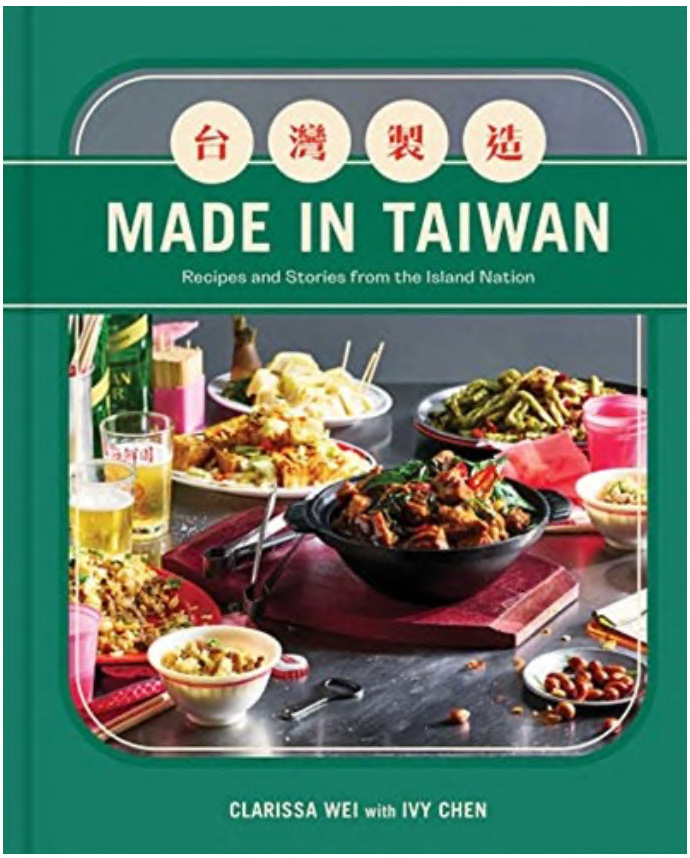
    I purchased this book, Made in Taiwan, by Clarissa Wei and Ivy Chen last December but didn’t start reading or cooking from it until this year.  I do love reading cookbooks, and admit that there was a period where I did more reading and less cooking.  Not this book.  For the first time in a long long time I want to cook everything in this book, even things I don’t normally eat or make.  I enjoy the nerdy details, such as making rice noodles from scratch, and even recipes for how to make the rice flour from raw rice kernels.  Yes, I could buy rice noodles, but I also love learning about the background and history of a thing, and I firmly believe that our food says so much about who we are.  We build large communities based on cooperation, and we cook our food; how could these things not say something about who we are?  Anyway, I am intrigued enough that I will eventually try most of these recipes even if I never make them again..


    So far however I’ve only made three dishes from this book.  Each dish was an absolute winner and I very much look forward to cooking more.


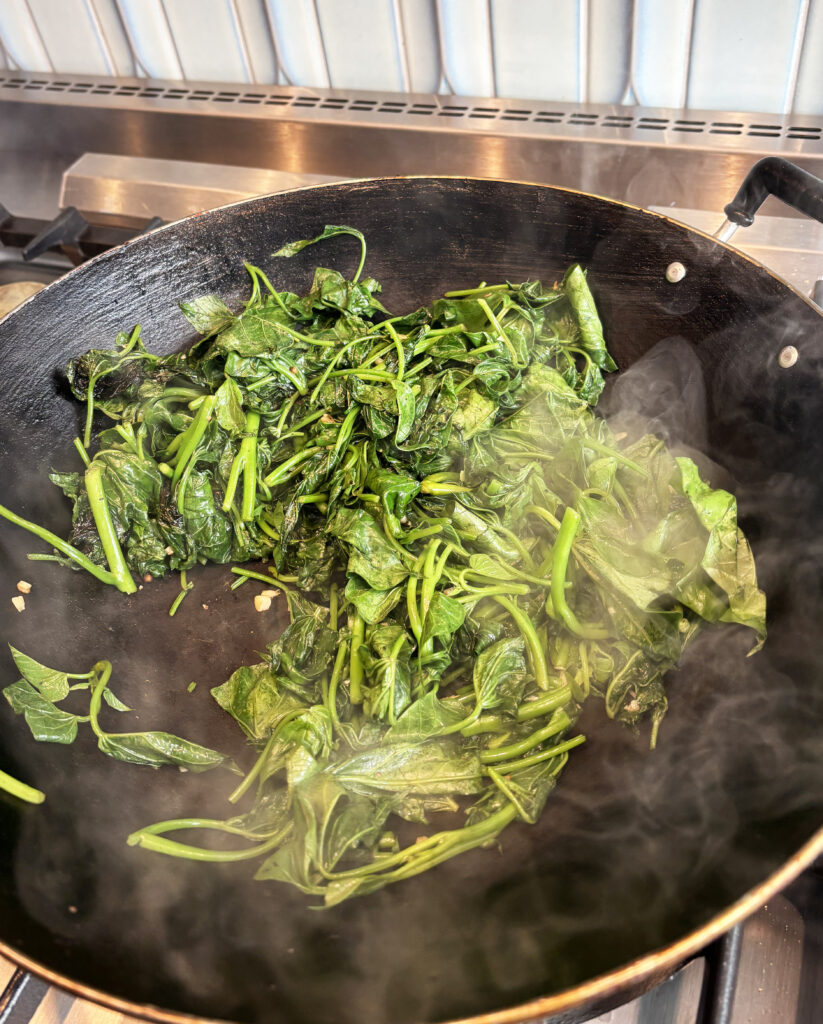
    The first recipe I tried was for a stir-fry of sweet potato leaves. A basic thing, right?  I love green vegetables and don’t believe I’ve met a green leafy vegetable I haven’t liked.   It also seems like every cuisine I’ve learned about has some basic technique for cooking green leafy vegetables.  Although the greens are different, the techniques are similar in that they incorporate some basic fat, aromatics, and water.  


    So sweet potato greens show up in my local Asian market, and recently they have even begun showing up in the farmer’s markets.  The greens in the Asian market are young and tender, perfect for this recipe, whereas the ones I got at the farmer’s market last year were large and tough.  My attempt at stir-frying those was a failure, but I suspect the farmer in question was thinking of them more as a braising green.  If I see them again, I am now ready to explore the possibilities further.


    But back to the greens at hand. The leaves of this bunch of sweet potato greens was smallish and tender, the stems tender as well. With the right greens this dish was a relevation. The stems displayed a small bit of toothsomeness with an almost nutty hint of bitterness to them. I discerned no particular bitterness in the leaves however, just a light, almost buttery flavor with just a hint of floral fruitiness that offsets the garlic perfectly. They are light, much the way spinach is light, but with slightly more crispness to the mouth-feel than spinach, and without spinach’s sometimes mineraly flavor.  


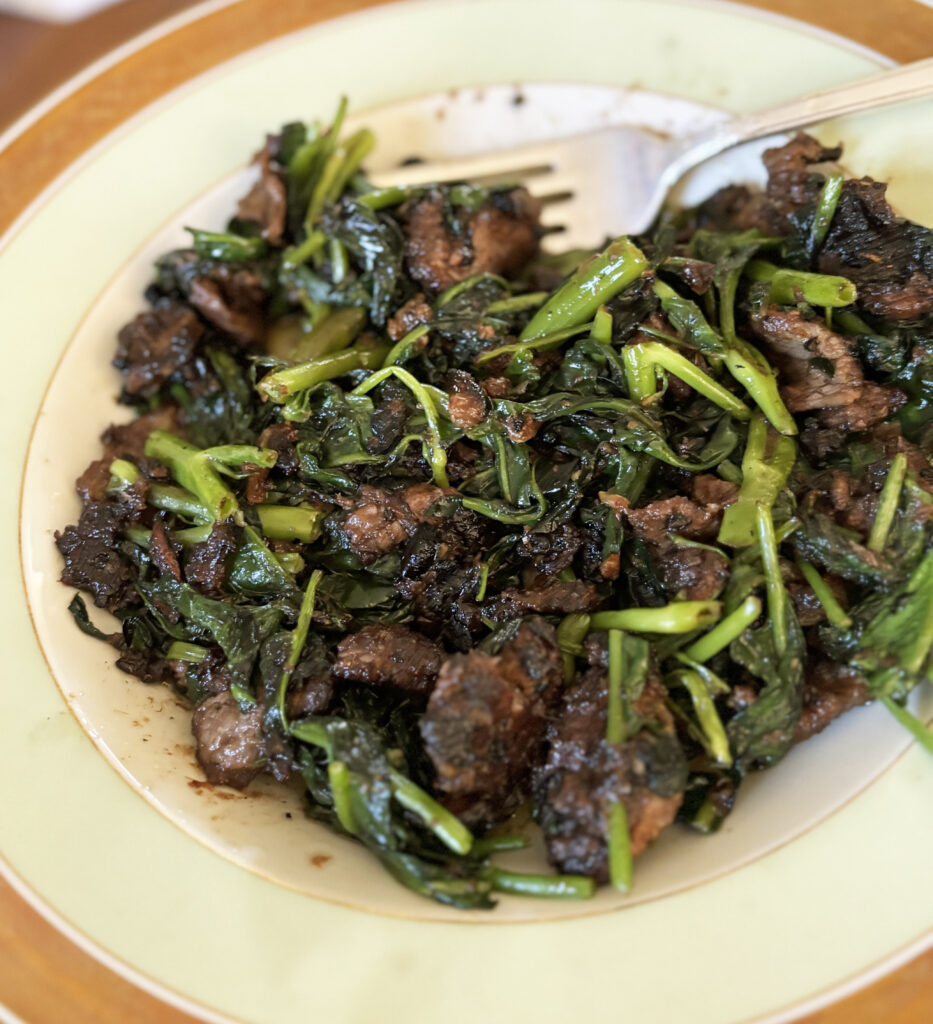
    And, while I am on the subject of greens I tried another new to me green when I made the recipe for Sacha Beef with Water Spinach.  I don’t believe I’d ever knowingly had water spinach before, but now it is a regular addition to my grocery cart just so I can make this dish.


    The recipe is simple and quick to pull together. The most time consuming thing is slicing the beef thinly and then letting it marinate for a full 15 minutes. Everything else can be prepped during that time.  Most of the success of this dish is due to the sauce. Although I originally wanted to make the homemade sacha sauce in the book, I am so enamored of a purchased Bullhead sauce, recommended by the authors, and available in my local Asian grocery, that I can’t imagine doing so anytime soon.
     
    The beef is tender and flavorful and I find the combination of the beef, water spinach and the savory umami-rich sauce almost addictively good. There is a bit of grittiness to the barbecue sauce, but it is not unpleasant and it added a nice counterpoint to the combination of flavors.  There is a hint of the dried shrimp in the sauce also, but I did not so much find it fishy as complexly rich.
     

    This is a dish that is far more satisfying than would be expected from the minimal effort involved. I’ve enjoyed it so much that I now purchase water spinach whenever I see it in the market just so that I can make this dish.

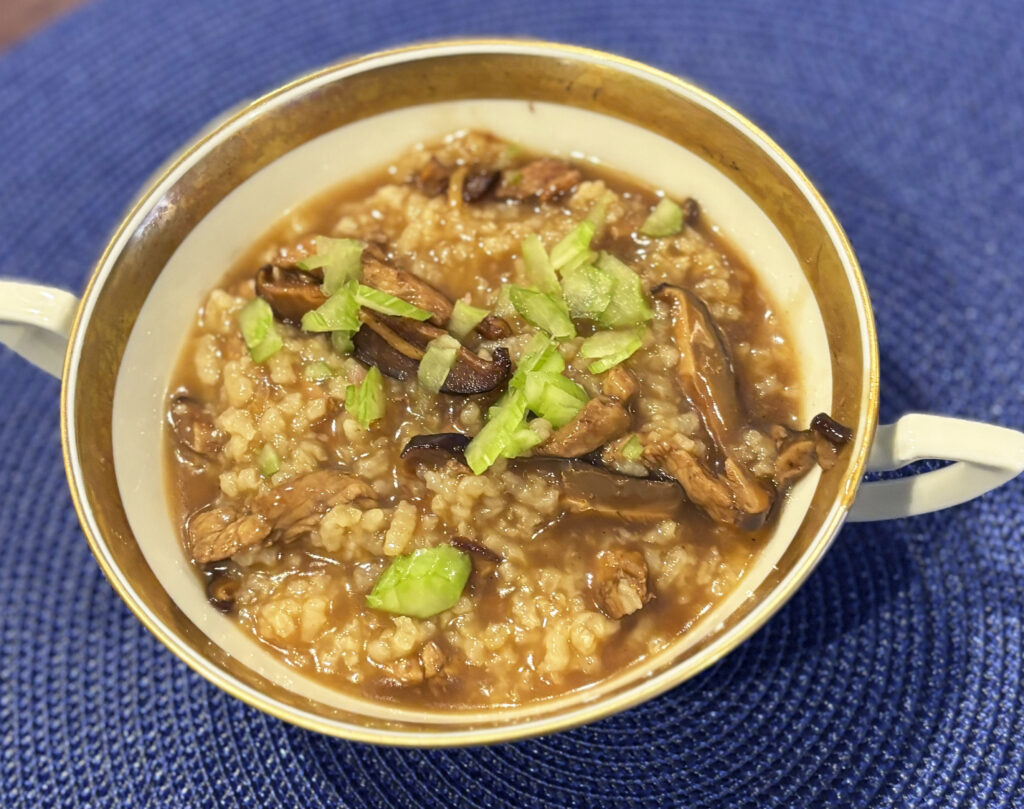
    The last thing I made before getting distracted was congee. I only discovered that I like congee fairly late in life. In retrospect, I wonder why I was. so reluctant to try it, given that I grew up on hot cereal, and I have always enjoyed my porridges on the savory side. Before making this, I had only eaten plain congee with a variety of savory toppings. I was eager to try this recipe for a pork and shiitake mushroom congee.

    My congee is much more deeply colored than the photo in the book, or is traditional, because I used a homemade Asian-inspired bone broth from my pantry rather than using the recipe in the book. I also soaked my mushrooms while the congee was cooking and did not begin my mise en place until after the congee was finished cooking which meant that the congee thickened while I prepped and cooked the pork. I didn’t mind this as I think I prefer my congee on the thicker side.

    This was savory, delicious, and very satisfying; I believe I will cook it again. I don’t actually eat porridge very often anymore, but when the craving hits, nothing else will do.

    This is such a small start from a very promising book but the act of cooking itself is such an act of both discovery and refinement. So much fun. Hopefully I will have more to report.

  • Knitting. Writing about Knitting…Writing.

    I didn’t intentionally stop writing.  I got one of the dread viral infestations that have been running rampant this winter, and then it seems like my energy levels have been slow to recover.  


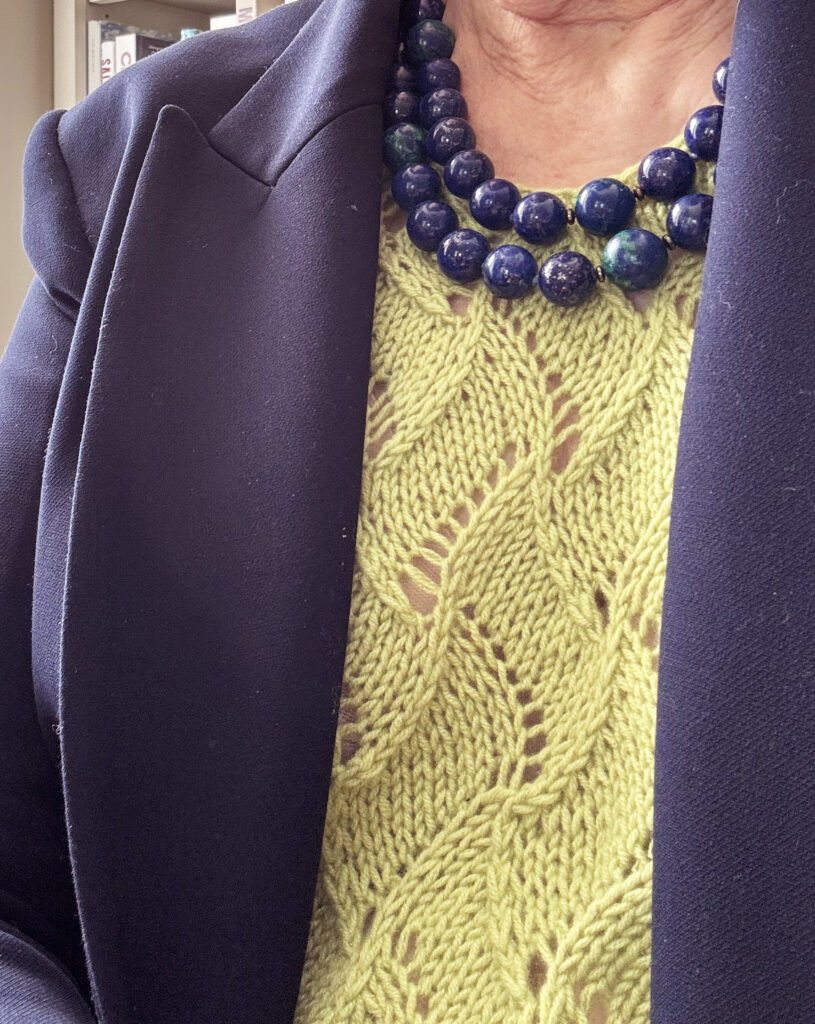
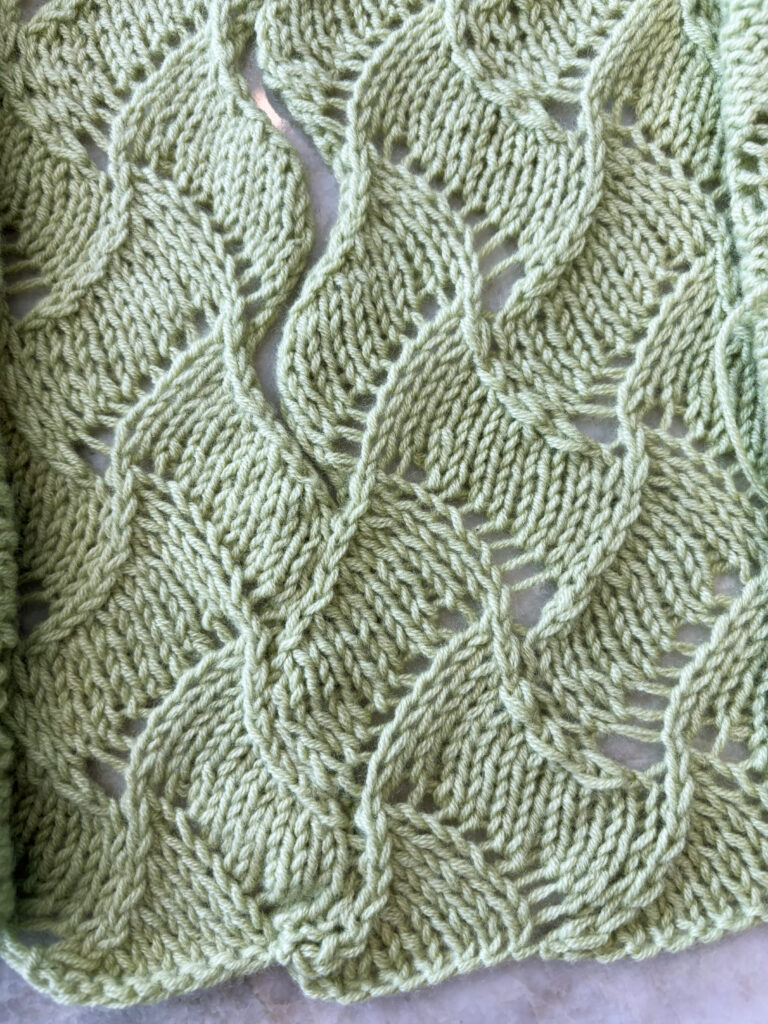
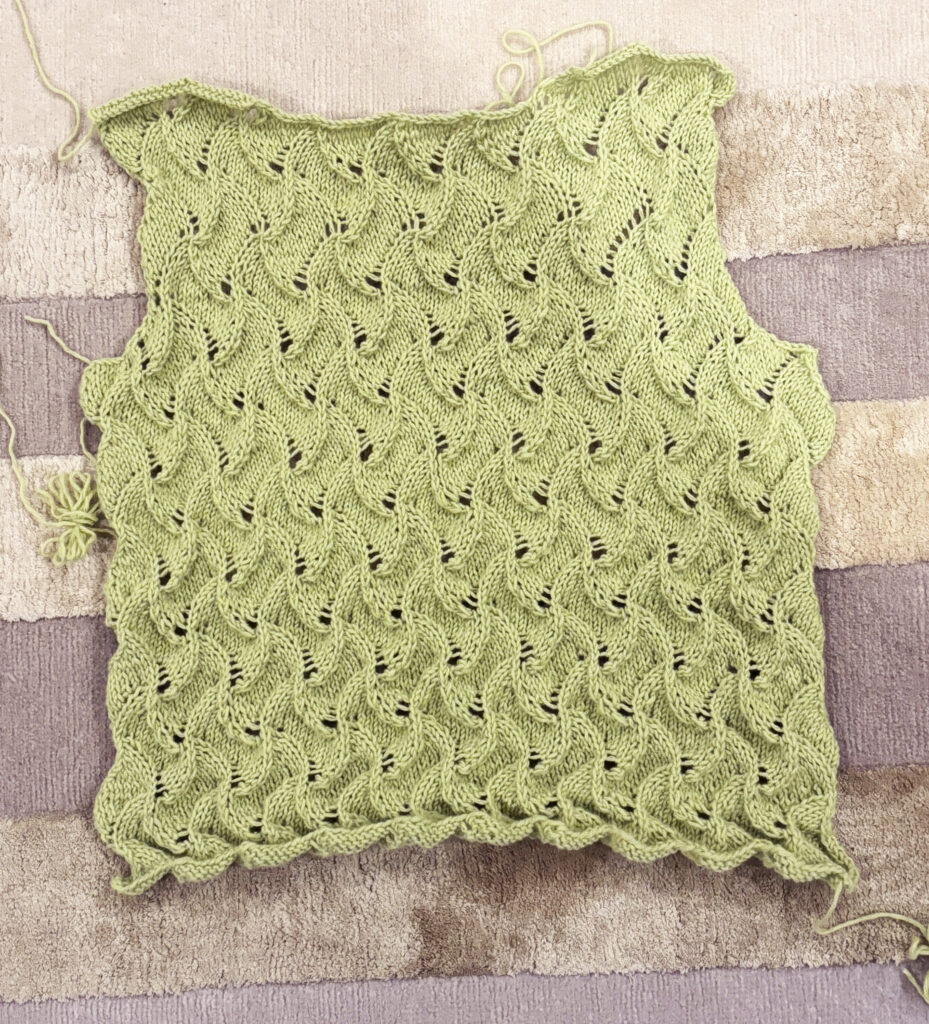
    Then I finished this cashmere shell.

    Well, I was planning to finish it, but finishing is one of those love/hate situations.  It always takes longer than anticipated, and I both love the detail of it, of finishing something nicely, but by the time I am at the finishing part, I just want the whole thing to be done so I can start something new.  And I know better than to start a new project before I finish the old project, or the old project will simply languish in a pile because, well, knitting is more fun than finishing.

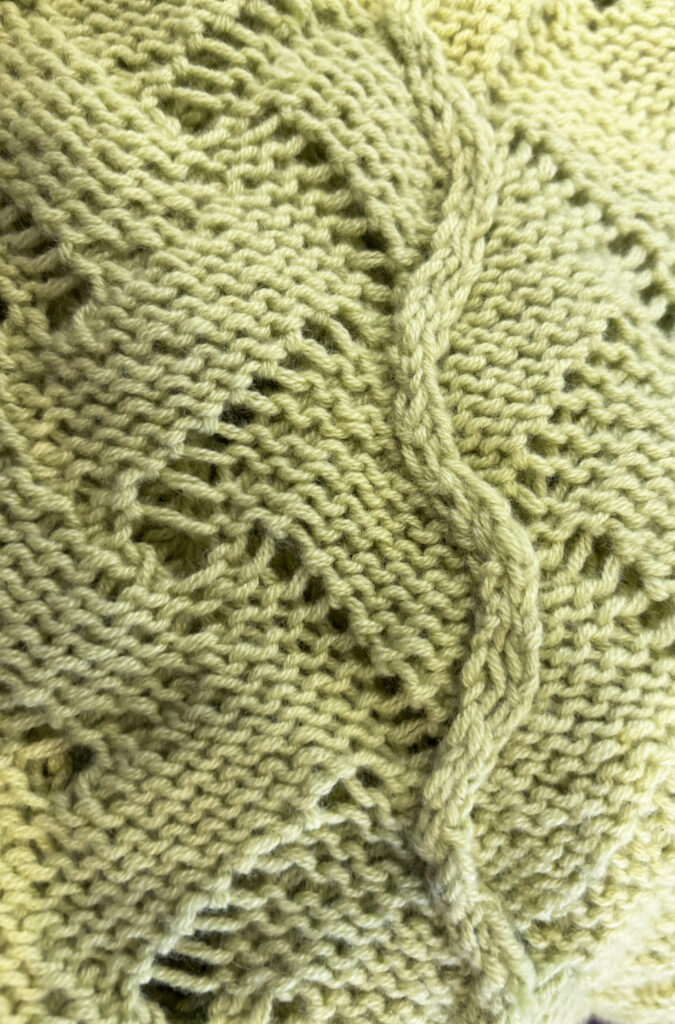
    But this project was an exception.  At least partly.  It was seaming the sides that thrilled me beyond anticipation. These curved edges had worried me.  Until I got started, and then I was captured by the magic of the curved side seam.

    Who says a seam needs to be a certain thing.  Who says a life needs to be a certain way?  IT feels to me like the world is descending into chaos, and yet all I have control over is my own small life.  That doesn’t mean I don’t care or that my actions don’t have impact on those around me.  But I am but a tiny droplet in an infinite pool.  I cannot control the choices of others any more than they can control mine (unless I allow them that privilege).  The simple truth is that as long as there are humans it appears there will be strife.


    But as long as there are humans there will also be beauty, and kindness, and creativity.  We can choose which parts of ourselves we feed.  


    For a while I wondered how I could write in this world.  Then I realized my world is my own.  And even these simple distractions are just as present, just as worthwhile, just as much a part of my own tiny puddle of existence.

  • On Hold

    I had a note in my calendar that I was supposed to write a blog post on Tuesday.  Unfortunately I spent most of Tuesday in bed with some kind of vicious chest cold.  I wasn’t doing anything on Tuesday, or yesterday either for that matter.  Today. I’ve gotten a little simple mindless knitting under my belt but am still lacking in energy and have a lingering cough, which probably lingers further because my chest muscles are so sore from coughing that my attempts feel a bit pathetic. In fact I do not feel inclined to do much of anything, but I’ll try to string some words together.  

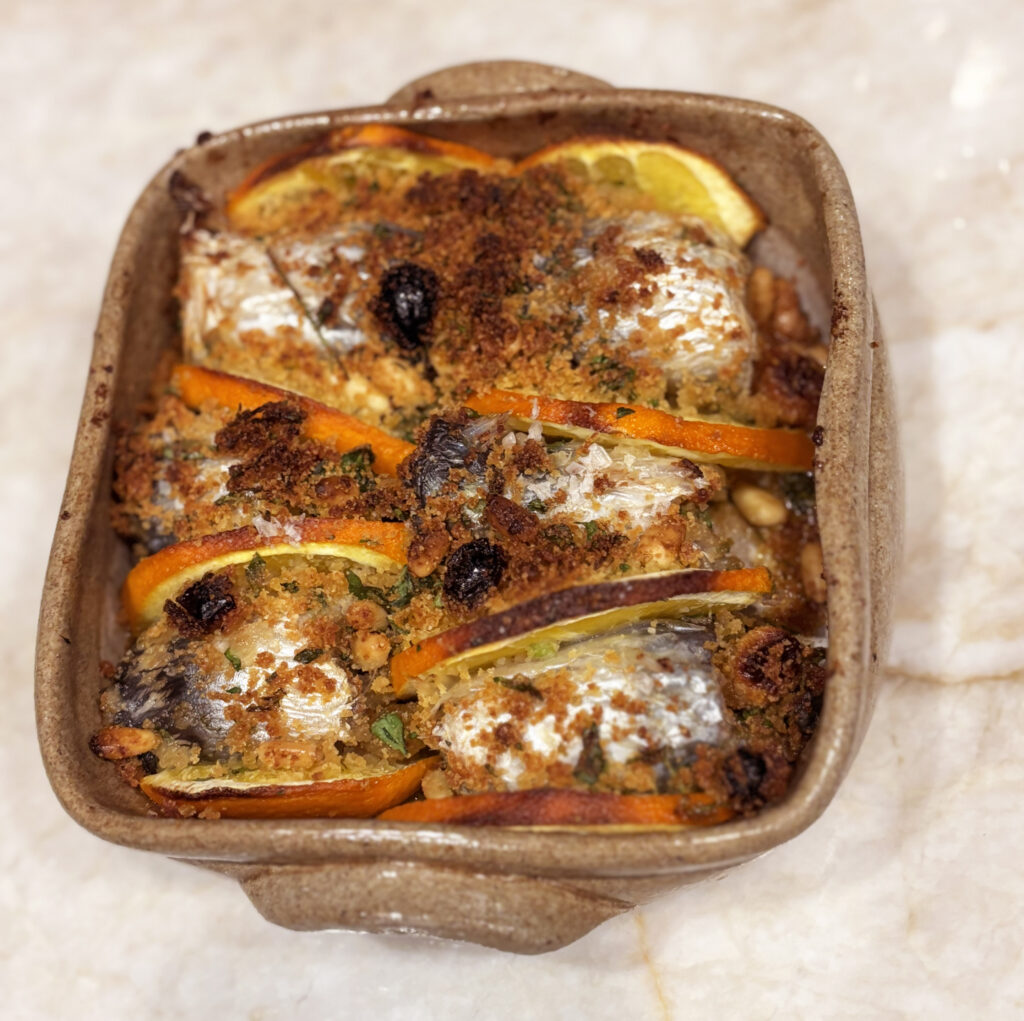
    I went out to the store Monday morning to see about getting some fish for dinner. I picked up fresh sardines.  By the time I got around to scaling, cleaning and filleting them, I was already coming down with cold symptoms.  Truthfully I didn’t feel like doing it, but I also didn’t want to waste the fish.  My patience, and therefore my skill, was lacking, but I got everything done. The process brought up happy memories of sitting outside with my dad scaling and gutting bluegills when I was a child.  I think he would have approved of the sardines as well although I don’t recall ever having fresh sardines when I was young..  These are rolled around a mix of breadcrumbs, orange zest, golden raisins, pepitas and caciocavallo cheese and baked with additional orange slices.  They were not difficult and they were delicious, but by the time they were done I was so tired I had to force myself to eat.  At least they didn’t go to waste, and I probably needed the protein..


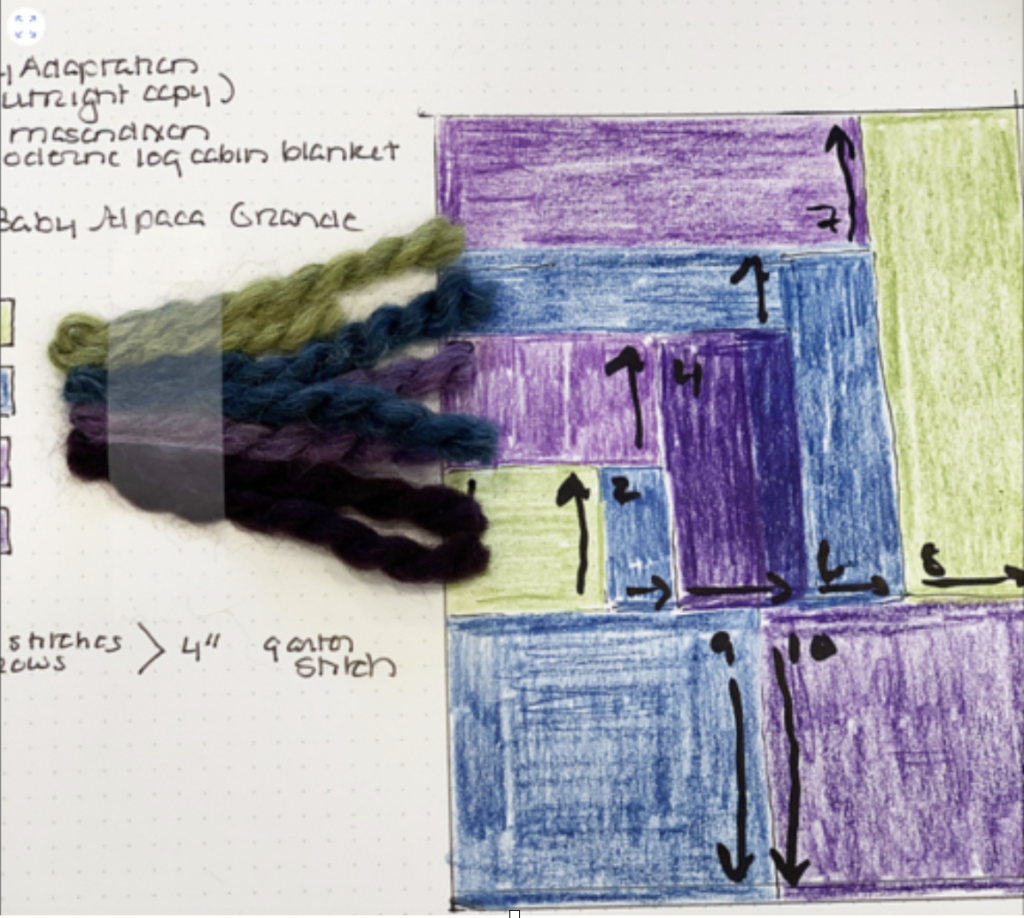
    Otherwise I’ve not been up to much.  Two days in bed.  Today barely puttering about.  I’m working on a garter stitch blanket in Plymouth Yarns’ Baby Alpaca Grande that I started in late 2021.  The pattern is the Modern Log Cabin blanket pattern from Mason Dixon Knitting although at a much larger gauge and yielding a much larger blanket.  I knit the first five blocks and then abandoned the project, probably because I made the temperature blanket in 2022, and one blanket at a time was enough for me.


    I am currently knitting block 5.  You can’t see the number because it is hidden by the yarn swatch, but it is the teal block above blocks 3 and 4.  Actually I will probably finish that block tonight and pick up stitches for block 6.  I’ve been chilled to the bone and can’t seem to pile enough sweaters or blankets on to feel warm.  The extra layer of alpaca feels delicious.


    My other two projects are too complicated for me to work on at the moment.   I’m knitting a lime green cashmere shell.  I finished the back last week.  I cast on for the front and knit one pattern repeat before I got sick.  There are four more pattern repeats before I begin binding off at the underarm, but I don’t see anything happening on this until I am feeling better. 

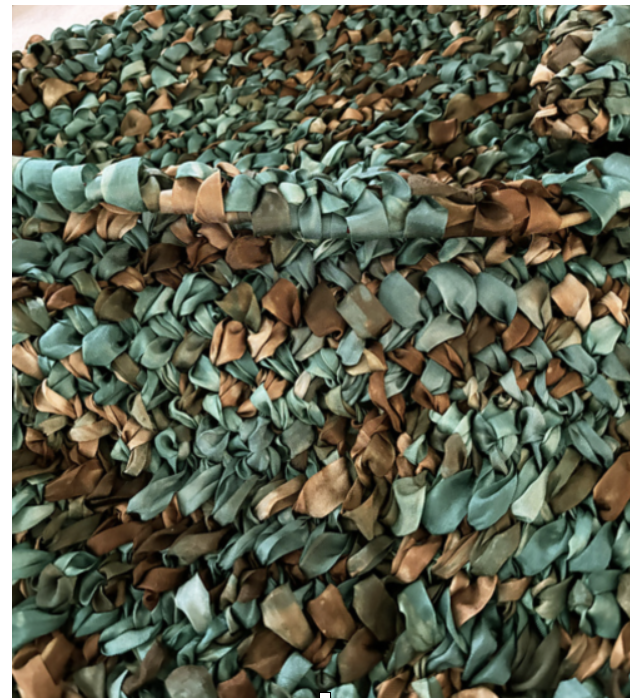
    Also in the active project bag is a jacket knit out of Prism half-inch wide rayon ribbon, but I’ve been avoiding it for a while.  I think the last time I worked on it was in October.  I am finding that the yarn is very twisted and I have to iron each skein before I knit it.  This is the annoying part.  I usually enjoy ironing, but untwisting and ironing 100 yards of ribbon at a go is not fun.  I finished ironing a skein just before Thanksgiving, and the only reason I didn’t start knitting it up was because then I’d have to iron another skein of yarn.  The knitting goes faster than the ironing. Silly no?  I’ve also learned that I tend to twist my projects and my yarn in funny ways when I knit, which doesn’t help in this specific case.  I know I will love the cardigan though, and I am determined to finish it this year.  There are three more skeins of yarn.  If I do a skein a quarter, I’d be contented with that.


  • Musings, Mutterings, Knitting.

    Hello blog! It seems I have been absent although in many ways that is not surprising.  It seems that I have been swinging wildly between being present in my life and at the same time being absent — not as in depressed, although that has probably been the case on occasions. More that I have just been sorting out some things in the hopes of reconnecting with something essential to myself.  That has seemed like a slow process.


    At the moment I feel fully “back”, meaning increasingly settled in myself but not a promise that the blog is back, although I hope it is.  I intended to attempt a start-up in January, and although it is not the beginning of the month, it is still January.  That is good.  There has been a lot of hemming and hawing here, fretting over wanting to write, letting my inner voices argue over whether or not I had anything to say only to find myself back in a place of apathy, where the whole blog thing didn’t seem worth the effort.  


    I had an idea to write about movies, or a particular movie, but the negative arguments won, the voice that says “who cares what I think”, which may or may not be true.  By the time I resolved the issue the movie in question was weeks behind me and it seemed hardly worth the point.  The idea may find its way back up, or not.    The only thing I know is that I want this blog to be about whatever is on my mind at the time I am writing it, and that it is an extension of a journal of sorts.  I tell myself that I should write polished essays, and I occasionally work on those, but that is NOT what I want this blog to be about.  My original idea was for an online journal, really purely for my own reference and entertainment, and then I let the idea get perverted into something else, something I didn’t want.  I don’t really know what I want now but I am willing to let the impulse play out.


    So, after this long, and mostly irrelevant introduction, the remainder of this sweater is going to be about sweaters and knitting.  Specifically it is about sweaters and knitting and colors, specifically puce and muted wines. 


    Puce seems to have been the color of the year.  I knit two sweaters in the color.  In fact the color of neither yarn was called “puce”. The color name for the yarn used in the first sweater was “vintage wine”.  You can see that sweater here.

    It is a lacy cropped cotton cardigan, knit in a 4-ply yarn.  Technically a summer sweater although I am not likely to wear it in the hottest months.  It is a color that has a presence throughout my wardrobe, a few pieces popping up whenever muted wines and roses become fashionable.  


     I never really thought about the color as puce until I was finishing up this cardigan.  Technically I would suppose puce is darker, with a bit more brown.  But it struck me that the range of muted brownish purply pinks suite me well, and I am consistently drawn to the range. 


    Then, in December I felt the urge to knit a warm snuggly sweater and I decided to knit another sweater in an alpaca boucle.  Although this wasn’t planned, the yarn I ordered falls into the same color range.  This time the color is named topaz.


    I finished it in early January and have been wearing it steadily throughout the current cold spell.  I am not quite sure how my dream of an oversized snuggly sweater morphed into this shorter, slightly more fitted sweater, but it did, and I love it. Even though I do not always like sweaters out of bulky yarns, this sweater has ended up being exactly the sweater I wanted.  It is a  sweater that sits a the top of the hip, that looks good with a pair of pants, and which has fairly close fitting sleeves that do not get in the way.  It is a color that makes me feel warm and happy.


    In fact it goes well with my most-frequently worn coat, at least most winters in Knoxville. Seen here with an assortment of reds, all of which are really pinkish or brownish reds. 


    This photo was taken last winter, when my hair was still permed in an attempt to maintain those post-chemo curls.  It is not permed now, and I am wondering if I regret the decision to grow my hair out and stop perming it.  I am not thrilled with my hair the moment, but I can always go back.  It is just the transitional process that is difficult.  Transitional processes are always difficult.  That doesn’t seem to get easier with age.


    Perhaps this blog, like my hair is in transition.  Like all transitions it will take time to see what develops.  And, in that spirit of transition I am going to toss this out, messy as it is, because once I start editing, doubts will set in,  and my words will fall into the bottomless pit, never to reemerge,


  • September Reading

    I skipped a few months, but I will continue the count and, hopefully, fill in the middle one of these days.


    45.   A Dance with Dragons: A Song of Ice and Fire Book 5, George R. R. Martin.

    46.  Smoke and Ashes: Opium's Hidden Histories, Amitav Ghosh.

    47.   This is Why We Lied, Karin Slaughter.

    48.  The Five Star Weekend, Elin Hilderbrand.

    49.  Golden Girl, Elin Hilderbrand.

    50.  The Covenant of Water, Abraham Verghese.

    51.  Katherine, Anya Seton.


    There are some books on this list about which I have little to say.  The George R. R. Martin is part of a longer post that has been swirling about in the back of my mind, a post I hope to get to one of these days, although at the moment my days are busy enough and I am content.  This state of affairs does not drive me toward greater achievements however.  There are many things I wish to accomplish, and a long bookish post on a fantasy series is just one project among many.


    I wrote about The Covenant of Water a year ago, after my first reading.  I read it again for book club.  At that time I wanted to discuss it in book club, and found it far more compelling and thought-provoking than the book that group read in lieu of this one.  When my second book group chose to read it this year I was eager, although we really didn't get into the meat of the book.  Still the book works so well, both as a compelling and touching story, and as thought-provoking novel and it holds up well to re-reading.


    Five Star Weekend and  Golden Girl are both summer beach reads, light, fun, entertaining and unsubstantial.  They fall into the category I call "popcorn fiction".  They are books that you dive into, read too fast, want to read more than you should, and which are then rapidly forgotten — fun, filling, with no nutritional value.  Still, I enjoyed them.  I was recovering from a flu-like virus and my brain wasn't really up for anything more compelling.  Books like these can be great palette cleansers, whatever their genre (mystery, romance, fantasy) and they are quick reads.  But indulging in a diet too heavy on this kind of reading and I feel like I become a dull girl indeed.


    I enjoy Karin Slaughter's novels, although perhaps "enjoy" is not the best word as they tend to delve graphically into the darker aspects of human behavior.  I preordered This is Why We Lied, and started reading it pretty much the instant I took it out of its package.  I'll also admit I enjoy the main characters and have followed their development.  This is also a pretty fast read but it sticks with me much longer, not so much because it is insightful as it is disquieting.     Still, I think it is good to read things that disturb us, that make us think about the aspects of life we would rather avoid.  Am I willing to read disturbing books more now that I am retired and live in my own peaceful little bubble, more than when I was out in the world and wanted to escape every day pressures?  I don't know the answer to that.  I'm not sure the question occurred to me before today.


    I was sixteen the first time I read Katherine by Anya Seton.  I loved the story, the romance of John of Gaunt and Katherine Swynford, but I also loved all the historical detail about life in medieval England.  In fact, this book kicked off a long time love of medieval history and early English literature, a passion I still carry today.  I have carried that book around, and it is one I read occasionally, although it has probably been over 20 years since I last read it.  There are books we hold onto as much for the emotional weight of their influence on the people we become as the merit, historical or literary of the works themselves.  I'll admit that I cannot read Katherine without, at least in part, connecting with memories of my younger self.  And yet I also see the book differently than I did.  I understand that we know more about the period, and about both Katherine Swynford and John of Gaunt than perhaps was known when Seton researched this book.  This knowledge does not significantly alter the worth of the book, or my enjoyment of it; the book is about a time and a place as it is about a particular love.  That endears it to me further.  If anything the depth and extent of the "extraneous" details, the attempt at historicity,  the development of people and a culture who think differently than I do, think differently than do the people of my own time and culture, makes the story itself, and the romance, all the more solid and enjoyable in my mind.


    That leaves me with Amitav Ghosh's non-fiction book Smoke and Ashes, which was, by far, the most compelling and absorbing book I read in September.  Not surprisingly, it is beautifully written.   I loved reading the book despite the sometimes heavy information load.  There was a great deal of information that I knew little about, as well as some things I might have known vaguely, along the fringes, but about which I had never connected the dots:  Information about the drug trade, exploration, and the what I see now as perhaps unsavory, and certainly morally questionable, foundations to the very structure of a society in which I live and from which I benefit.  Anyway, this is just my reading and my understanding, and my long-standing policy with non-fiction books is not to review the information, but rather that the way I rate the book is based on how likely the book is to make me question my own understandings of the world in which I live, and drive me toward doing further research.  Said research may uphold or refute the authors statements.  


    My main goal in life is to never become complacent.  I find complacent people, and complacent books, boring as hell.  This book is anything but complacent.  A worthy addition to my library.