Restingmotion

  • Continuing On…

    Hello Autumn!  I welcome the arrival of fall, although the world feels oppressed with summer-like heat at the moment.  Not summer.  The days are shorter, the light different, the summer colors have long since begum to fade. I love the autumnal fade, the process of winding down and preparing for rest.  An interesting dichotomy that, as the natural world winds down, the social world, the school world, the world of the arts seems to kick in high gear.   It is autumn and winter I look forward to, but it is also autumn and winter in which I feel most pulled in multiple directions.


    As usual in September I am behind in the garden, and ready to look inward to the studio.  I am also behind in the studio as August and September seemed to toss a few minor hiccups my way.  But that is of no import, and I am surprisingly sanguine about projects getting resolved in their own good time.


    There are two unfinished projects on my sewing table right now, one almost finished, the one I’m not going to write about, the past being the past and all that.  Don’t you just love being teased and then dropped?  And a second project, one that was cut out and then, completely unintentionally, set aside.  That is my subject today, simply because the project may have been abandoned, but it was not forgotten, and I am about to pick it up and finish it.

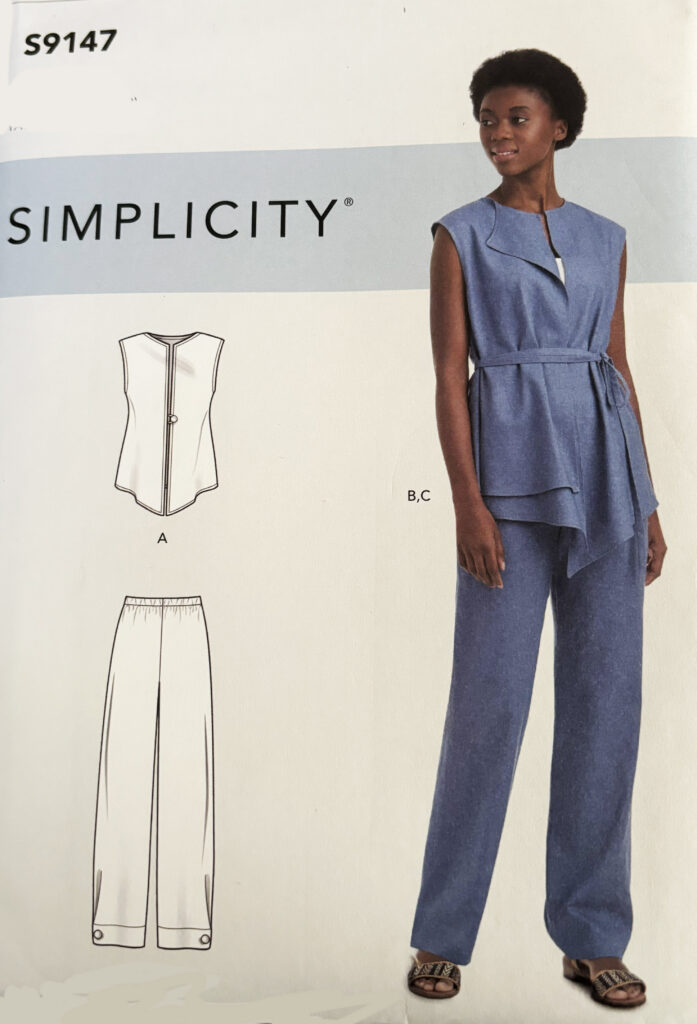
    In July I was working with the Simplicity pattern pictured above, Simplicity 9147,  long discontinued.  This is the pattern I used for the simple, straight-legged elastic waist pants I made earlier in the summer and have been wearing since.  This time however, I was working on the vest pattern.


    One of the reasons I started a sewing blog oh so many years ago is that I am terrible at keeping records, writing things down on random bits of paper or notebooks and then tossing them out in an organizational frenzy.  Blogging helped me keep records.  But here I am two months after starting this pattern trying to reconstruct what I did.    There are some basic facts however, and I can start there.


    The largest size on the pattern I have available is a size 14, which, according to the pattern information is for a 36-inch bust.  Now my full bust is not 36 inches,  but my high bust is 35 to 35 1/2 inches.   For older Big 4 sewing patterns I have found that buying the pattern by my high bust measurement works best for me and I would get a far better fit through the upper chest and shoulders by starting with the 14 and then adding a full-bust adjustment.   My full bust is 4 inches larger than my high bust, which means that I actually have to do a full bust adjustment on most patterns, unless it comes with cup-sizes.   This still puzzles me to no end, because I had to do it when I was younger as well and I have never felt like I presented as particularly busty.  But then again perhaps I’ve just never gotten over my mother’s comment that I didn’t need darts because I had a “dartless” figure.  I now know that was clearly not true, and I’ve always had at least 3 inches between my high bust and full bust measurements, even when I was a skinny young thing.  The problem was more likely that I just couldn’t get bras with small enough bands at JC Penney in the 1970s.
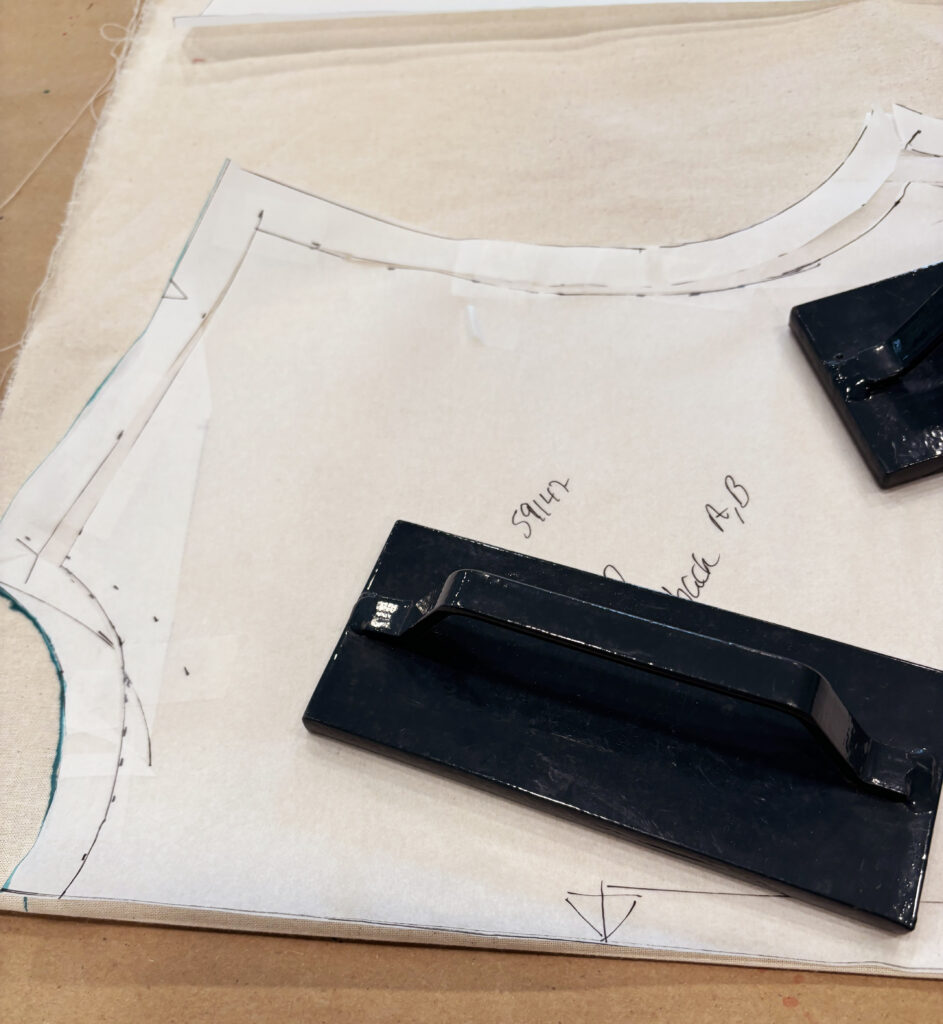
    But back to the pattern at hand.  Even though I know I often need to cut patterns single layer, I cut the first muslin as designed, on the fold in back and with two identical front pieces. I did my full bust adjustment.  In measuring the pattern it did not appear that  I needed to add anything to the back of the pattern.   Then because I also know that I have what is called a shallow chest (hollow in the upper chest), and a forward head, I made those adjustments.  Both meant moving the neckline a little forward at the center which also means tilting the shoulder seam forward at the neck.  Based on more recent experiments with a sloper and my knitting, I figured I needed to drop the center front about an inch, and because changing the neckline also affects the shoulder seams, adjust the shoulder seams accordingly.  I did all that and made the first muslin.


    The first muslin fit pretty well, surprisingly well in fact and I was excited because a year ago I just felt overwhelmed by all this stuff.  I don’t know why, I suppose I was just out of practice.  It is only math after all. My initial adjustments were good.  The bodice fit, the bust darts provided ample room and the bust point was in the right position without my having to move it up or down.  In fact, this Simplicity pattern fit me pretty well, with only minor adjustments (since I always need to do the full bust adjustment) and the bust point was at the right point for me, unlike both the Love Notions Cadence dress and the Closet Core Cielo dresses,  where the bust point was an inch too low.
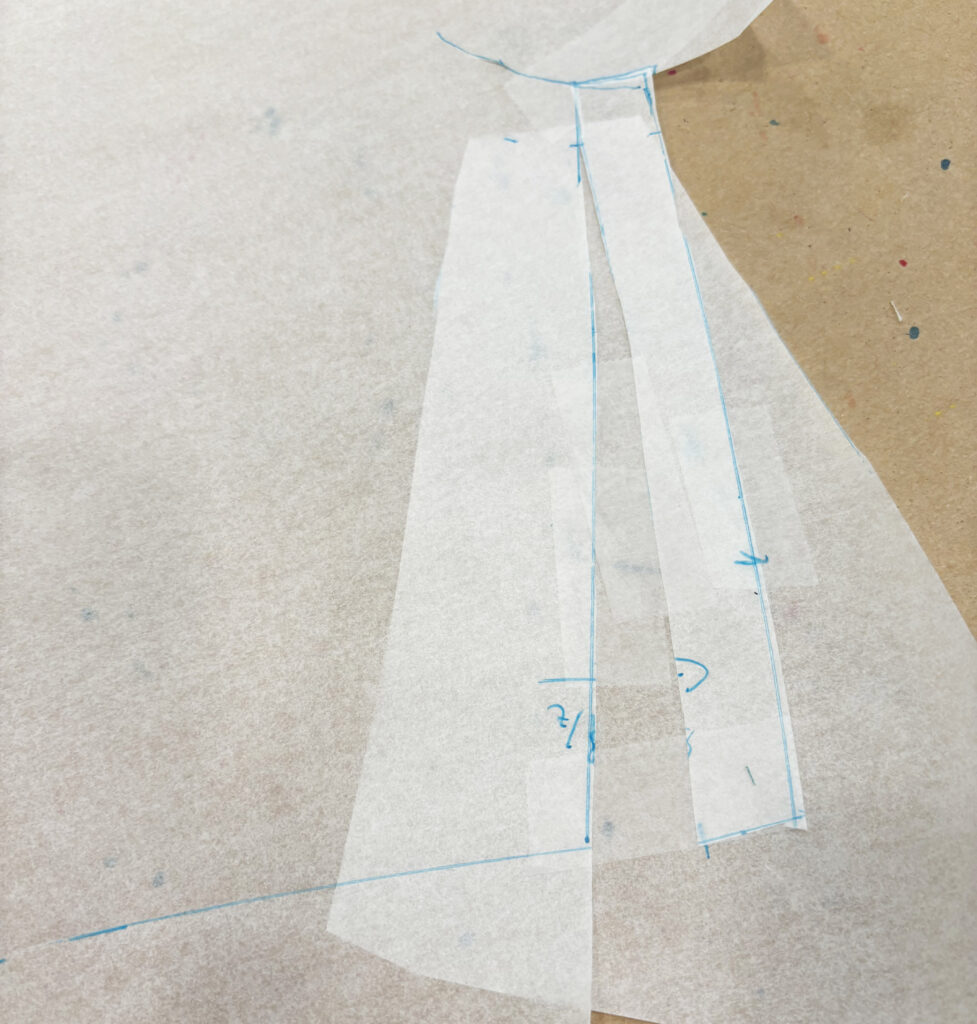
    The only minor quibbles were at the shoulders.  My right shoulder rolls forward, and I needed to move the shoulder seam forward 7/8 of an inch at the outer shoulder edge, and there was also a wrinkle at the arm where I have a smaller shoulder joint on the right and a slightly narrower upper torso on that side, resulting from my flatter egg-shaped upper torso.  All of this is related to my scoliosis.    Further alterations were needed, which was not unexpected.  But I was happy to have taken a two-stage approach because it made the process more clear.   After moving the shoulder forward (both front and corresponding back pieces) , I still needed to remove extra fabric at the front edge of the armscye between the side seam and the shoulder without removing the needed extra volume at the center front.  A minor adjustment when tackled incrementally as I did here, but it does substantially reshape the armscye and increase the size of the dart on that side.
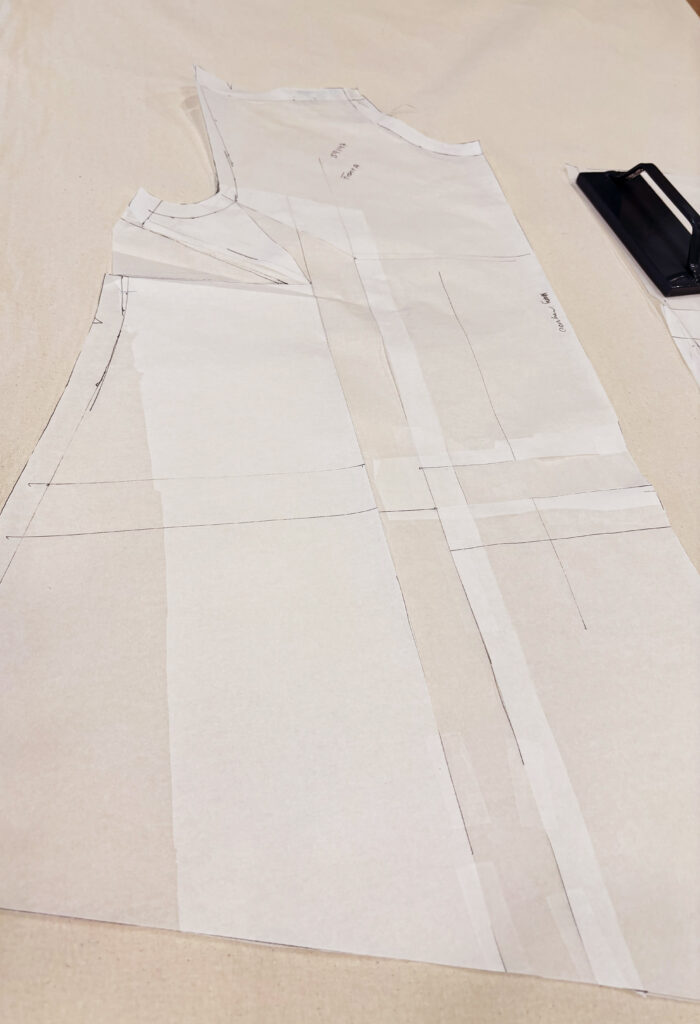
    Once I finished the pattern adjustments, I redrew my pattern pieces.  As expected, I would have to cut this pattern single layer, as each piece is different.  The differences are actually slight, but the implications for fit are significant.  I cut the garment piece out of gray linen and put it aside, thinking I would sew it as soon as I returned from a quick trip to Texas.  
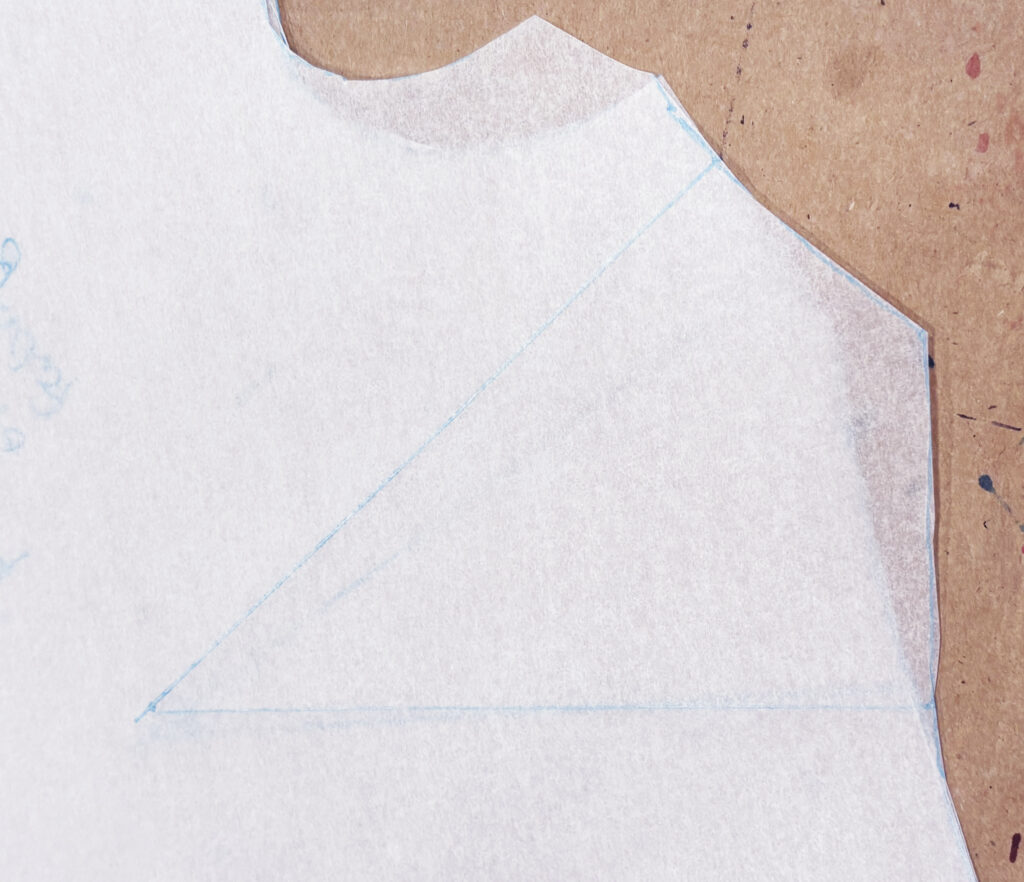
    It is still waiting, but I am planning on starting the project now.  I am making this out of a light summer weight linen, perhaps too light for fall, but you wouldn’t think so based on today’s temperatures.  I actually have doubts, wondering if perhaps the linen I chose is too light for the planned garment.  But it is all a learning process anyway and I am going to go ahead.  The worst thing that will happen is that I don’t like the garment, but I have learned something from the process.


    I will keep you informed.


  • Clothing. Thoughts and Questions.

    A couple of years ago I was in a quilt shop in Bandera Texas when I spotted a camp shirt made out of cotton batik.  The colors reminded me of the autumnal colors of Texas grasses and the limestone of the Texas hill country.  I was reminded that once upon a time I would have lived in such shirts.  Not only that, there was some part of me that wanted to reacquaint myself with this perhaps neglected portion of my psyche. Neglected, because I wouldn’t have worn those shirts during my NY years, during my career years, during the time when I was perhaps too attuned to the dichotomy between my childhood west Texas self and my professional NY self.  


    A couple of years went by when I wasn’t really interested in clothes at all, an anomaly in my life.  I’ve always been interested in clothes, in the way people put things together, and in fashion, even as, at the same time, I struggled with fashion.  I’ve never been particularly fashionable, or stylish, or cool.  Perhaps my interest is more abstract or intellectual. I would buy something I loved and then let it sit in my closet for six months or a year, until it settled in, and then wear it to death, even though it was probably “out of fashion”.  I suppose then my interest in clothing is both practical, because I have to wear clothes, but also sociological, because I love watching the way people wear clothes, even myself sometimes. I was also reminded that clothing is, in many ways our armor, the way we present ourselves to the world, a signaling message which we can employ deliberately, or sometimes even unthinkingly. 


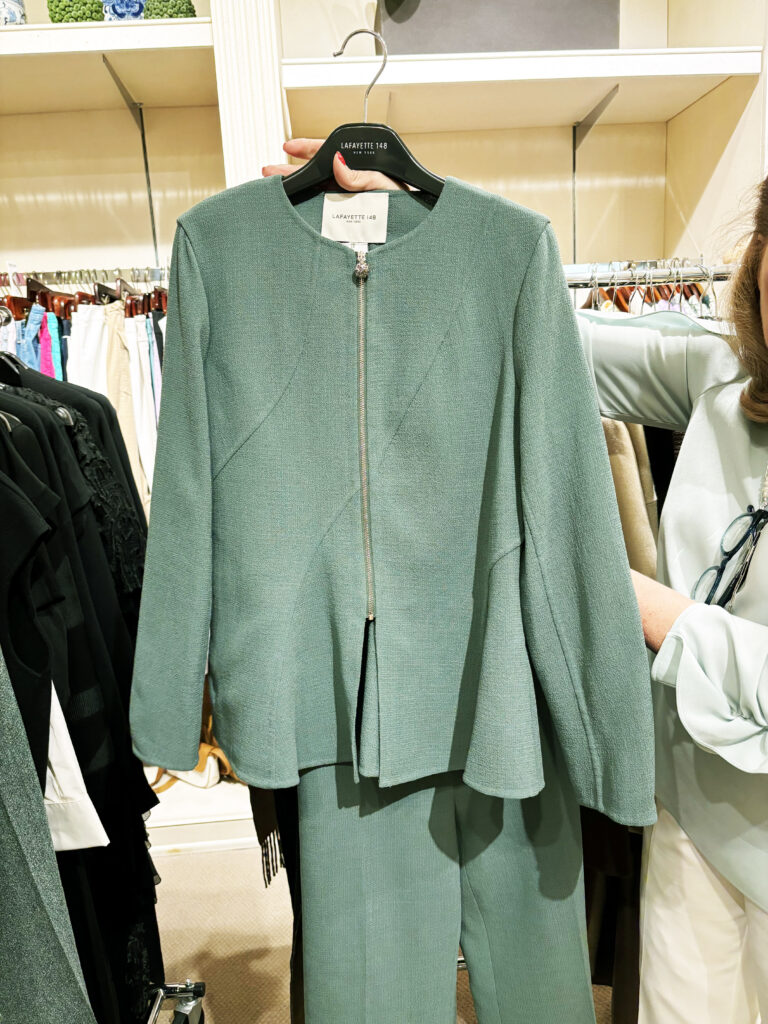
    I was reminded of all of this recently when I attended a Lafayette 148NY trunk show.

    I love the brand, and if I still led a professional life, I might well live in it, but there was very little in this collection that appealed to me.  Mostly this was a color thing.  One thing that did catch my eye was the suit shown above.  The color was perfect.  I loved the graceful lines of the jacket and the high-waisted faced pants. There is no picture of it currently available on the website, so my impromptu snap will have to suffice.


    But truth be told, I could probably justify that suit: it is not particularly corporate, and there are occasions I could wear it.  I don’t need it, but I could wear it.  Except….. except that I am going through an entirely different internal monologue concerning pants right at the moment.  I could buy that suit, and it could be tailored to look good, and I would wear it, but there would always be small issues with the fit of the pants that although not particularly noticeable to others, make them uncomfortable for me.  When I was younger, I just assumed that this was one of those inconveniences of life and I just lived with it.  But this year I have made pants that fit pretty well, that are comfortable, sitting and standing, and walking and bending over and doing all the things that we humans normally do.  And I have learned that I really like that level of comfort.  The pants I made so far are not tailored, but are instead rather casual, straight, loose pants.  But that doesn’t mean I couldn’t take the lessons I’ve learned and attempt to make a more tailored pant.  I can alter tailored pants so that they fit better and look good, but perhaps I could achieve even more.  I don’t know.  I’m not sure I’m ready to commit to a pair of ready-to-wear pants at this moment.  And so my suit dreams fade.


    Or do they?  Do I even care about suits?  Or am I just trapped in a stroll down memory lane?  When I was cataloging my pattern collection I would look longingly at blazer and jacket patterns, and at suits.  I’m not sure I would ever make a suit again, but I remember suits past, and am not I suppose ready to give up the thought of suits future, or at least the patterns that contain both memory and promise. 


    I don’t know if I am going to make tailored pants, but I suspect I probably will.  I do not know if I will ever make a suit jacket or blazer, but I might.  I know I will make camp shirts.   But I also know I’m not going to make all my clothes, nor buy all my clothes.  I like the process too much, and I am privileged enough to have options and skill and choice.


    At the moment perhaps I feel pulled between the idea of camp shirt and suit in the same way I feel pulled between various changes in my life.  In some ways the camp shirt represents the life I increasingly aspire to, and the suit the life I have mostly, but not completely, relinquished.    And between them is some middle ground, that is broad and wide and probably accommodates both.


    Reality is a pastiche of things,

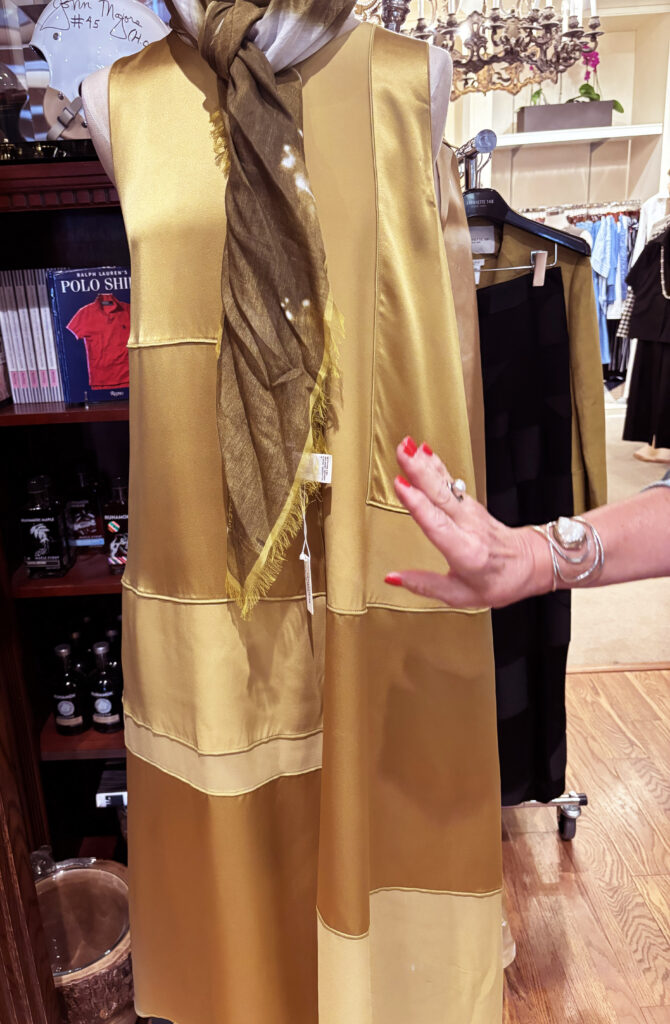
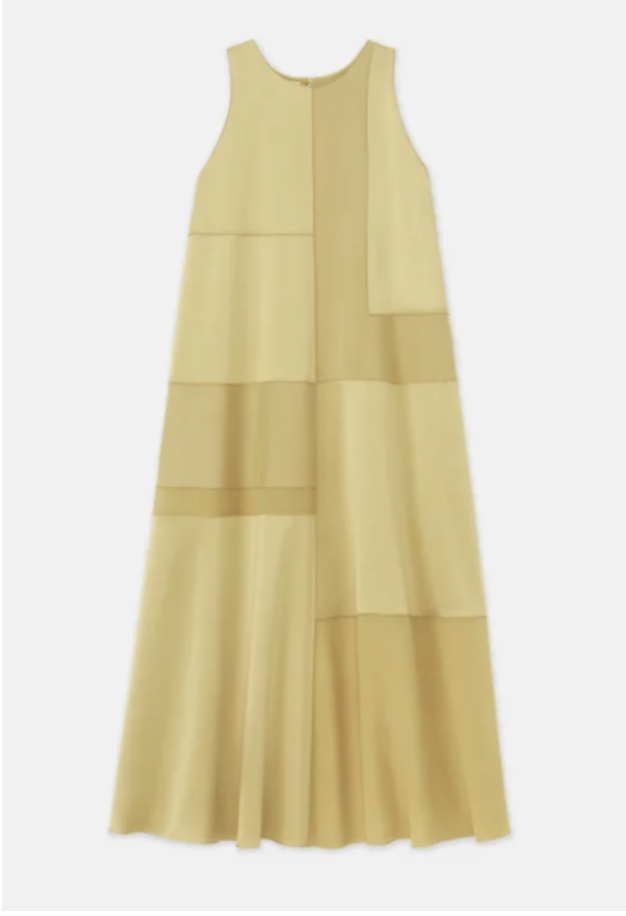
    The second thing that caught my attention at the trunk show was this dress.  Above (my photo)  is a more accurate reflection of the color (at least on my monitor) than the photo from the website (below).


    I took the photo because I like the idea of the dress and the way it is color blocked (all in one color).  The dress is silk in a mixture of fabrications;   georgette, crepe back satin, another silk, perhaps a heavy crepe de chine.  Both sides of the crepe back satin are employed, creating matte and shiny surfaces. The different weaves reflect the light in different ways.  


    There is room in my life for a dress like this, but I would never buy or wear that dress because the color is one that would make me look particularly ill.  As inspiration however, it sings. A similar idea could be used in any dress in any color.     It is not so much the dress that appeals to me as the idea of the dress.  To me the dress embodies the idea of play but it is also wearable, and even elegant.    There is a thread between quilting cottons and suits and party dresses, between our career selves and both our early and late childhood selves.  We can allow ourselves to play.  What interests me in the sandbox of life may not be what interests you. But it is all the same sand.


    “The world is so full of a number of things”  wrote Robert Louis Stevenson.  I’m sure you know the rest of the line, I shall not copy it here.  When we are young the world is only as small as our imaginations, we can be anything and everything.  And then we grow up and grow smaller.  But perhaps we are each of us also as full of a number of selves.  As we grow older we can choose to relinquish the narrow constraints that “adulthood” has placed on us, we don’t have to be defined as the one thing that we were, but can embrace the many things that we are.   Quilting cottons and fancy silks bear equal weight on the spectrum of our imaginations.


  • In My Own little Corner

    This is one of my happy places.

    In the library, the corner where my desk sits.  Of course I look out at all the books except the ones behind me, but it is easy to roll my chair around as needed.  This corner houses my cookbook collection, or about half of my cookbook collection.  The other half is downstairs in the breakfast nook.  The wooden stool is not usually there, but I needed to access a high shelf.


    I recently resorted all the cookbooks.  I had thought about it for a while; I’ve been cooking a great deal the last few months —  exploring new recipes, revisiting old favorites, thinking about the way I want to eat now — and in the process realizing that the way my cookbooks had been ordered recently wasn’t really working for me.  But shifting books, especially big heavy hardback books, is a job.  It is a job made all the harder because the books are on two levels of the house and when I started I had only a rudimentary idea of which books would go upstairs and which would be downstairs.  All I knew was that the previous method, straight alphabetical by author on each level was confusing.  The books I used the most were downstairs; the remainder were upstairs.  But then I would start using a book that was upstairs more, and a book that was downstairs less.  When I wanted to cook Thai, or Spanish, or whatever, none of the books were together, and I like to compare recipes.   Long ago, when I cooked a lot, I grouped books by category.  It was time to go back.


    Admittedly I never really stopped cooking, but I had grown a bit staid and stale.  Then I bought a new mixer after contemplating it for about 3 years.  I hadn’t really done any baking in those three years, whereas I used to bake a great deal.  Baking for one is problematic, and my church no longer has a coffee hour on Sunday, so I no longer have the excuse of baking things that I can take to church.  Yet I miss the act of baking and making dessert.  I actually miss making desserts more than I miss eating them.

    So I bought the mixer above and started playing.  This will be a good mixer when I get to bread, but I’m not there yet.   I started with simple and familiar basics:  choux pastry (which does not require a mixer at all) and meringues and pavlovas.    I made choux puffs to make tiny appetizer sized lobster rolls, then I made cream-puffs, where the mixer was required for the pastry cream, and savory puffs filled with pimento cheese, and salmon mousse.  I made multiple batches of pavlovas with spring berries.  I made a batch of cupcakes and then I stopped baking for a while.  I’m not worried, I will start up again, probably as the weather cools.  But the mixer, and the baking, shifted my brain from the utilitarian “I need to eat” setting to “let’s play in the kitchen” mode.  I’m still playing. 


    It seems like I’ve been doing everything except writing.  I play in the kitchen.  I work in the garden, mostly weeding, but I went through a period where my early mornings were all spent wrestling with chicken wire as the rabbits were feasting on my vegetable beds and my flowers.  I’ve been sewing, slowly but steadily, learning new things as I go, but also making things I am happy with and happy to wear.  Knitting.  Reading.  Occasionally seeing friends.  


    All of this makes for a very full and happy life, but it is not necessarily an interesting life to write about.  What would I say?  “I cooked dinner, I am working on a muslin, I knit four rows of lace?”  Who cares?  I’ve been reading, but mostly reading genre fiction which I have thoroughly enjoyed but I don’t really have anything to say about the books, nor do I need to say anything.


    Mostly I’ve just been wondering what the purpose of a blog is in this world where the internet and social media in particular sometimes feels like it has become too commercialized, to politicized, too fraught.  I was an innocent when I started this blog. I am terrible about throwing away pieces of paper.  I’ve lost a lot of things.  I thought of this blog as a journal I couldn’t throw away only to regret it later.  A part of me wants to go back to those innocent days.  That may not be possible.  But it seems that writing here fills a role, provides some outlet that I still need. Throwing words out into the digital void is different than writing a journal.  It is not better.  It is not worse.  It is different and I write differently.  I also see myself differently, and learn about myself in different ways.

    Somehow, a post Lisa wrote in 2011 came up on my feed.  That post is here. I don’t know why, I think I just needed a little kick.  So I think I will post a picture from my kitchen window.  If I am standing at the sink, this is the view from my window.  But the entire outside wall of my kitchen is windows.  I neglected to put in upper cabinets because I wanted the view.  In the house before this house, the condo I lived in when I first moved to Knoxville, there was no kitchen window.  The kitchen was in the center of the house, there was no view to the outside.  I hated it.  In retrospect perhaps that contributed to why I lost interest in cooking.  George died.  I had only to cook for myself.  I felt claustrophobic in that kitchen.    

    It has taken me a while to settle fully into this new house; there were reasons, but I am here now.  My kitchen is another one of my happy places.  I watch the robins while my coffee brews in the morning. At the moment my big fancy espresso machine needs a bit of fiddling and I don’t have the patience for it, so the drip coffee maker is out.  Apparently this is a happy place for my orchid as well.  

    No complaints here.

  • Studio Update

    I’ve been tired today, too tired perhaps to trust myself working in the studio.  Instead it has been a slow knitting and reading day, but I do want to make a progress report, so let’s see if I can string words together. 

    Most of my knitting time has been spent on the Summer Wine cardigan.  The lace pattern consists of a fairly simple four-row repeat and it is easy enough knit, even on evenings I am very tired; it is also simple enough to unknit as needed.  That has happened a couple of times as well.  I took a break to recheck my math once I started the armhole shaping, in a mad panic, somehow thinking I had made an error. I hd not.   The armscye shaping is now done.  There is some slight variation between right and left, but now I just have to knit even for another 10 centimeters, when I will begin the left shoulder shaping. 


    This cardigan is fairly fitted through the shoulders and upper chest, and only slightly past waist length overall.  The shoulder shaping will not be symmetrical, but I’ve been pretty consistently rewriting the fit on my knitted projects, based on the sloper I made, what two years ago now? 3?  Some of the sizing has changed, and I’ve accommodated that, but the shoulder shaping has not.    I’ve been very happy with my progress Improving the fit of my sweaters and the results are well worth the time involved.  I will have to do some recalculating when it comes to shaping the tops of the sleeves, especially as each sleeve will be slightly different, and I haven’t really perfected a system for that.  This might just be a fiddly bit of math that I have to do with every project.  But smooth sailing now, just finishing this piece, the back, and then the two fronts before calculating the sleeves.  I almost always end up redoing the math on sleeves anyway.


    But I’ve also been sewing, and perhaps putting in more time in the sewing room than knitting.


    I washed a stack of linen with plans to make some summer pants and tops.  The pants take priority because I have summer dresses in my closet, plenty of tops, and three skorts, but not really any summer pants.   Because it is summer, and it is hotter than usual here, I have been thinking “easy, casual, loose” and so the plan has been to make some fairly wide-legged, pull-on elastic-waisted pants.


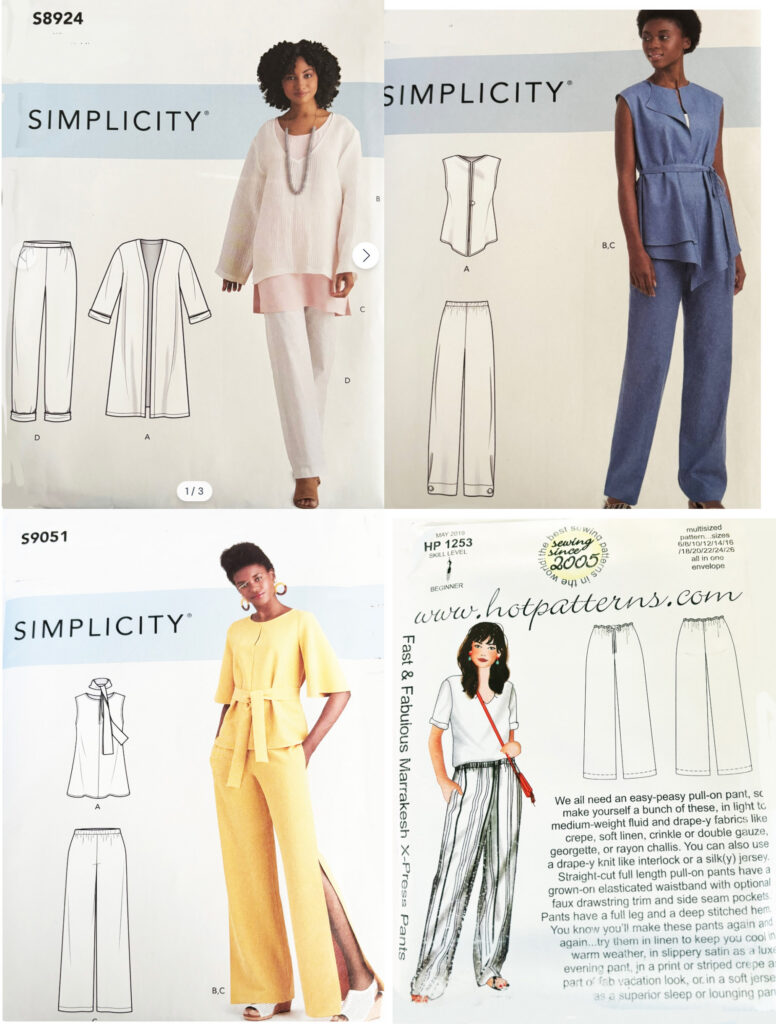
    Upon searching my pattern stash, I found I had four possible patterns.


    Three of the patterns are by Simplicity, one by Hot Patterns.  Although I have many pants patterns, these are the only ones that call for a woven fabric and have an elastic waist.  I have a two one-seam pants patterns, which I intentionally did not wish to use for these pants.    The ponte pants I made in the spring were also based on a Simplicity pattern, and I thought that might give Simplicity some advantage here, but nonetheless I looked at all four patterns before progressing.


    All three of the simplicity patterns were meant to sit at the actual waist.  They were pretty similar through the hips, with the same ease and basic lines.  All had the same crotch curve, which was in fact the same curve as the pattern I used for the aforementioned ponte pants.  This gave Simplicity an advantage.  The differences were in the width and shape of the legs.  The crotch curve on the Hot Patterns Marrakesh design was different from both the simplicity pattern, and the curve I had created for my own knit pants, giving it one negative strike at the outset.  The Marrakesh pants pattern also has a grown on waist, and I specifically wanted a separate waist band, strike two for Hot Patterns.

    I decided to start with Simplicity 9147 (above) using the straight leg version (View C) as it was closest to what I had in mind.  However all of the Simplicity patterns only went up to a size 14, so the first thing I needed to do was grade the pants up.    First I graded the pants to a size 18.  The pattern calls for 4 inches of ease through the hips, and I knew this would not be enough ease in the back pattern pieces; possibly not in the front either.   I also altered the back crotch curve to match the crotch curve that I had created on the ponte pants, which basically meant creating a deeper curve with a longer extension.  I basically just copied this from the curve of the knit pattern, then added extra wide seam allowances and sewed my first draft.


    You don’t get any in-progress pictures.  There were a couple of iterations, but I learned a lot from the process.   I’ve always had trouble with pants, but my goals were basic.  Straight of grain perpendicular to the floor, straight side seams, no skewing.  Sounds easy, but it never is with me.  I’ve been in all kinds of fitting classes where we’ve done all kinds of odd things and it remains a struggle.   Now it feels like I am finally beginning to understand.


    Basically, all I needed to do was add width at the high hip in the back, and alter the crotch curve and center seams.  In the end, I ended up using the front crotch curve from the size 14 pattern, with the deeper longer curve on the back pieces.  These then had to be graded to work together.  I also needed to shorten the center front seam by 2 inches and lengthen the pattern at the center back by 2 inches.    This ended up being exactly the correction I had needed to make on the pattern for the knit pants, although I actually understood it better this time around. It is for this basic reason that both my first woven and knit pants were for basically straight leg pants with a waistband that sits at the waist.  These patterns make a good jumping off point for future work on pants.

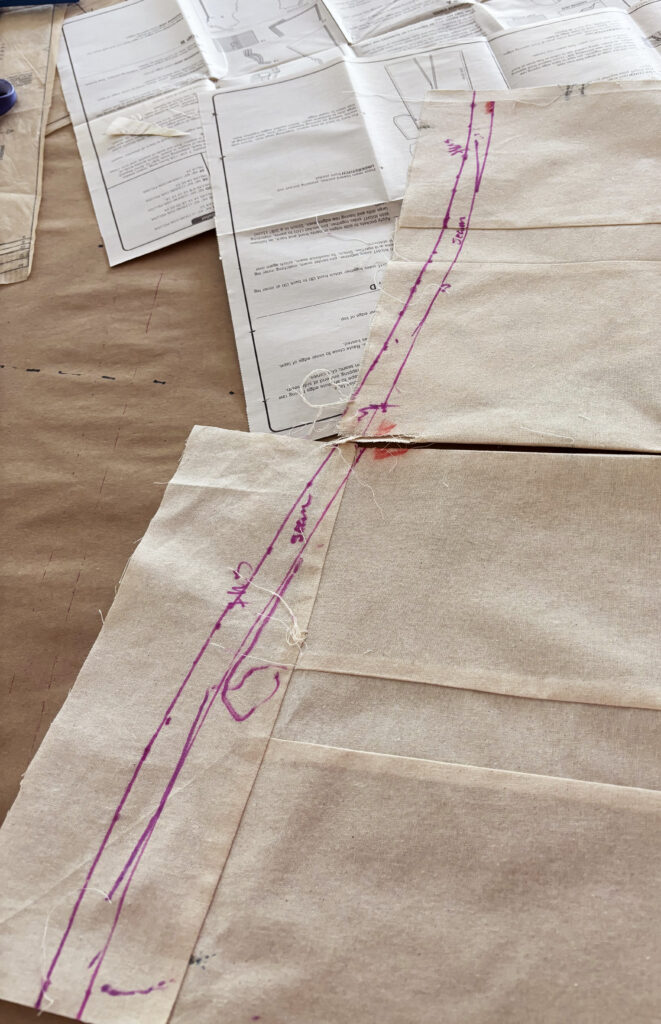
    Here you can see half of a muslin, side by side front and back pieces, with the center back at the bottom and the center front at top.  This shows the basic progression although some additional fiddling was necessary before everything was transferred to a new paper pattern. But it was this view, this photo that sparked an “AHA!” moment that really helped clarify my thinking.


    After a couple of days. working on muslins, the first pair of pants, out of a medium-heavy weight linen double jacquard, were pretty easy.  

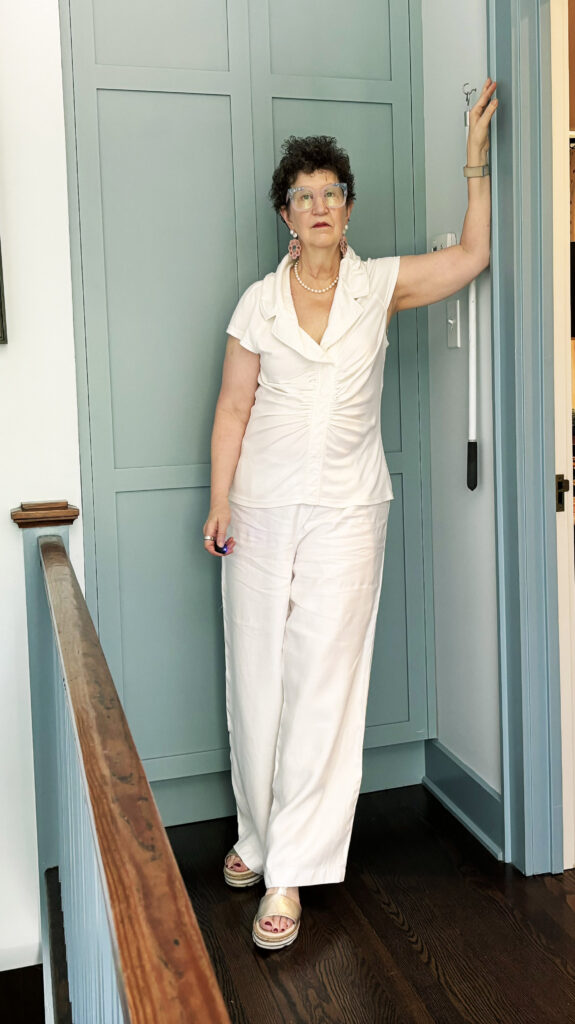
    I cut the elastic for the waistband a little large, and the pants slip down about an inch with wear.  You can see that in the photo.  It is something I will have to fix, but not yet.  The temperature is in the mid 90’s and humid, and I am perfectly happy not having a fitted waist band at the moment

    I’ve since cut two more pairs of pants, one in a fine, tightly woven black linen, and one in this pretty Japanese cotton.  The black pants have been sewn except for the waistband and the hems.  I didn’t finish them today because I am tired enough that I think I should stay away from sergers with cutting blades.


    I also have a pale gray linen with a bit of a lilac undertone that I intend to use for both pants and the layered vest shown in the pattern photo above.  Vests are in right now, but not necessarily this kind of vest. I’m not sure if the currently trendy version fits into my very casual lifestyle at this point anyway, but the point is moot until I progress further with pant fitting. 

  • A Walk Through the Garden

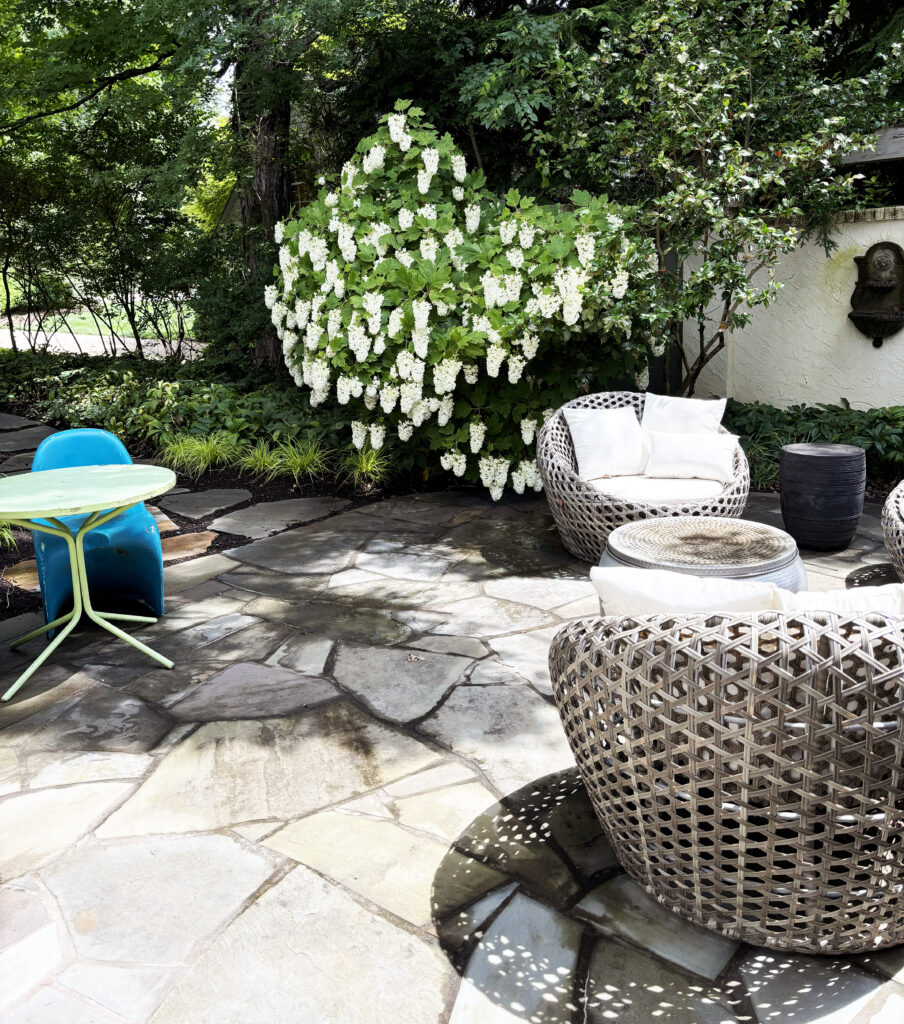
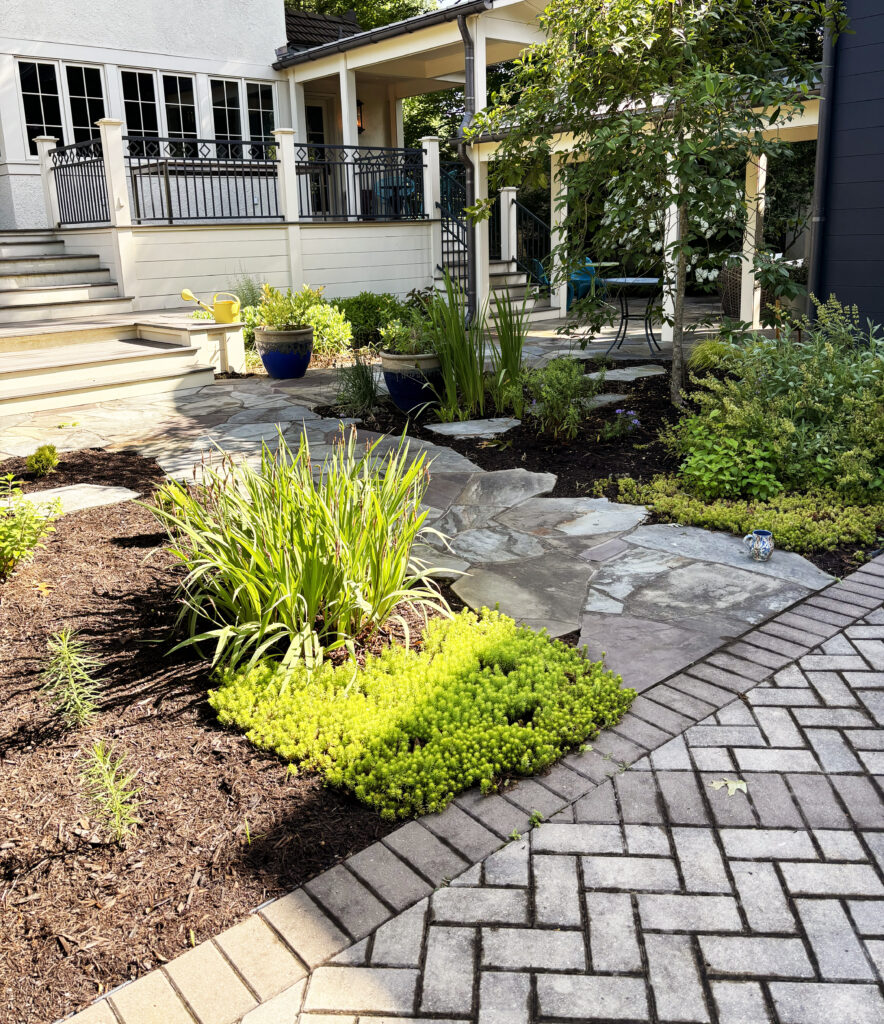
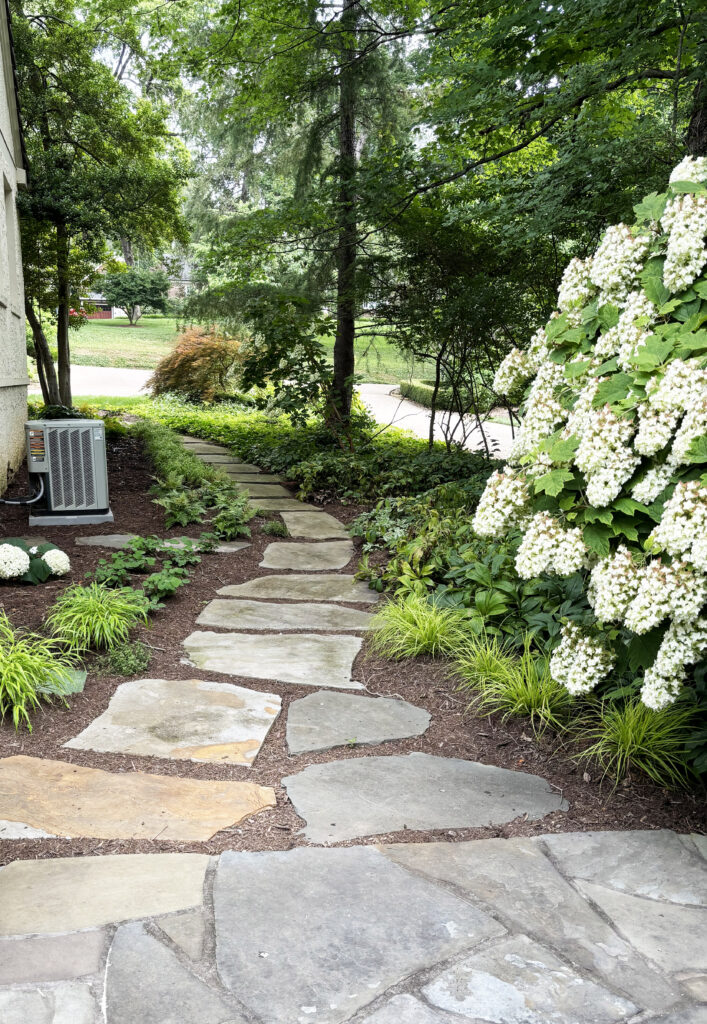
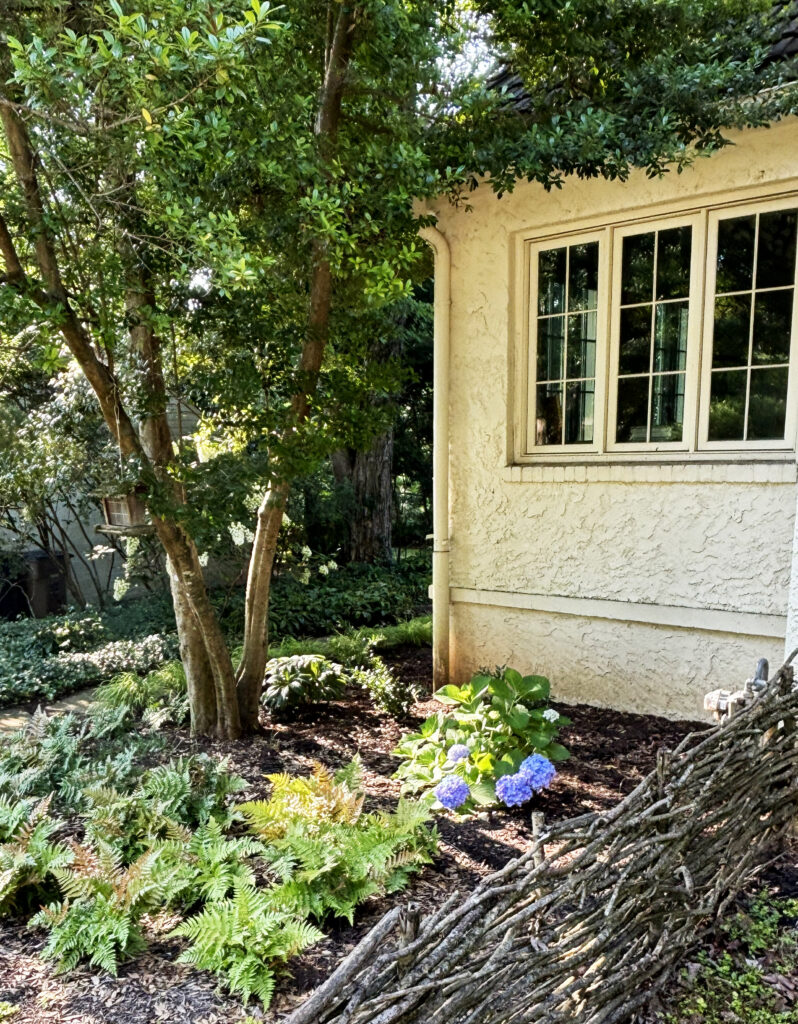
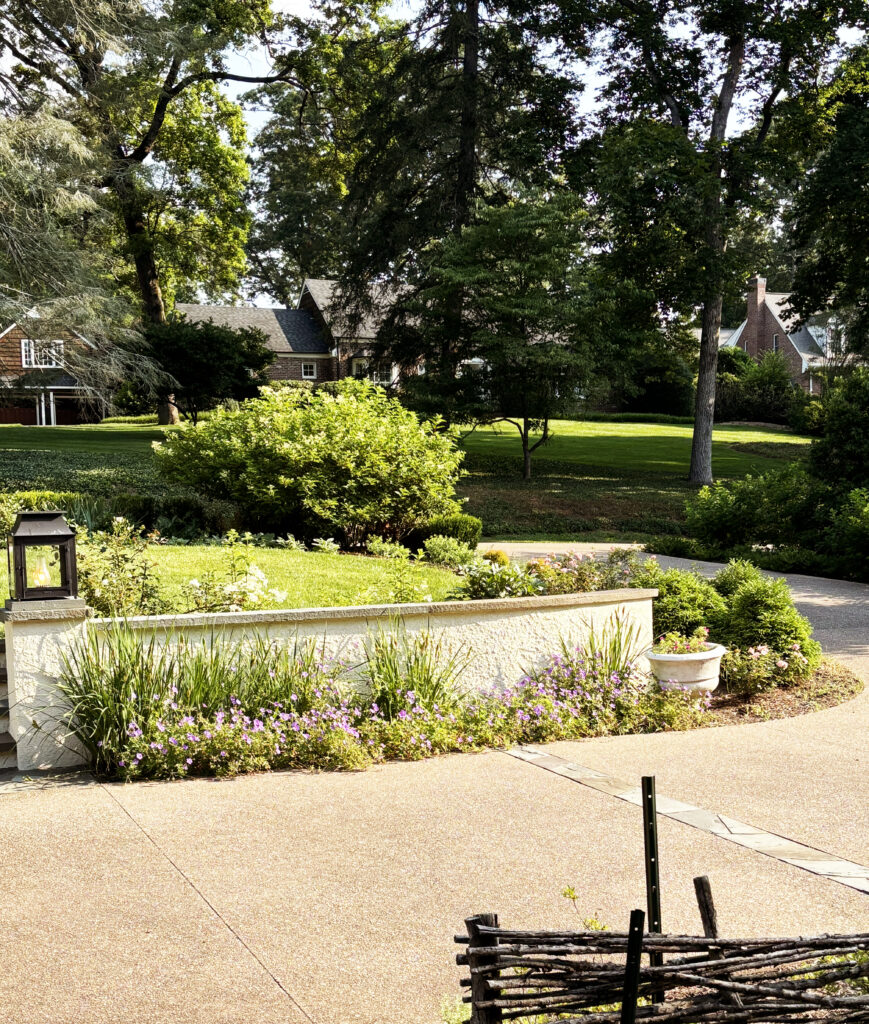
    I’ve spent a lot of time in the garden this spring.  Now that summer has officially arrived, it is too hot for me to be out but for the early morning hours.  Still I am happy.  I had a landscape crew do most of the heavy lifting, but the weeding, watering, and maintenance is all mine, plus ,loving a few things about, here and there.

    It all makes me very happy.

    I’ve spent more time sitting outside as well.  That is partly because I’ve been more dedicated to taking care of things, to getting my energy back, perhaps just to the mental shift that requires me to reclaim more of who I was once was.  I’m not ready to lose her, but she was embattled and energy lost is hard to reclaim.

    Luckily I have a shady oasis in the mornings.

    And I’ve been shifting planters around, brightening my spaces with flowers.  That took a little time, and has been a gradual process.  I had to add something new, then make sure I put in the time and energy to actually water everything and keep it happy, before adding more.  I have failed at this a lot in the past.  It has taken a lot of dedication to push myself to build my energy back up, but it was ether push forward or give up.  I’m all for pushing.

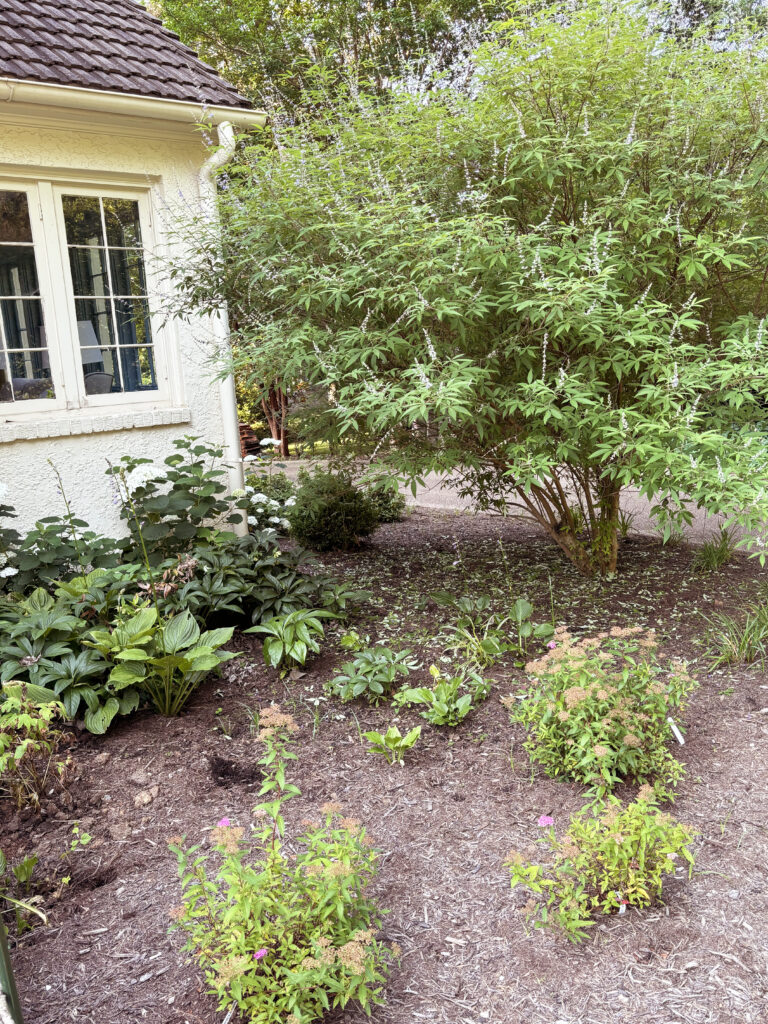
    Plants still need to fill in but now instead of empty spaces and failure, I see hope and promise.

    Yes there is still a lot of weeding, but now I feel motivated to keep up.  I’ve a nasty habit of seeing the things I haven’t done instead of the things I have accomplished, but this year, I am looking more at the good, and working more to eliminate those nagging doubts, and those creeping stoloniferous weeds.

    It is a nice mix of the established beds I put in years ago now, and the new.  The promise, and commitment, of trying to keep newly planted things alive.  The hope that is ever present, even in the vegetable garden, which I didn’t eve really start planting until June, too late really, because I was too occupied elsewhere, but better than not starting it at all.

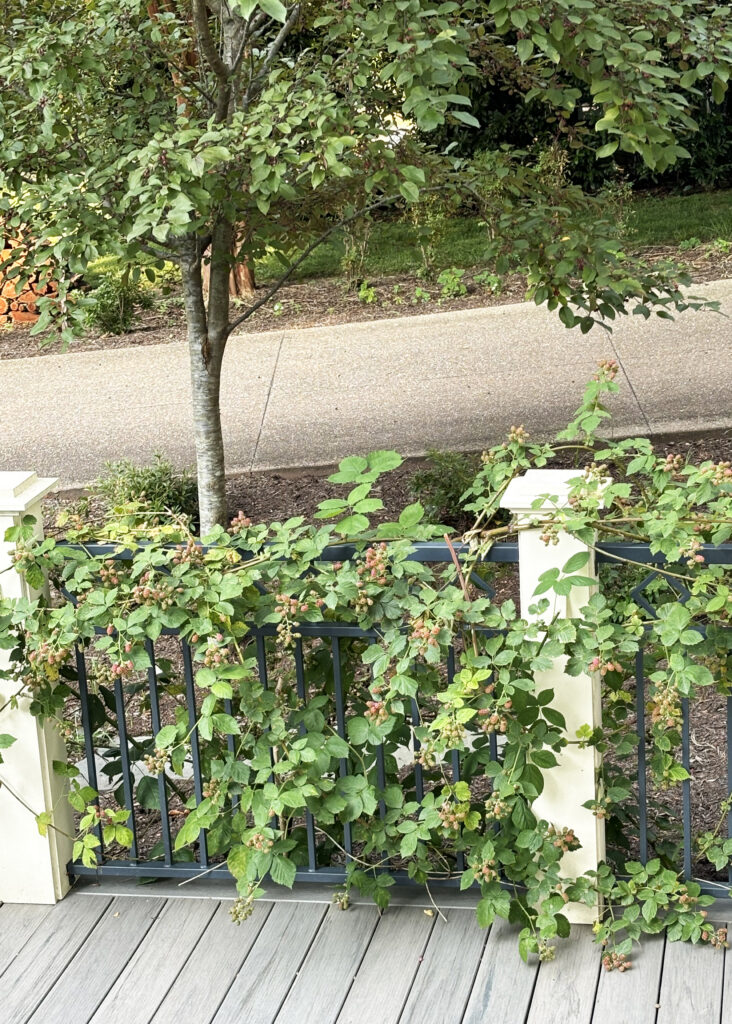
    At least there will be a bumper crop of raspberries.

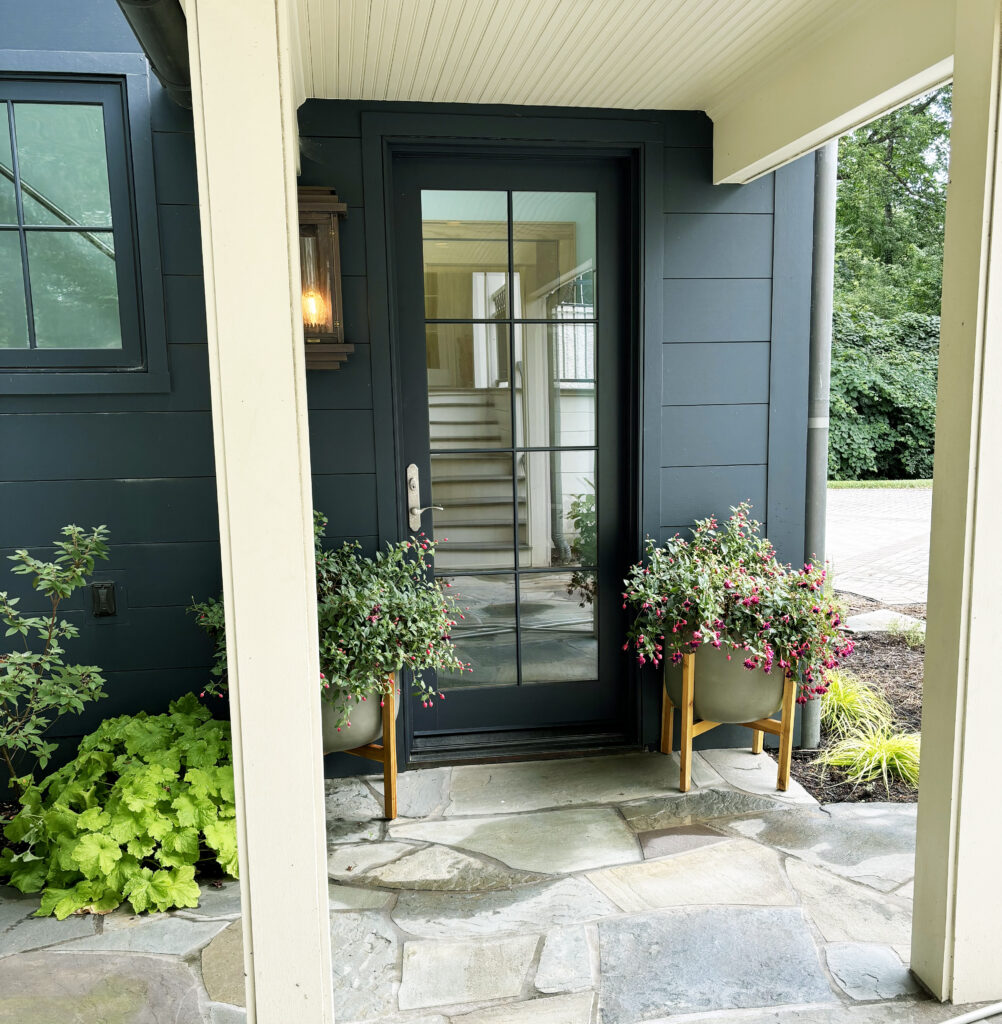
    As well as flowers, and doorways, both new and familiar.


  • On and Off the Needles

    My knitting mojo has been restored.  Not that it ever really left, but somehow knitting had slipped into a very low gear for a couple of months.


    Then I finished a sweater.  I started a new project.  Actually I started two new projects, and there is always something compelling about the new.  Now there are three projects on the needles, and an untold number of UFOs.  

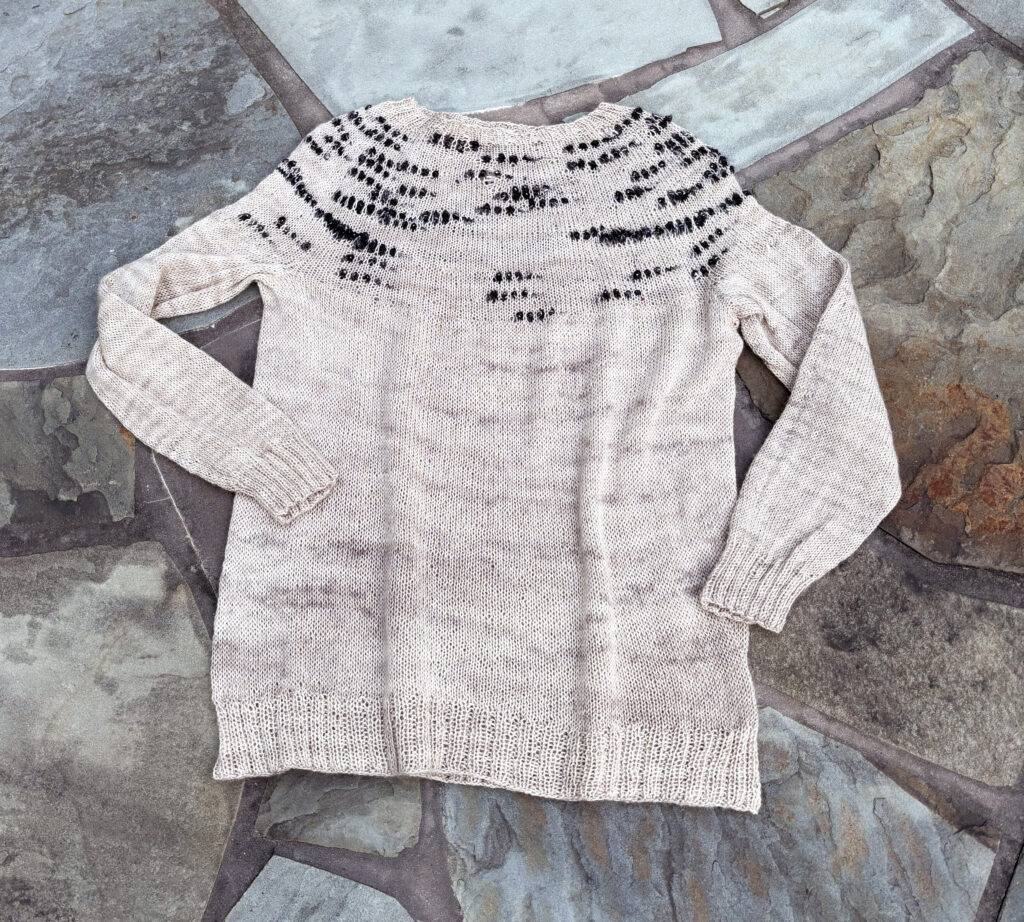
    But let’s start with that which has been recently finished.  A Murder of Crows has been completed.  Knit from the pattern of the same name by Dawn Barker using Barker’s own BFL fingering wool.  I loved knitting this sweater.  It doesn’t look like much flat on the pavement, but I love the fit.  It is exactly what I wanted even though this is not exactly the season in which it will get much, if any wear.   I have plans, and wool, to knit another.


    But first a few other things.


    I wasn’t really bored with Crows before it was done, wasn’t really  itching to start something new, but I also knew that I needed something on the needles beside the  green rayon ribbon cardigan I am also knitting.  Although I love the fabric and will undoubtedly love the final sweater, I find the knitting itself fiddly, and the process of ironing and winding ribbon tedious as all get-out.  That sweater started in one piece from the bottom up, and I’ve just divided it into sections at the armscye, finished the right front, and started the left front piece.  Now I need to wind yarn again.  I refuse to rush myself.  In all likelihood I won’t be wearing this sweater before October.  I love the idea of the finished sweater, but if this were all I were knitting, I would be in a state of despair.


    I needed another project, or even two.  Two ended up being the magic number. 

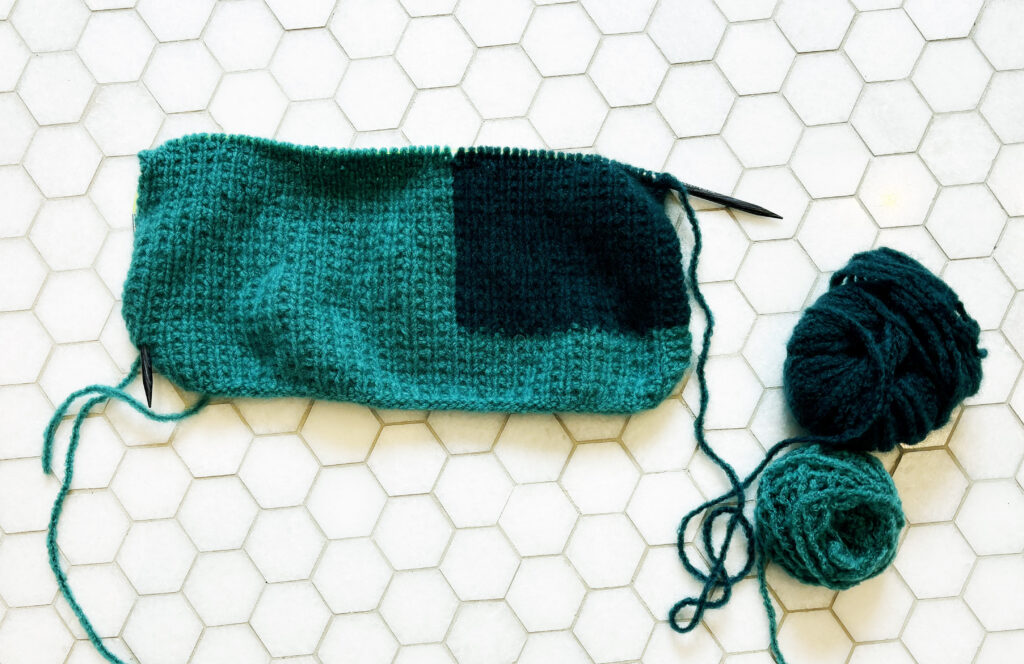
    I walked into the yarn closet and the first thing that caught my attention was a bag of Lang Cashmere light in two shades of green.  The yarn was purchased for a particular project, but that is not the project I am knitting.  I found the pattern, which was written for a single color with an option of using two or more colors.  Except that there were no instructions for how to deploy those colors.  I had no picture, just a vague idea in my head.  I thought about contacting the designer but in the end just went my own way and drew a rough sketch and started knitting.  I am happy with the results so far.   The plan is either for a wrap of some sort, or a simple rectangular shawl, details yet to be determined.   Knit on size 10 1/2 needles with simple geometric color blocking this should be a relaxing knit.

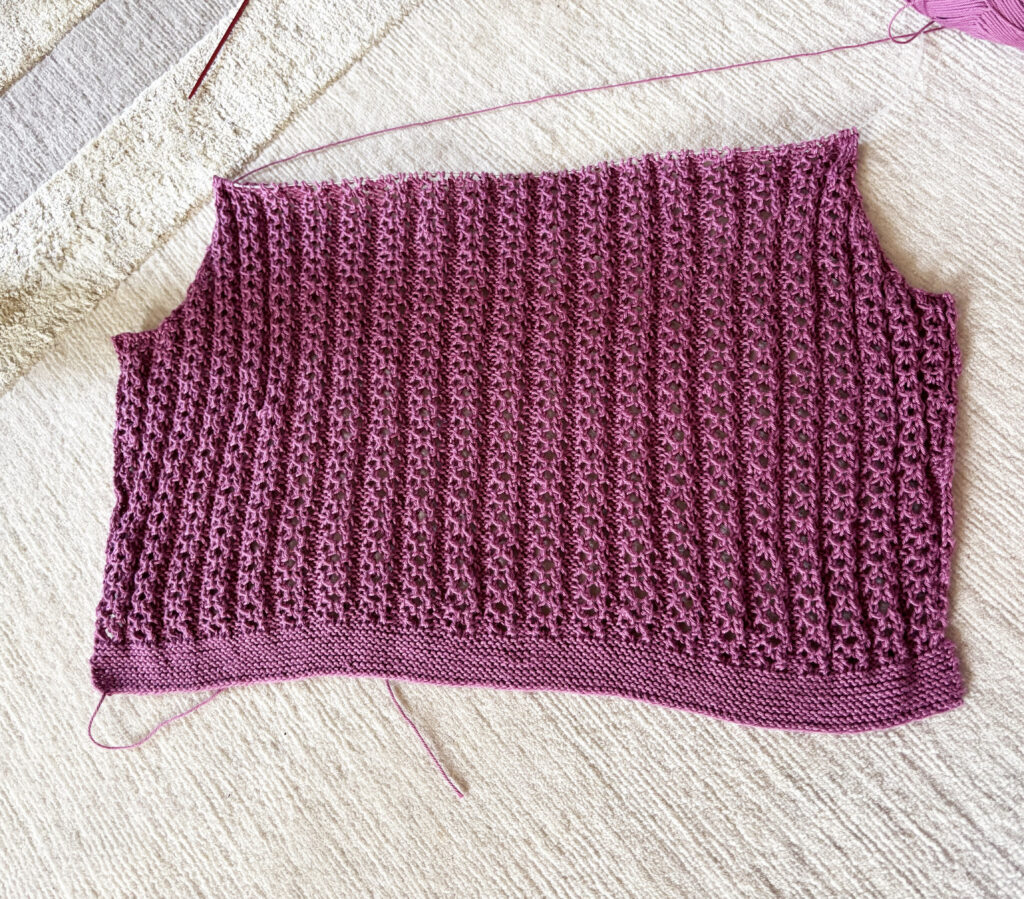
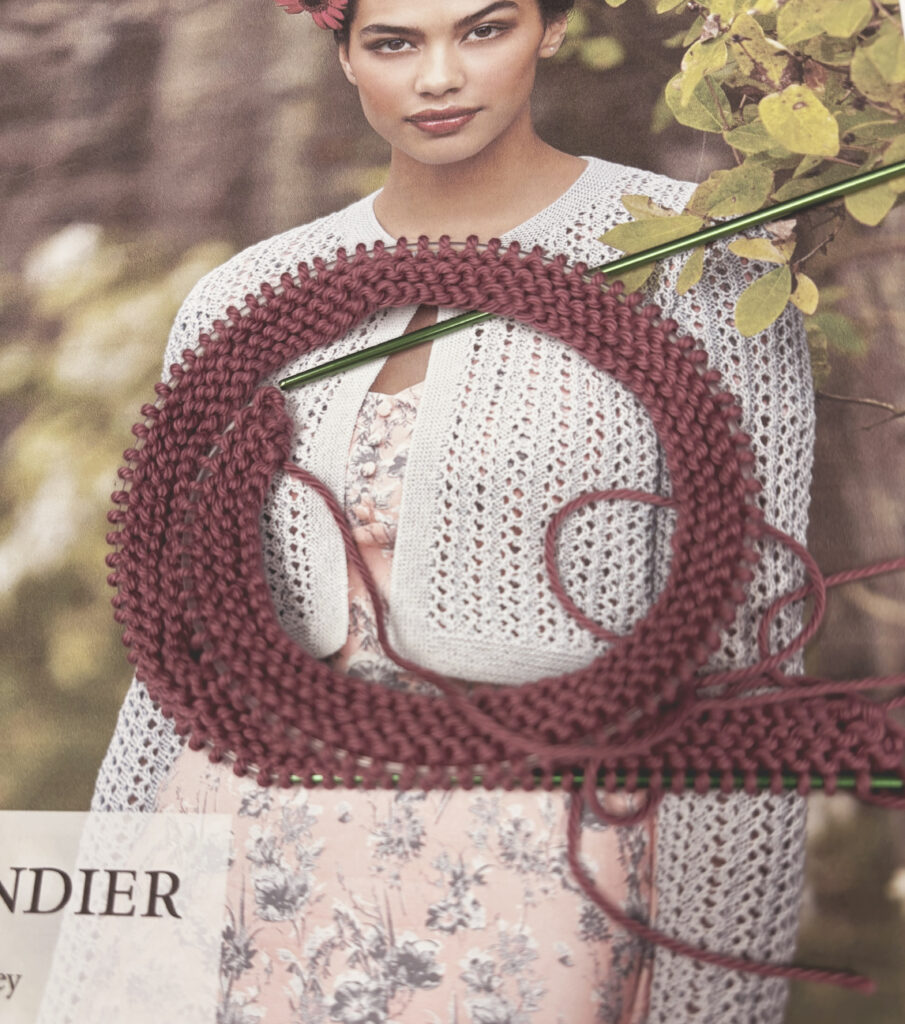
    About the same time that I was finishing up the last sleeve on A Murder of Crows,  I was at Loopville, my LYS, when I came across a batch of Rowan Summerlite 4ply cotton in a delicious muted wine color.  I fell immediately in love and decided to knit Martin Storey’s jacket, Amandier.   This is knit on much smaller needlesand although the lace pattern is simple, the knitting requires a little more attention than the cashmere shawl above.  I’ve just finished the 16 rows of garter stitch that form the bottom band on the back of the sweater and am about to change from size 1 needles to size 2 and begin the lace pattern.  


    Filled with anticipation and eagerness for anything new, I am entranced with both of these projects at the moment.  I want to knit and ignore everything else in life, but that really won’t be possible.  I will iron and wind that ribbon yarn.  Eventually, any way.


  • April Books

    The problem with book posts is that very often there are books about which I have nothing to say.  They may have been disappointments.  I may have enjoyed reading the books, and even felt them to be useful, but still not found them so interesting that I wish to write a blog post.   The question then becomes whether or a not a list of books is worth maintaining on this blog.  I have a list of books I've read elsewhere, but if this blog is a place to review what is actually capturing my fancy or on my mind, book lists may prove to be useless.


    I "read" eight books in April.  The word read is in quotation marks because I listened to two of those books on Audible while I was working on embroidery or other needlework.  I spent over 60-hours on embroidery in late March and early April, more than enough time to listen to two volumes of the Robert Jordan Wheel of Time series.  I enjoyed them.  Do I have anything to say about them? No.  Do I consider listening to books the same as reading?  The answer to that really depends on the type of book and the circumstances, but generally I would say "not really", although listening to books simply to gather information, or for distraction or entertainment can be a profitable pursuit.  Do audio books count as books or not?  I remain undecided, but I am leaning toward yes, although I recognize that I do not process things I hear in the same way I process the written word.  A good book, a highly worthwhile book, may require two readings to fully absorb, and there is no reason why that first, lay-of-the-land reading could not be in the form of an audiobook.    Of course there are a lot of books that are only worth a quick once-through, perhaps even a skim.  And the number of books that really hold up to deep reading, books from which more is revealed with each pass, are few. Despite this,  all books we read, whether for knowledge or escape, contribute to who we are and what we think and believe.


    Here I am back at the list.  To continue from my last post:


    20.    Caesar: Life of A Collosus, Adrian Goldsworthy  (biography)

    21.    Troubled: A Memoir of Foster Care, Family and Social Class, Rob Henderson (memoir)

    22.    The Heaven and Earth Grocery Store, James McBride (novel)

    23.     The Girl Giant,  Kristen den Hartog (novel)

    24.    The Vulnerables, Sigrid Nunez (novel)

    25.    Winter's Heart,  Robert Jordan (novel)

    26.    The Color of Water,  James McBride (memoir)

    27.    Crossroads of Twilight, Robert Jordan (novel)


    The first two books, Caesar and Troubled, were both fabulous and thought-provoking although for very different reasons.  Most of Caesar was read in March although I finished at the beginning of April.  It reminded me of a lot of things about Rome I once knew but which had slipped to the back of my memory, and I learned much about both Julius Caesar and Rome.  This was a fabulous informative, well-written, compelling biography. I do, however, understand that I need to read the book again in order to fully absorb it.  


    Troubled was also fascinating and thought provoking, a faster read but well worth thinking about.   The book is well written, but the prose is a bit terse and guarded, no grandiose memoirist Henderson.  Still the story was both sad and thought-provoking.   I may disagree with some of Henderson's theories and agree with others, but agreement with the author's premise is never a prerequisite for liking a book —  I would simply expect the author to make me think, and Henderson does that.  I'm not convinced the book deserves the kind of focused rereading that Adrian Goldsworthy's book does, nor do I find it as complex, but I do need to engage with the book a little further if for no other reason than to better formulate my own response.


    Most of the fiction was read for entertainment reasons.   As mentioned above, I listened to the two novels by Robert Jordan.  I am enjoying the series, and it is actually rather complex and intellectually interesting.  I will probably read in its physical form some day.  

    I read James McBride's The Heaven and Earth Grocery Store a second time, for my book club, and I although I enjoyed thoroughly, very little new was revealed.  It seems to straddle the line between commercial and literary fiction, with some literary aspects but the basic formula and neatly resolved ending that usually comes with commercial fiction.  There is probably a name for this category, I call it "book club" fiction.  Reading the novel again did prompt me to  read McBride's memoir of his mother The Color of Water, because on this reading of the novel it struck me that a number of the characters and plot points were based on McBride's own family story.  That impression was confirmed.  I suspect the novel could only have evolved out of what began with the memoir, and yet I still find the novel more fully realized and interesting.


    Of the two remaining novels, Kristen den Hartog's novel The Girl Giant, was well written, thoughtful and somewhat engaging in a rather quiet way, but I never really connected with it.  In fact I felt it rather bland, but that is all about me.  


    The novel I did love was Sigrid Nunez's novel The Vulnerables.. This was definitely a literary novel, and in many ways a "small" novel, taking place over a short period of time in the life of a single character.  I found that a great deal of Nunez's auto-fictional musings on art, life, literature engaging and compelling.  In fact a lot of the passages I copied out in my journal reference literature, from Dickens to Brecht, not so much directly,  but the way the author uses literature as an internal framework for the journeys that encompass a life.  Due to its literary nature, there are no answers here, no pat conclusions.  It is a book I will pick up again and again to read the odd passage.

  • Playing With My Food 2

    Happy Memorial Day Weekend!

    For me this weekend has been designated a weekend of rest following a particularly busy spring.  More busy than I would prefer.  Whether or not it has actually been busier than other springs may be up for debate, although I have certainly been more stressed than usual.  Whether this is a factor of busyness or the ever-evolving, and revolving, process of change, remains undecided.  Whatever the source, I increasingly believe that doing more does not necessarily lead to a better life.  Possibly quite the opposite.

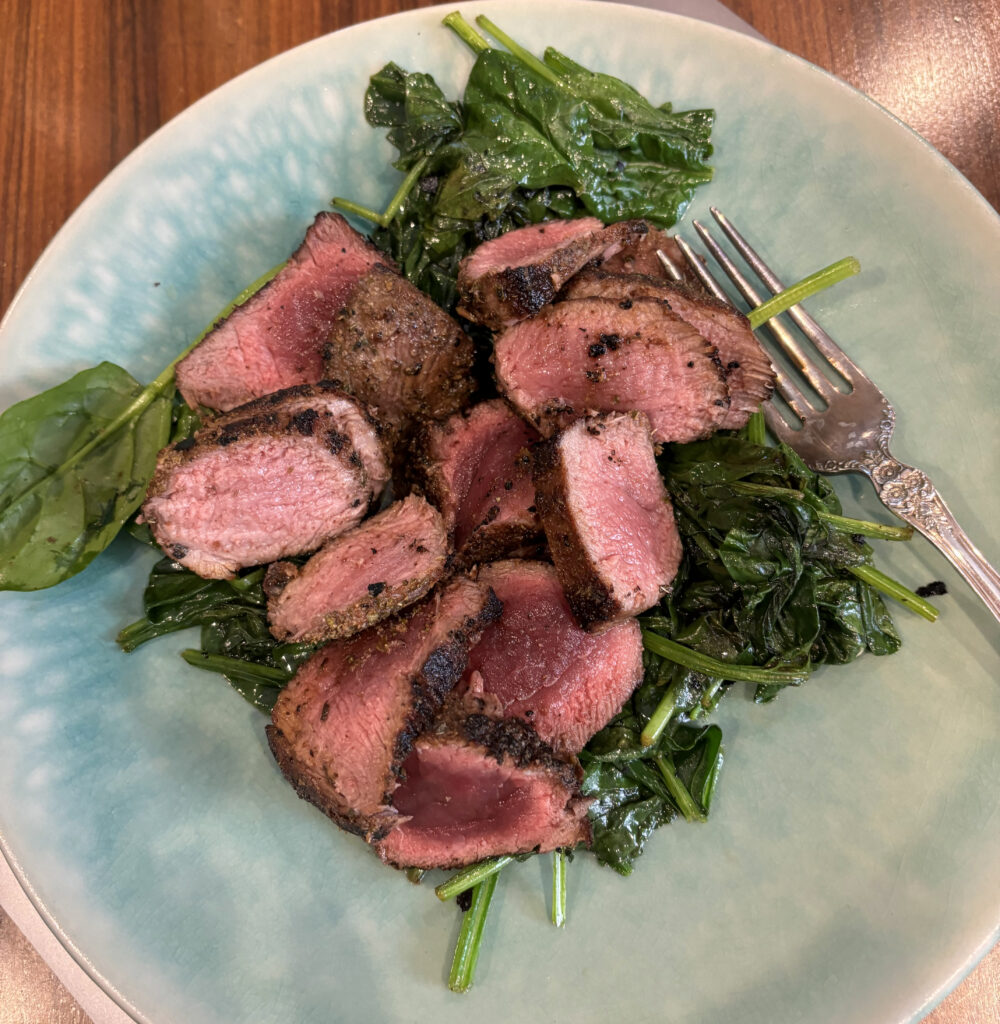
    Still, one must eat.  I eat at home most of the time; for the most part I eat home-prepared meals, although a significant number of those meals were merely functional:  meat, poultry, fish and a vegetable or two.  Cooked but not cooking.  Does that make any sense?  Quality of ingredients remained important, but simplicity was paramount, as in the simply seared axis venison loin and spinach above.  I am also not above an occasional meal of cheese, olives, crackers and a glass of vermouth.  But eventually the urge to play returns.


    In April I started cooking from Ann Taylor Pittman and Scott Mowbray’s cookbook The Global Pantry Cookbook.  It was the Food 52 cookbook club cookbook of the month, and as is sometimes the case, I was initially skeptical.  Not because I was not interested in the global pantry, but because my pantry already contains many of the book’s featured ingredients and I use them frequently so I wondered if there was anything new.  I shouldn’t have worried.  I was also, it occurs to me now, both ready to play, but not ready to experiment.  This cookbook then, was a good place to start.  Many of the recipes I prepared were in fact, quite retro.  There is something about that I think, when we are opening the door to some new self, we also wish to hold onto the past a little more tightly.

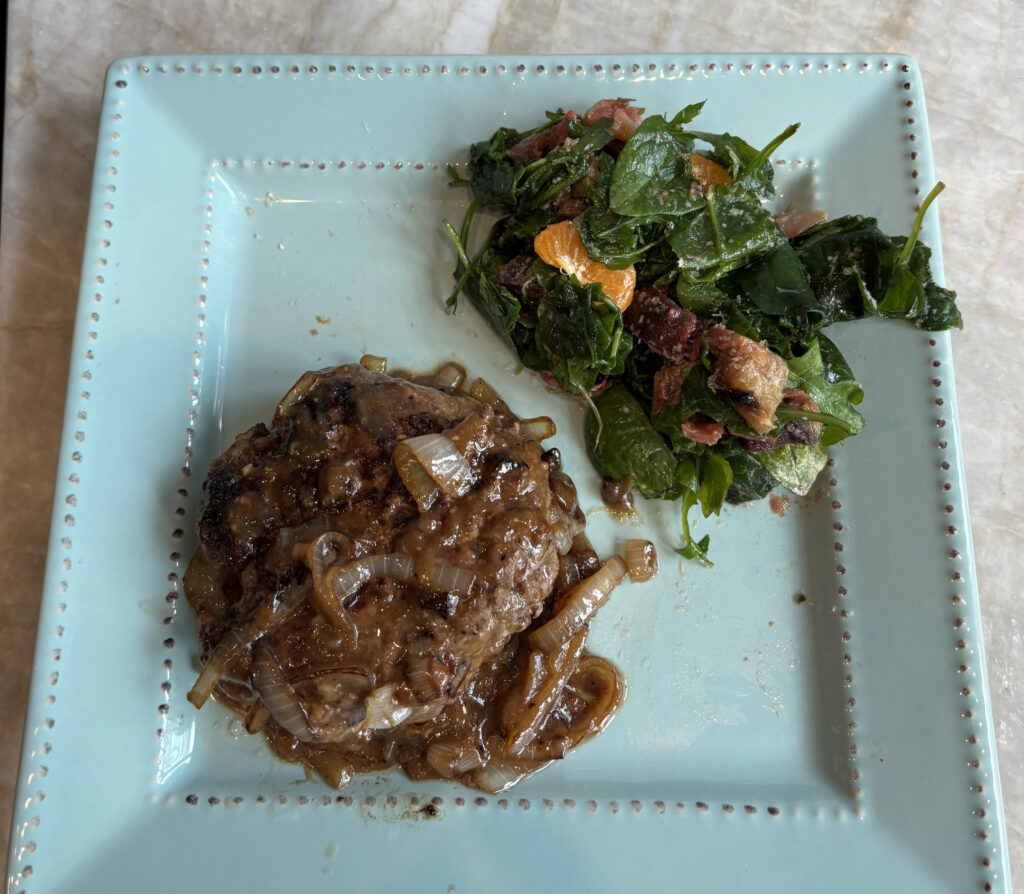
    I started with “Hamburger Steaks with Rich Onion Gravy”.  I eat hamburgers frequently, I usually eat them on a plate not on a sandwich; hence I normally eat hamburger “steaks” even though I don’t use that term.  I often sauté onions or mushrooms to top those burgers, the same way my mother prepared them when I was a child.  As a child I think I ate far more hamburgers with mushroom gravy than I ever ate hamburger sandwiches on a bun. So the question was, “How is this different?”  


    First off, Pittman and Mowbray add breadcrumbs to their burger mix, making a burger that is, to my mind anyway, more of a giant meatball than it is a burger. I didn’t do this, even though it is a common enough technique.  I simply mixed salt and pepper into my burger meat.  I did, however, cook the burgers in a cast iron skillet as recommended in the recipe.  This is classic burger technique and nothing new.  After the burger is cooked the authors add onions to the pan drippings and sauté them until golden.  Again, classic, something I have done for 50 some odd years with either onions or mushrooms.   Finally,  in the last step, their recipe shifts from my classic version.  I might deglaze the pan with wine and follow with broth or stock to make a pan gravy.  I don’t usually add flour, instead cooking down the pan juices until syrupy.  If feeling generous, a pat of butter may be added at the end.  Pittman and Mowbray do it differently.  They whisk flour into their stock, which is also classic American cookery.  Their global tip is to add a generous dollop of white miso which adds richness in mouthfeel and umami to the pan sauce.  I liked the result.  I did use flour, but less than called for, as the gluten-free flour blend I had at hand included xanthan gum, which is a powerful thickener.  Frankly, I could have done without the flour altogether, but the resulting burger with onion gravy is good.  I will keep miso in mind as an alternative technique for making a pan gravy for either a burger or a steak.    I’m not sure this is as much a new recipe, however, as it is a thought variation.

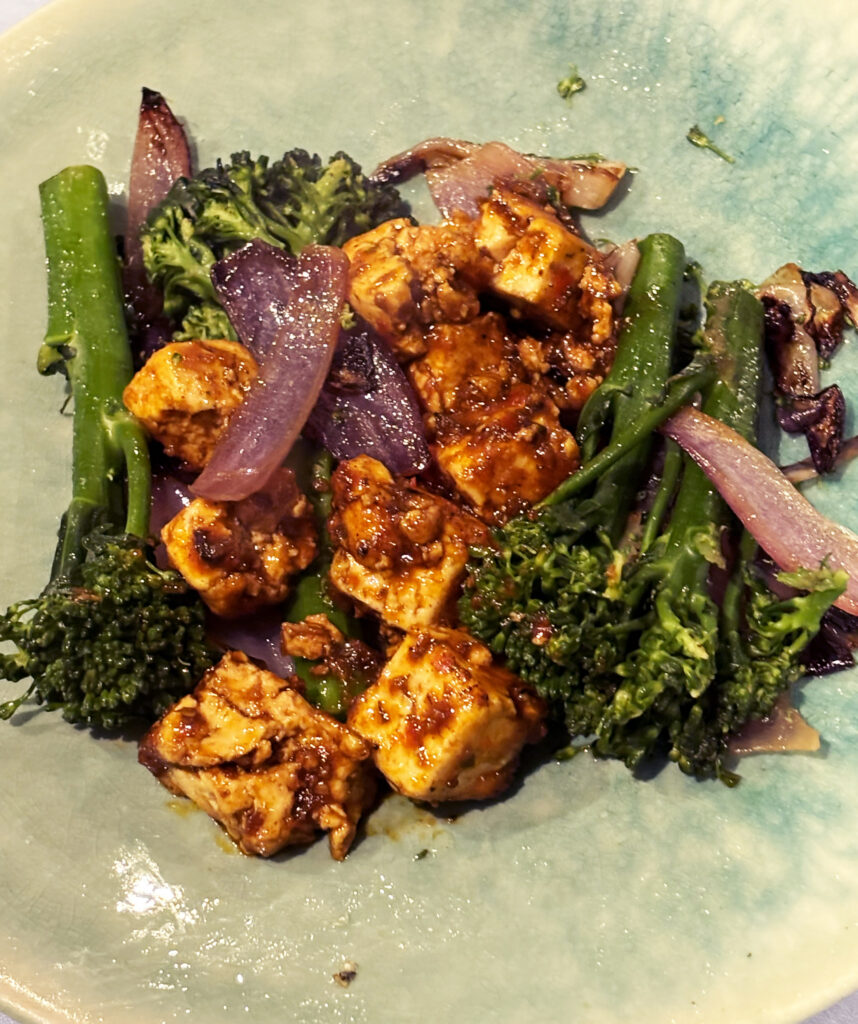
    Next up I did try something new.  This recipe is called “Virtuous Vegan Harissa Tofu Bowls”.   Let’s just call my version “Harissa Tofu” because I neither served it in a bowl or added the grains.  The recipe called for farro, which is not gluten-free; I could have substituted a number of things, but I was quite satisfied with the tofu and broccolini without the added grain.  With the requisite grains, the recipe serves 4; my version without serves 2. The broccolini is parboiled in the same water used to cook the grain.  I suppose if not cooking grains the broccolini could be steamed.  I parboiled the broccolini and saved the water for use in a vegetable soup later in the week.  


    The tofu is pressed, then cut in cubes, tossed with a mixture of cornstarch, salt, and garlic powder,  then shallow-fried.  The tofu is then cooked briefly with a mixture of pomegranate molasses and harissa.  At the same time, onion is stir-fried or sautéed with the broccolini until the onion is just charred, at which time the tofu and broccolini were tossed together and served.  The resulting dish was a wonderful combination of flavors — the tofu both crispy and soft, the sauce bright, tart, with a mild heat balanced by the pomegranate molasses and the sweetness of the charred onions and the fresh vegetal flavors of the broccolini.  This combination has been added to my list of tofu recipes I will make again and again.  This is a list that remained stagnant for years, and is suddenly blossoming.  I also like the idea of adding the garlic powder to the cornstarch before frying the tofu, another small improvement in technique which yields big dividends.

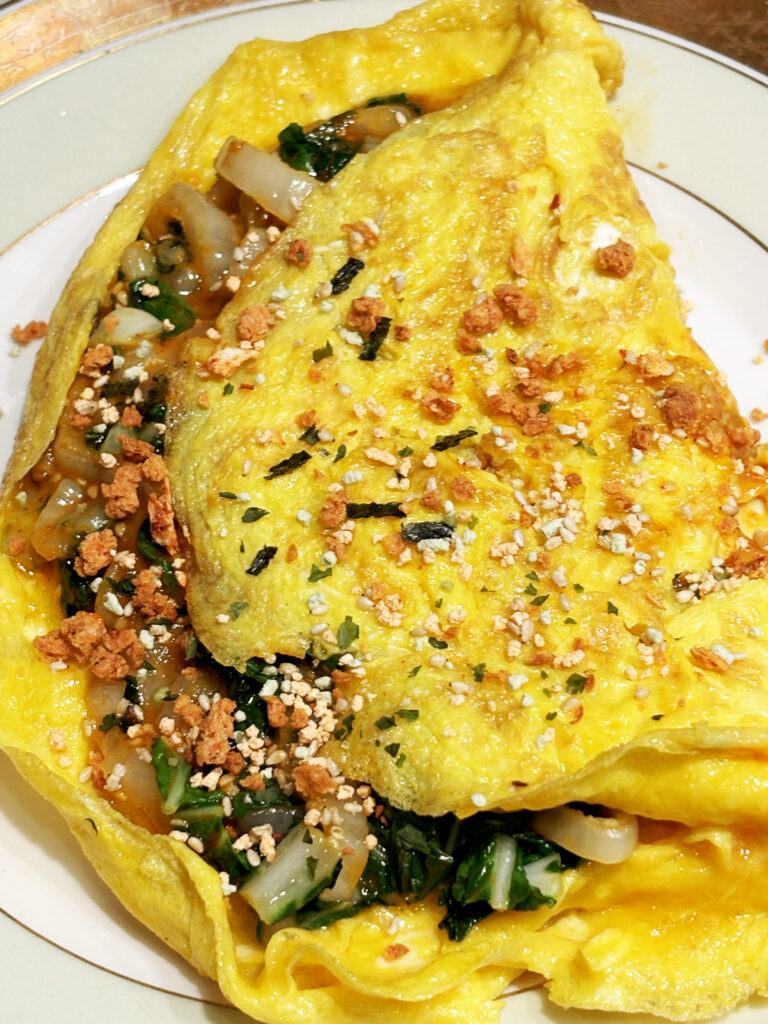
    About this time I found myself at the very end of the winter bok choy season.  The last of my crop was beginning to bolt and so there was a quick harvest and a search for new ideas using bok choy.  I remembered that I had seen a recipe for a bok choy omelet I wanted to try, and I found the recipe in Ali Slagle’s  I Dream of Dinner.. The recipe is “Bok Choy – Gochujang Omelet”.  It is really a rather simple omelet.  The bok choy is mixed with a simple sauce made with gochujang and lime juice.  Slagle doesn’t cook her bok choy. I briefly pan sear mine before adding it to the sauce.  I also used more bok-choy to egg than the author recommends, but unless I am trying something unfamiliar, experience and my own preferences tend to lead.  What makes the recipe special is the generous amount of lime zest that is added to the egg mixture before scrambling.  What didn’t work for me were the sesame seeds.  The first time I made this I was out.  I sprinkled furikake on top of the omelet for the requisite bit of crunch and loved the result.  The second time I used sesame seeds but didn’t think they added anything special to the dish, which also uses toasted sesame oil.  Since then I have left the sesame seeds out and simply sprinkled the final omelet with furikake.  Currently I am using kimchi furikake. And yes, this is my current favorite omelet, I’ve probably made it at least once a week for the past six weeks.


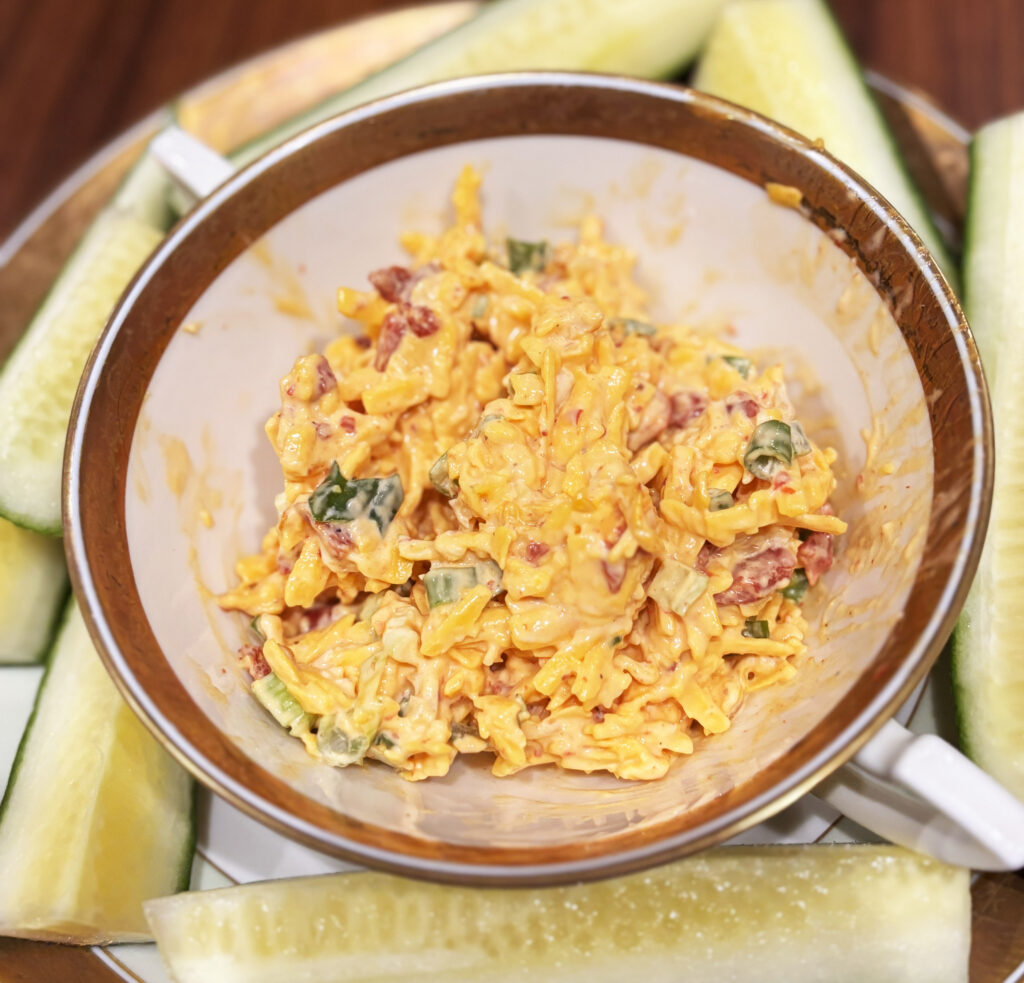
    Then I returned to new riffs on familiar foods.   The Global Pantry Cookbook has a recipe called “Ann’s Smoky Pimento Kim Cheese” which is a riff on traditional pimento cheese.  I love pimento cheese.  I grew up eating pimento cheese.  I couldn’t buy it when I lived in New York State so I made my own for decades.  I still make my own because I like the basic bare bones pimento cheese I grew up with, which is easy to make — grated sharp cheddar cheese, pimentos, mayonnaise.   I’ve eaten gussied up versions with cream cheese.  I’ve eaten all kinds of store-bought versions, but I’ve only ever purchased one pimento cheese, which was locally made from local cheeses and is no longer available.  Even then I probably purchased it because I could purchase it in smaller quantities than I was likely to make at home. I prefer my simple at-home version to all the others, but if I make it, I will eat it. 

    As much as I love pimento cheese, I probably love kimchi just as much.  But it had never occurred to me to combine them, an idea worth exploring.  Pittman and Mowbray start with a fresh red bell pepper, which they smoke before adding it to the kimchi.  I did that once.  It was good, but I don’t like it better than the smoky jarred piquillo peppers I usually use in my own pimento cheese (instead of the standard pimientos).  I did however like the addition of the kimchi, and the small amount of grated onion, neither of which had graced my pimento cheese previously.  I don’t think I would grate onions every time.  And I won’t make pimento kimcheese every time either but I do like it as a regular variation.  I used jarred kimchi, and the results will vary depending on the kimchi used.  Use a kimchi you like.  I liked my first batch better than my second, but I also liked the first jar of kimchi better than the second.  This whole experiment reminds me that I need to start making kimchi again.  I miss my homemade kimchi, which I stopped making when I was going through breast cancer treatment. It really is time for a reboot in the kitchen.

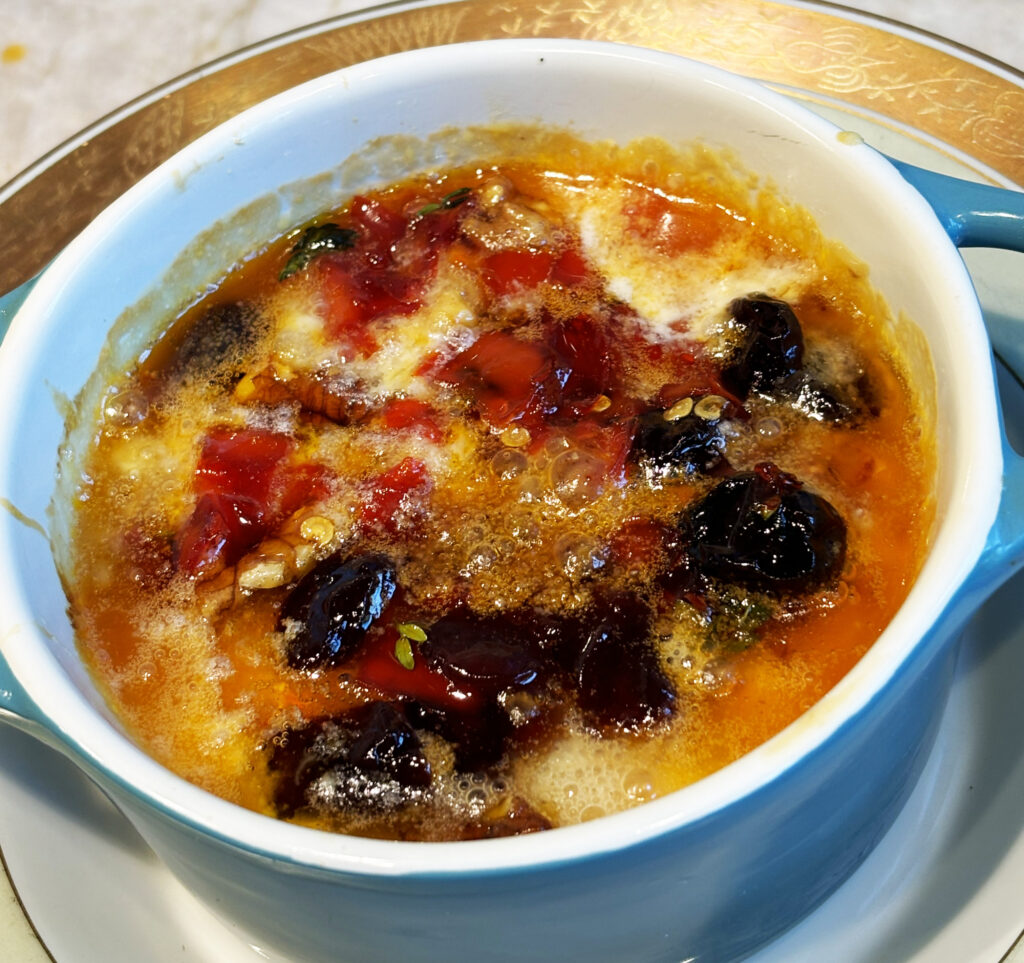
    In the midst of a fridge clean-out, I found just under a half-round of Sequatchie Cove Creamery’s Walden, a soft reblochon-style cheese, hiding in a corner of the cheese drawer, and this reminded me that The Global Pantry included a recipe for a baked brie.  Well, I couldn’t use a traditional baked brie technique, but I thought I could adapt the recipe somewhat.  I cut the cheese in quarters and placed it in a ramekin around an egg creating a kind of baked-brie/cocotte kind of dish with the egg and cheese and spiced honey topping.    The recipe called for honey, tart cherries, black walnuts and Calabrian chiles, and the entire thing made a perfect, if also somewhat luxurious, repast at the end of an unusually exhausting day. 

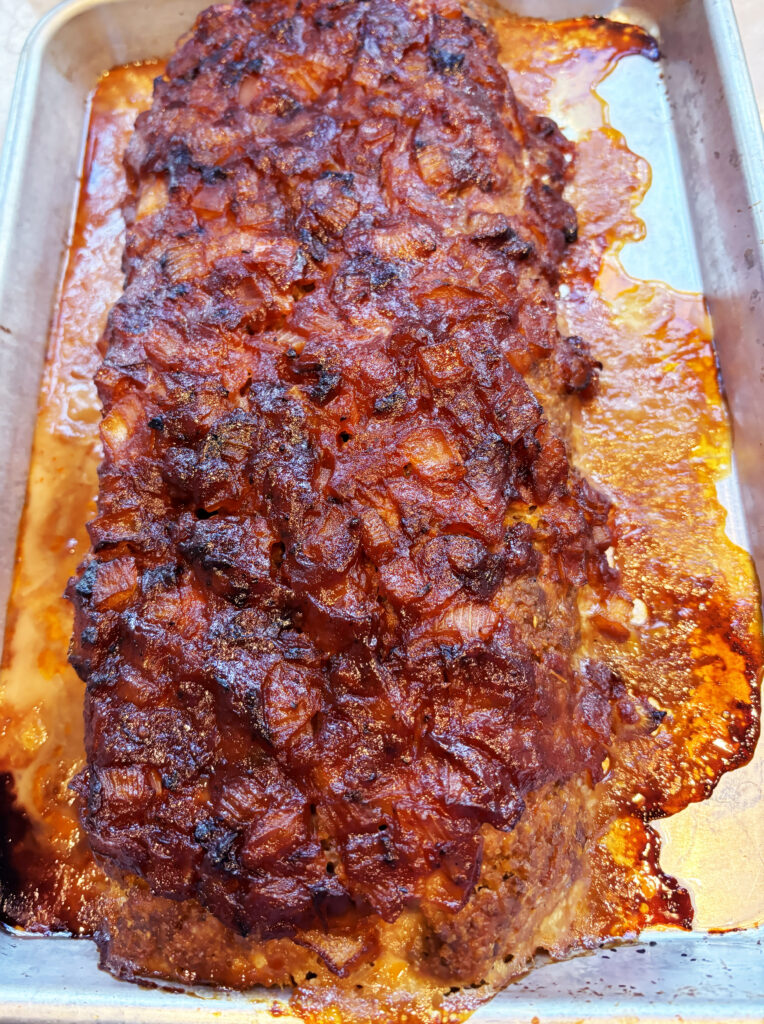
    Last but far from least was another reworking of an old classic.  I actually made “Damn Fine Meatloaf with Spicy Onion Glaze” twice, so there was a lot of meatloaf eating at the end of the month.    Pittman and Mowbray update a classic meatloaf mix of beef and pork by adding oyster sauce and soy sauce, and topping the meatloaf with a spicy ketchup/sriracha glaze.  The first time I made it, I did not use the recommended panko breadcrumbs, but instead dried out and crumbled up a piece of leftover homemade cornbread.  The meatloaf mixture was fairly wet, and I wasn’t sure if this was the difference between using cornbread instead of breadcrumbs, or due to the fact that gluten-free and gluten breads have different absorption characteristics.  I baked the meatloaf in a bread pan, but even after adequate cooling I had trouble removing slices without the meatloaf crumbling.  If I turned the meatloaf out of the pan as a whole, the delicious glaze was on the bottom, not so desirable, but the texture and flavor of the meatloaf as a whole was wonderful.  The second time I used panko, but made the meatloaf free-form on a cookie sheet and covered with the glaze.  This worked beautifully, but I think I preferred the texture of the meatloaf made with the cornbread.  I am sure I will repeat it.  Whenever I make cornbread, there is usually some left over, and this is a very simple meatloaf which yields big dividends.


    None of my April kitchen explorations were particularly adventurous, unusual, or difficult.  I am reminded that there is much I have neglected that I wish to do again, but that is true in all of the things that are important to me in my life.  Rebooting kitchen, sewing, knitting, garden — each is a life-time’s task.  Whatever bit I can do is enough.


  • I’m Still Here

    I am still here.  And there have been a lot of thoughts flitting through my head, some new, some old. Apparently I am living through a process of settling down into myself.  I know I keep saying that, but I continually surprise myself, and so it bears repeating.

    Peony

    Let's start with a peony.  This is the same peony that I shared at the bottom of my last garden post, just a better picture, taken in the evening, in the "golden hour".  This peony has been thriving, with over 4 dozen blooms.  It lives on the east side of my front yard.  It is the peony whose roots are intermingled with a little lime hydrangea.  I have thought, on several occasions, that the two should be separated, but they seem to be thriving together, and so I leave them be.  All of the peonies are roughly the same age, but this one, cohabiting as it is, seems to be the happiest.  it is the one peony for which I do not have to supply support as it is propped up on those hydrangea branches.  I suspect that it thrives in the early spring sun, before the hydrangea fully leafs out, and the hydrangea protects it from the worst of the summer heat.

    Peony1

    Most of the peony blossoms have been beaten into the ground by now, these photos were all taken last week, before torrential rains, thunderstorms and heavy winds took their toll, but the memory of peony season remain.  The peony above was the last to open,  just before the rains hit, but after a brief pause it is sending out new blossoms now.  What I thought was a fleeting moment has become something different, not just a moment but a trend. 

    Iris1

    I don't really remember the name of any of the peonies I've shown you, but I do have a garden plan, and I do have them marked.  The same will be true for iris varieties in the other pictures I intend to put up in this post.  I could look them all up, but I'm not really sure it matters much.  There are things that do matter, but the name of the flower doesn't particularly affect my enjoyment of it.  Better, I suspect to simply accept the joy that is offered.

    Flag iris

    Things bring me joy as well, but it doesn't really matter if the thing itself has any value outside of my own feelings for it.  As far as I am concerned, it seems I have reached a point where provenance, in and of itself, doesn't matter.  If something has beauty, or function, or is meaningful to me in some way, that is all that matters. That is not to say that I cannot be judgmental, that I don't have my own biases.  I do make judgements. We all make judgements, and very often these judgements are made on incomplete or faulty assumptions.  I know that I sometimes make misjudgments, about things, and about people, mostly because of lack of information, ignorance even.  I can only hope that I am willing to change my mind when faced with additional information if so warranted.

    Iris2


    Which brings me to people.  I am human, and I, like every other human, seems to have a default setting, an inbred assumption that the way I see the world is the same way everyone else sees the world.  Of course this is not true.  What seems like common sense to me might be outright foolishness to you, if not downright dangerous.  What I've found is that I don't really care about what anyone else believes, or even whether or not we agree, even on topics that are important to me.  I do not mean that I would disrespect or ignore someone else's beliefs, beliefs are important to who we are. I mean that I don't dislike someone just because they don't believe the same things I do, nor do I assume they are stupid, wrong, evil, or a host of other adjectives. I do care about people who are willing to seek out common ground, who are willing to think about their own beliefs as well as those of others, who are curious, who are willing to say "I don't know".  All I suppose I care about is that we are willing to seek those things we have in common beyond our differences, and see that are differences are a part of ourselves, that we are willing to question, not only others but the very basis of who we are, the very thing makes us human.  That doesn't mean we can always connect, but I like to hope that we can always try.   If you don't want to connect with me, I have realized that I won't dislike you, but I might not make time for you either.   If someone intentionally tries to hurt me or those I love, that is something else altogether.  That doesn't mean I can't strike out when I feel backed into a corner.  That doesn't mean there aren't days when I am more entrenched in my own views than others.  We all have good days and bad days.    I think the best we can hope for is that our good days outweigh our bad days.

    Pot1

    Which brings me to something else that struck me along the way.  The other day I was a part of a conversation about Mahler symphonies.  Several symphonies were discussed and I found the conversation fascinating — the person who loved #3 or #5, the person who liked 7 more than 5.  The person who found 7 difficult.  I would listen to snippets of each in my brain.  And then I was asked which was my favorite Mahler symphony, and I drew a blank.  Not because I didn't know the symphonies, but because right now, I don't have a favorite.  I love them all.  I can imagine them each.  Once upon a time I would have said the ninth, a popular choice that, or the 5th.  I did say I am leaning more toward the late symphonies now than I was when I was younger, which is true.   But I also realized that I no longer really play favorites with music.  Perhaps this is an outgrowth of my project to be less judgmental when listening to music, to just allow myself to experience the moment.  If so it is an unexpected consequence, and yet, ultimately, a rather good one.  I don't need a desert island symphony.  Actually the sea is probably symphony enough.  Whatever I am listening to is enough. 

    Whiterose

    Certainly this hasn't been always true.  I've had favorites, I've held grudges.  But at the moment neither one really plagues me much.  The book I am reading is the book I am reading.  The person I am talking to is enough.  The music that surrounds me in this moment. I wonder how long this will last. Is this a permanent change? or a temporary bubble?

    Chives

    But it struck me, this week in particular, that this is where I am now.  I love the blooming roses as much as the chive blossoms.  I love the new green buds on any tree.  I've long loved all kinds of music, all kinds of books, all kinds of art.  I love the five dollar purse I bought at Target as much as the fancy designer bag George gave me. I suspect whether I love something, or someone, or not depends entirely on my ability to engage with that thing or person on some level.  There are no limits.  


    Today I am tired.

    Today I am reading a Daniel Silva novel.

    Today I am listening to Zemlinsky. 

    Tomorrow will be different.  All of it can be good.

  • Poetry, Drama, And Yes, One Novel: March Books

    Still playing catch-up.  These are the books I read in March:


    14.     Bless the Daughter Raised by a Voice In Her Head, Warsan Shire (poetry)

    15.     How I Won A Nobel Prize, Julius Taranto (novel)

    16.    The Hidden Lives of Tudor Women, Elizabeth Norton (non-fiction)

    17.     How to Know a Person, David Brooks.  (non-fiction)

    18.     Anon(ymous): A Drama, Naomi Iizuka  (drama)

    19.    Julia Hungry, Hannah Louise Poston (poetry)


    Look how nicely balanced and aligned my reading was in March!  I don't believe I noticed this until I typed the list out, just now.  The list aligns as if it were a survey of the various types of books I read, which is interesting.  The list is also interesting because, about half of these books I read fairly quickly.  The  shortest books were the books I spent the most time with, namely the two volumes of poetry.  The two non-fiction books,  at the center of the month, were the quickest reads.  I shall start there.


    Both The Hidden Lives of Tudor Women and How to Know A Person were entertaining, easy to read and informative books. Neither book requires an investment of more than a couple (perhaps a few) hours.


    I would certainly recommend Norton's book, The Hidden Lives of Tudor Women,  to anyone who doesn't know much about Tudor England, but would like to learn more,  and who is interested in the lives of women.  Norton provides a well-researched survey of what is known about the lives of women, both of the upper and lower classes.  She can be commended for spending time on the lives of the elderly, of servants, and of women who do not often show up in history books.  However, much as I found this a refreshing survey,  I found nothing new here, nothing that I had not already learned from other histories of the Tudor period.  But then, I have long been fascinated by Tudor England, by its history, its politics, its religious struggles, and its literature.      


    How to Know A Person, David Brooks' latest book is another easy, and sometimes entertaining, at other times maddening, foray into pop sociology.  Brooks is popular and influential; reading his books, is like placing a finger on a pulse of one part of the social landscape.  But I always find them lightweight, as if the author is willing to run right up to an insight, meeting it face to face on the surface, and then pull back, refusing to delve into anything that might be uncomfortable.  The author's trademark technique of combing research and personal narrative is intended to come across as charming, perhaps even engaging, but I almost always end up finishing the book feeling as if there is no "there" there.  Brooks begins by laying out what is necessary to actually get to know others deeply, and initially the book appears laudable.  He tells of his own struggles in terms of being more open; then he falls back into pattern, breaking people up into narrowly defined categories.  The not-so hidden message is that we know what we are supposed to do, but we are flawed. This is a feel-good book, acknowledging what we know, acknowledging that we struggle, but rather than helping us become more open, it gives us permission to fail.  And maybe that is why we (myself included) read David Brooks, he is a milquetoast for the 21st century.  David Brooks appears to have made a career of being reasonable, of reminding us of things we should know, should do, but not pushing too hard or too far.  Brooks has filled a niche as a spokesperson for an age, a group, a society, that knows it is supposed to believe something, it just hasn't quite figured out what that might be.


    Moving out from the center, I read a novel, How I Won A Nobel Prize, by Julius Taranto.    This is an intelligent and ambitious satiric novel which revolves around campus cancel culture and the wider issues that arise in the midst of rapidly changing social mores.  On a spectrum from commercial to literary fiction, I would place it on the literary side of  commercial, blending aspects of the two, perhaps "upmarket", in that there is a lot of metaphor, a lot of insider, east-coast-elite-education references, and yet there is a very definite clearly satisfying and unambiguous ending.  The novel is very metaphor heavy, often deft in its exploration of the failings of both right-wing and left-wing ideologies in terms of cultural accountability and morality.  I often found it laugh out loud funny.  Well written, and very much of the moment.


    Anon(ymous) is a play written by Naomi Iizuka. I read the play because it was being performed at the local Clarence Brown Theater.  I have found that I enjoy reading a play before seeing the performance, and sometimes, as I did here, I read the play again after attending the performance.  Reading plays is not like reading novels.  Plays are stories, and you need to read it as if it is telling a story, but unlike a novel, it is incomplete.  The reader must imagine it being acted out, imagine it materializing before their eyes.  Of course seeing a play solves this problem, and this is probably why many people find it easier to see a play than to read it.  I studied a lot of early English Drama in school, plays that are not really performed much today, more's the pity.  I like reading plays and this play was no exception. Anon(ymous) is a powerful play about refugees, about journey, and finding home, based on the Odyssey.  Like Odysseus, Anon left home many years before, his journey is beset by trials and tempests, and eventually he is reunited with family, overcomes suitors that would keep him from family, and triumphs.  The play is filled with characters and situations that directly echo the Odyssey and yet this is a journey for the 21st century.  I distinctly remember thinking that if young people read the Odyssey today in the way this play presents it would hit home so deeply.  It also made me think that perhaps I never considered how the Odyssey itself affected audiences in its own time.  Much to ponder there.  This is a poetic, powerful, and profoundly disturbing play, that really brings home the plight of refugees, but also our own complicity in that plight.   The production was also powerfully realized. I absolutely loved both.  The play reminds me, in terms of its power, and the way it has permanently affected my thinking, of the play Necessary Targets by Eve Ensler, and the novel Exit West, by Mohsin Hamid.  Different, its own story, but one we all need to see and hear.  It also has me wondering about rereading the Odyssey.  What would my 66-year old self see that my 20-year old self did not?


    I opened and closed the month with volumes of poetry.  Two slim volumes, both by women, both volumes I have carried around in my purse for much of the month.   Bless the Daughter Raised by a Voice In Her Head by Warsan Shire is a volume of powerful poems about womanhood, trauma, migration, resilience – poems that are striking, inspirational, that worm their way deeply into the conscience.  I love the way the idea of "blessing" runs through the book, no so much as something bestowed upon, or condoned, by God, but as a process of memory and meditation, to bless something, to take it into your heart so that it shapes who you become, alive in the multiplicity that is the world.  


    The other volume of poetry Julia Hungry by Hannah Louise Poston is still traveling about in my purse, available to peruse whenever I am stuck waiting in line some place or another.   This slim volume is filled with incredible poetry, rhythmically, almost musically complex, moving, sometimes absurd, sometimes funny, sometimes sad or hopeful.   It has been a long time since a new volume of poetry has struck me so profoundly.   Highly recommended and worth seeking out.