Author: 459856pwpadmin

  • Playing with My Food 260426

    I go through phases of more practical and functional cooking and then phases of play, when I explore some cookbook and recipes otherwise unfamiliar.

    In March I was cooking from Kusina by Woldy Reyes, a vegetarian cookbook inspired by the author’s Filipino heritage.

    There was some necessary prep work:

    I started with some Annatto oil (jar at back right) which was needed for the banana ketchup (front left in the squeeze bottle). The annatto oil was from Memories of Philippine Kitchens, by Amy Besa and Rory Dorotan. I’ve cooked from this book before, and the annatto oil is useful in many ways. Woldy Reyes has a recipe for gussying up commercial banana ketchup, but I started making my own some time ago when I couldn’t find a version I liked and didn’t taste too sweet/chemically in local stores. This may be why Reyes gussies his up. My own recipe works off a base I found in the Adobo Road Cookbook by Marvin Gapultos, which was the first Filipino cookbook I bought, many years ago. That recipe has been modified by ideas found in Snoop Dog’s Goon with a Spoon cookbook, and ideas from Filipino food blogs (use of the annatto oil). From Reyes’ book I will probably change the base recipe again, using chili paste for heat rather than the finely chopped jalapeños I have used in the past. Banana ketchup is a sweet/spicy condiment that I actually use more than tomato ketchup, or at least more than commercial tomato ketchup. When I bother to make my own tomato ketchup, that might take first place for use.

    Did you know American’s used to eat a wide variety of ketchups, made from a variety of ingredients? That was before Heinz began mass-producing the tomato ketchup we know today, after which market forces, rather than expanding our options, actually narrowed our palate.

    Also in the picture above are chili oil, pickled golden raisins, and confit shallots. The pickled golden raisins are bright, tart and sweet and completely different than middle eastern pickled golden raisins I’ve made previously. The confit shallots are also probably something that will frequently appear in my fridge. Reyes chili oil however is not my favorite version of chili oil, but I will use it up. There seems to always be a need for chili oil.
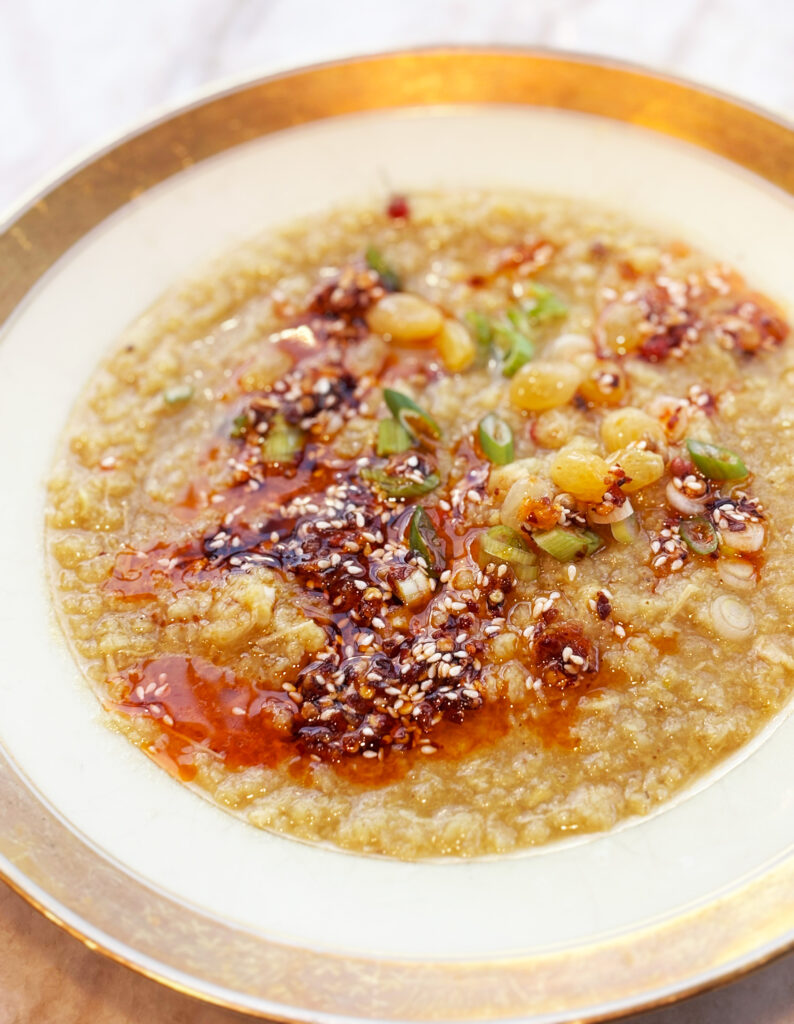
    Speaking of those pickled golden raisins. They were fabulous on a bowl of Lugaw, which seems to be something of a filipino version of congee. I prefer my house congee, but I like the idea of the combination of chili oil (whatever version I have on hand) and the sweet/tart raisins as condiments.
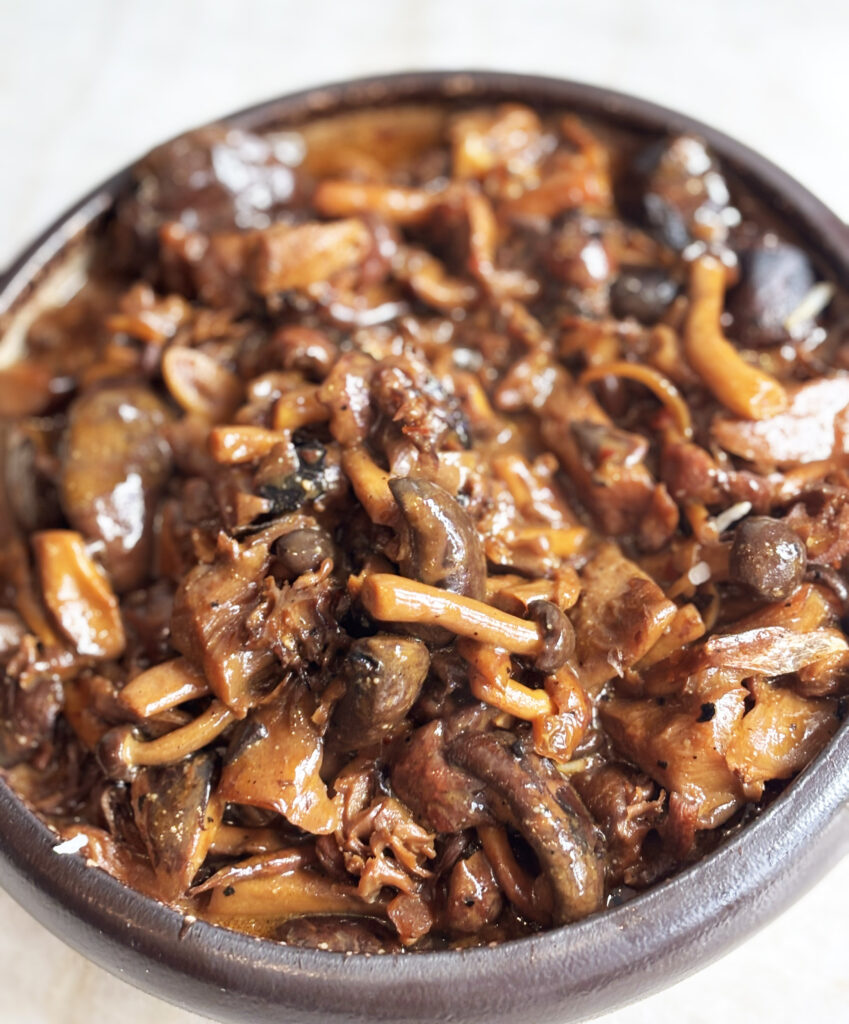
    This is a Mushroom Adobo. It is vegetarian and I used a mix of king oyster, grey oyster, shiitake and cremini mushrooms which gave the dish a complex flavor. What was surprising was the use of coconut milk, which I found gave the dish a fabulous richness and complexity, perhaps a bit softer than more traditional adobos. Reyes says this is best immediately, but I actually liked it better the next day when it was perhaps not as bracing but the flavors had melded into something utterly compelling.
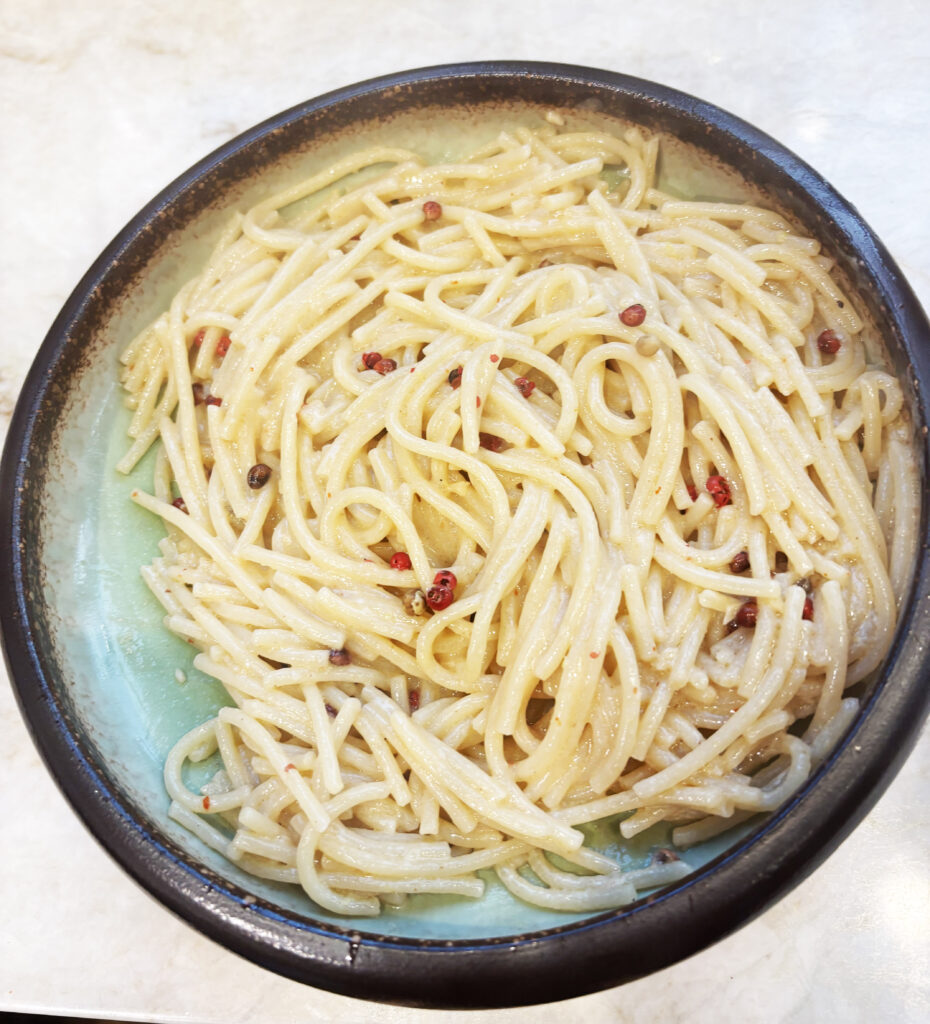
    Above is a photo of Miso Coconut Pancit, a noodle dishes that uses Bagoong. I used gluten-free spaghetti here, and Reyes’ comment that he would call this “filipino Alfredo” is apt. The coconut milk and bagoong give this a creamy, subtle yet umami-rich flavor that I found very appealing. I don’t usually think “subtle” in terms of filipino food, at least that has not been my experience, but what do I know. I love the bright fruity pop of the pink peppercorns here. In fact, I used more pink peppercorns in March than I have in the previous two years.

    Bagoong itself is usually made with shrimp and it has a deeply funky, salty, umami flavor. This vegetarian version does as well. It makes a large batch so I tried freezing the extras in small cubes. That was perhaps a mistake as it is rich in oil and getting them out of the freezer trays was a mess. Next time I would freeze it in small jars which I did not have to decant. Some of the oil did separate out, but not much. The recipe did call for a lot of oil. Many people in my cookbook club said it was too much oil and they cut the quantity in half because they had trouble getting it incorporated into the rest of the mixture. I had no real problem with that, the process felt much like making mayonnaise, although there were no eggs present. I’ve whipped olive oil into a cream before, so this was not much different. I think the texture was somewhere between a pesto (before you add the cheese) and a mayonnaise. I do think it would be a completely different condiment with less oil but I might try it sometime. This is excellent, and I am glad I have it, but I’m not sure I would use it frequently enough to just store it in the fridge, at least at this point. Who knows though, I might just go on another filipino food trek one of these days.
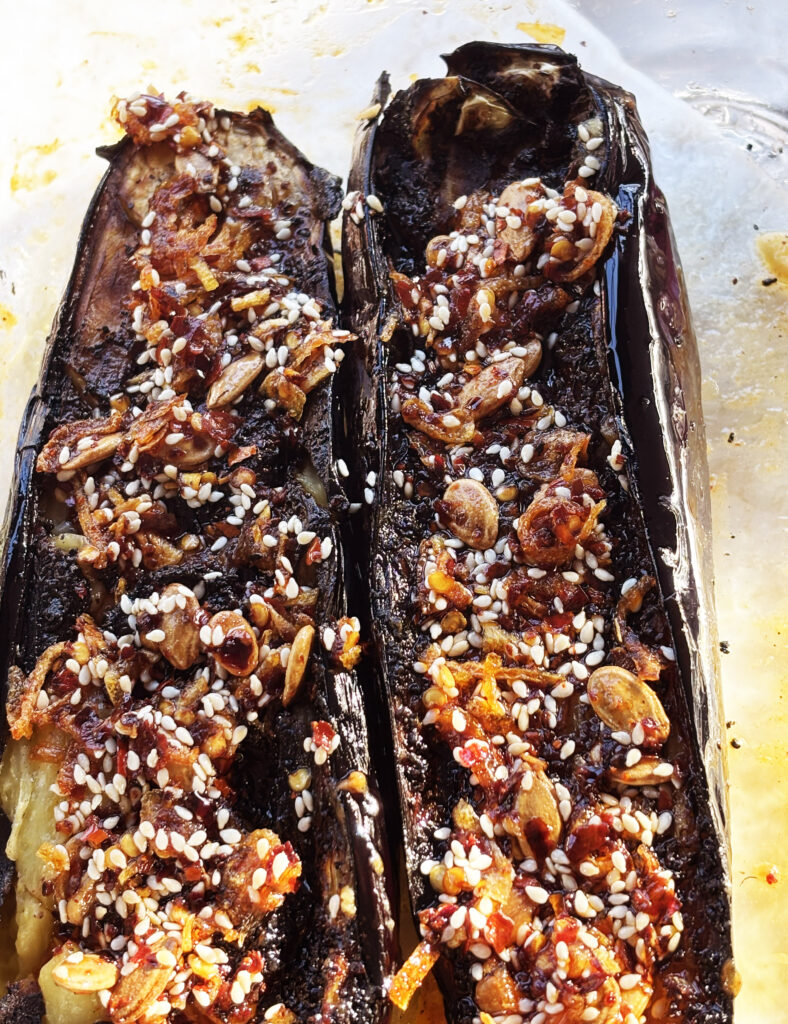
    This dish, with eggplant and chili oil was my least favorite dish of the group although I don’t really think that was the fault of the recipe per se. My out of season eggplant was bitter. I used small globe eggplants from the grocery store, and I would have been better served to go to either the Asian or Indian markets, and purchased a different variety of eggplant, as they both tend to have outstanding produce, better than my local grocery stores by a wide margin.

    As I mentioned earlier, I’m not particularly fond of Reyes’ chili oil either. Mixed with the bitter eggplant it did not shine. I turned the leftovers into a kind of fusion layered eggplant, ricotta, and ground lamb gratin that worked beautifully though.
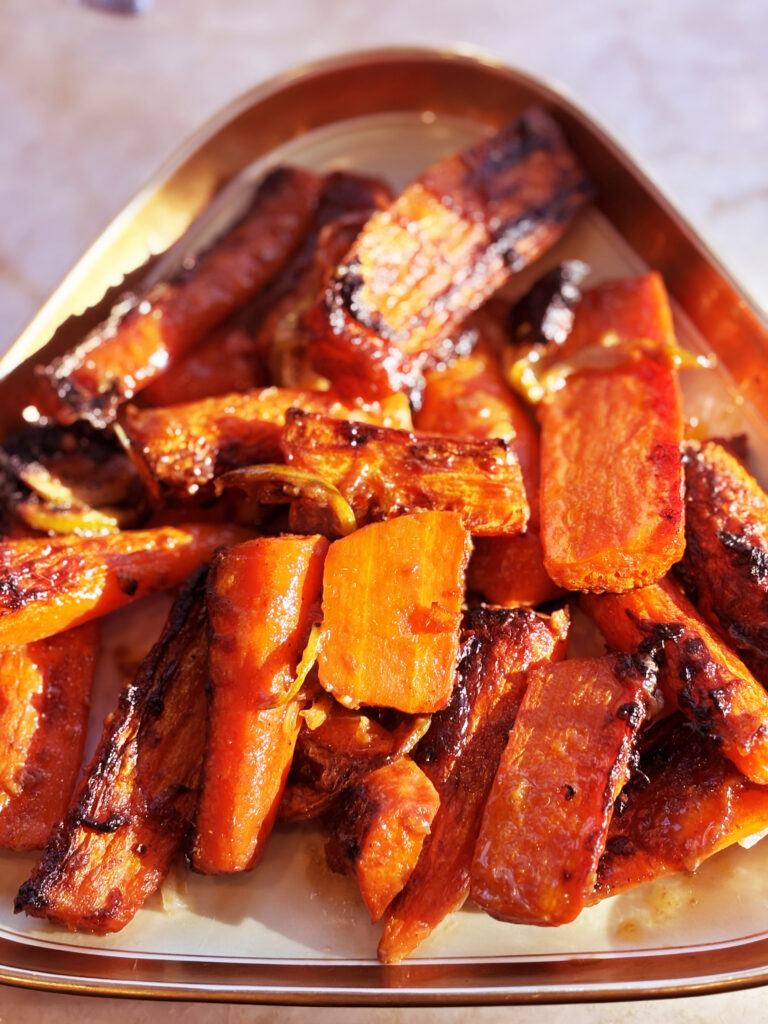
    I love roasted carrots and these roasted carrots with banana ketchup and limes were no exception. The only was the issue is that the recipe states that one should slice the limes (whole unpeeled) very thinly, and they were charred beyond recognition before the carrots were even fully roasted. Next time I would roast the carrots about half-way through, and then stir in the sliced limes. I might be added sliced limes to other roasted vegetables as well.
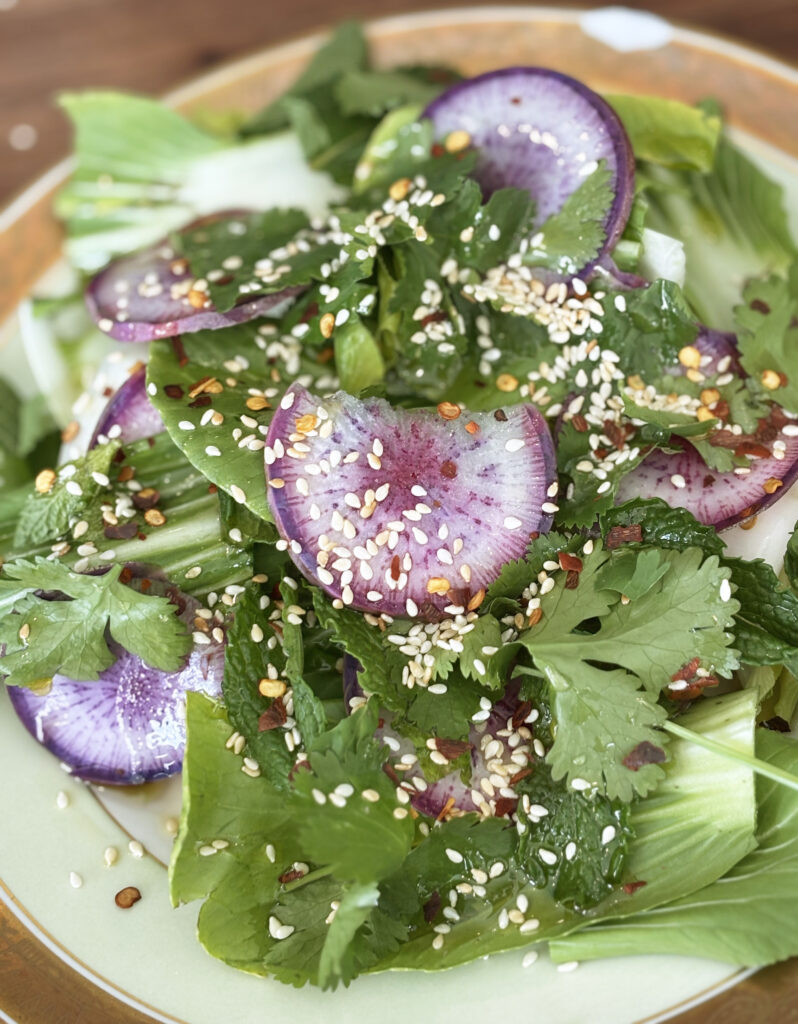
    This was my favorite dish from the book. It is visually stunning and fabulously fresh and flavorful. The recipe called for purple daikon, but I rarely see them in the market. When I did find the purple daikon I had to make the salad. I would never have thought of the combination of bok choy, mint, cilantro and daikon in a salad but it was excellent. I will not forget it. The addition of pumpkin seeds and sesame seeds was perfect counterpoint, and although the dressing was good, I think this would work with any light vinaigrette that leans tart.

    Overall this was a fun book to explore, and although I admittedly had doubts upon my first reading, I ended up loving it. I am surprised at how that happens sometimes, that a book I would have never chosen on my own become a favorite. At the same times occasionally books I am looking forward to disappoint. I suppose this is one of the reasons I adore my cookbook clubs, and time to play. I learn new things, my taste evolves, I suppose my entire perspective evolves.
  • March Books (Plus 1)

    I left a book off my February list. I’ve also changed my format slightly. The process is evolving. Now I will write about the books in the order read, beginning with the missed February book, then skipping to March. I am not aiming for reviews, and as I somehow failed to take notes on my reading in March, expect only brief impressions.

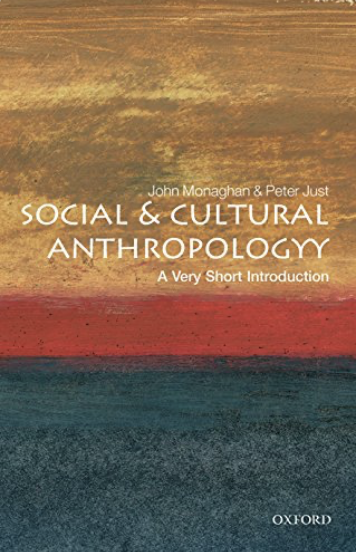
    11. Social & Cultural Anthropology: A Very Short Introduction, by John Monaghan & Peter Just.

    This was a short, clear introduction to ethnography as practiced by anthropologists. I’ve read some primary source material in anthropology, and last year I read a college intro survey to anthropology which I thought was pretty insipid and dealt more with trying to win students into the field rather than teaching anything. Harsh, I know, and possibly wrong-headed. This book was different. The cultural examples were fascinating, but the book also delved into the controversies and difficulties with studying and understanding other cultures, the problems of implicit bias, and the dangers of passing off assumptions as science. This was worthwhile.

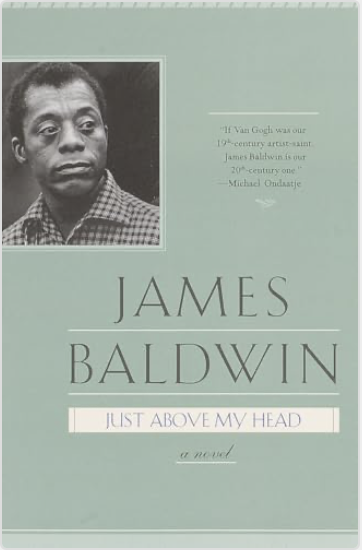
    14. Just Above My Head by James Baldwin.

    I loved reading this novel, loved the story, loved the language and the pure literary pleasure of it. Baldwin writes with poignancy, clarity, and depth of joy and horror, of loss, of love, of the range of human existence, and he does it with language that is precise and caring. Reading this novel clarified my thinking about all the flaws in These Pretty Pieces of Flesh, which I had read the previous month. But this is not about comparison. My reading of that first book felt hampered by rage and resignation. Baldwin addresses all the same emotions, all the violence, and all the love, but he does so with acceptance and love and without pushing you off the mountain. A book worth crying over.

    15. Portrait of the Artist as a Young Man by James Joyce.

    Again I reveled in literature, in beautiful prose, in nuance, and in writing that guides you gently without hitting you over the head with what you are “supposed” to feel. This novel is a wonderful exploration of of individuation, of that process that the young (teenage) mind hopefully goes through in the process of transitioning from childhood into adult consciousness. I adored reading it now, and found it insightful, thought-provoking, and yet completely compelling. More so with this read as compared to my first read when I was 18 or so; then this was a difficult novel. This time it was a joy; thought-provoking but still a joy.

    16. Picky by Helen Zoe Veit

    Today it is assumed that children taste food differently than adults. But that has not always been the case. I read this book because it plays to my natural biases. It is a cultural history, written by a historian, and it is not going to help you teach your children to be less picky. Veit goes into exhaustive detail concerning the evolving understanding of food, nutrition, and what we eat. It is a fascinating book about how we evolved, over a very short period of time, from a culture where children ate everything to where we are today. At times too strident, I found the book nonetheless fascinating and a quick read.

    17. We Are All Guilty Here by Karin Slaughter

    At last! Some popcorn fiction, otherwise known as quick, escapist reading, this time in the suspense genre. I’ve always enjoyed Slaughter’s novels and this one was no disappointment. Smart female protagonists, powerful storytelling, and yes, some really uncomfortable brushes with the evil that can infect humanity are all present here. This is the first volume in a new series. I am looking forward to more.

    18. Tomorrow and Tomorrow and Tomorrow by Gabrielle Zevin.

    Wow! I had doubts, partially because I am not a gamer, and really do not understand gaming culture. I also found aspects of the college portion of the novel disturbing. Sadie is smart, but her sexual experiences appear to be flat and one-dimensional in a leather stereotypically sexist way. But overall the book arises beyond that.

    The book was fabulously well written, compelling and fun reading, and it held my interest throughout. It also made me think about gaming, and world-building, and the way they interleave with new understandings of literature in ways that I had not encountered or figured out before. The characters are extraordinarily cynical and nihilistic even though the book is not, and I found that interesting. I am also fascinated by the depth of the characters, and the way this book really empathetically explores the dynamics of a creative team that works together brilliantly, each sparking insights that enhance the output, but who cannot succeed in a separate close interpersonal relationship. The very thing that draws them together, also drives them apart.

    If I were rating Tomorrow and Tomorrow and Tomorrow, I would put it below the Joyce and the Baldwin, but I am not fully convinced of my own rating, In one sense I would say this is an almost perfect novel. In another sense, I would say the language is too simple, it reminds me too much of YA fiction, with a healthy dose of elite-college educated snark and self consciousness thrown in. I wonder if I am looking at this novel the way Joyce’s contemporaries looked at Portrait of an Artist. This novel does something different than what I expected, and it has led me to think about literature, and movies, and gaming in new ways, to form new connections. I think time will tell.

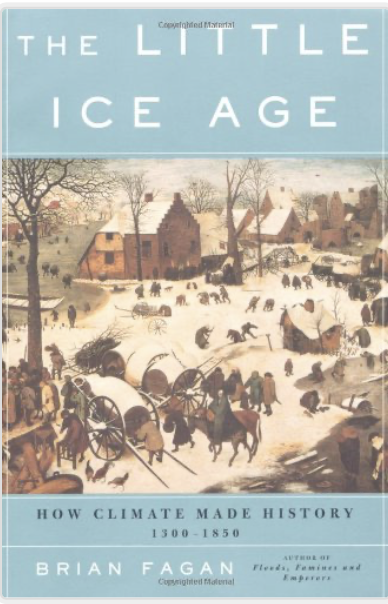
    19. The Little Ice Age: How Climate Made History by Brian Fagan.

    This book was a serious disappointment. I assumed I would like this book. The best thing I can say about it is that it is very readable. However it is seriously marred by the author’s inconsistencies and the way he cherry-picks data to fit his thesis, both using and misusing historical data, or hiding data by over-dramatazation of isolated events that blur the big picture. Of course this makes for a readable book. Fagan tells a great story, and there are some truths here, but although I can’t call this fiction, it blurs too many lines. I wish it were better. He is not wrong. But he is not right either.

  • Thursday Miscellany

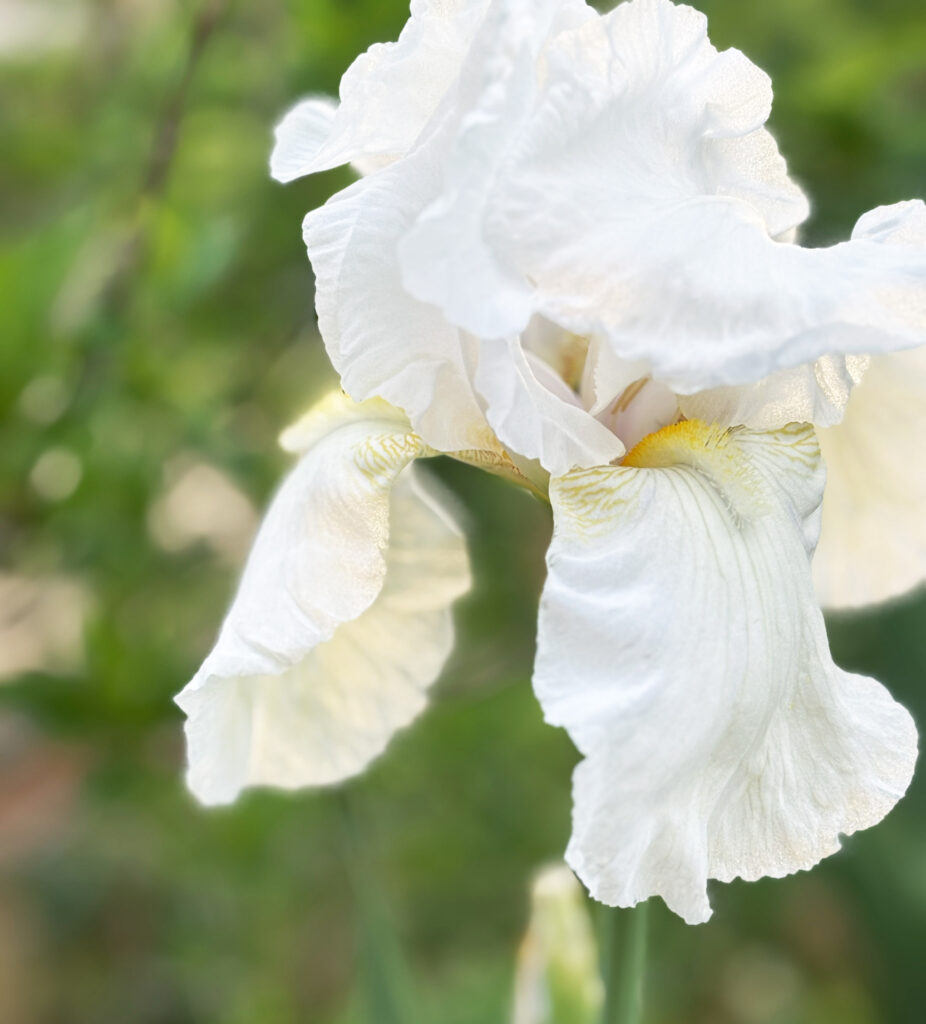
    The first iris opened yesterday.

    It brought a big smile to my face as Garbo and I left for our morning walk. It also brought relief in a way because this solitary white bloom shifted something in my brain, providing the impetus for this blog post.

    You see, I’ve been struggling. I hate to admit when I struggle, tending to fall back on a clichéd “fine” or “good”. I can convince myself that this is a minor obfuscation, because I am functioning — I am dressing myself, feeding myself, and keeping up with minimum maintenance. But it is also a gross understatement. Neither can I state that admitting that I am struggling here is much better, because well, throwing something out into the internet is simultaneously both obviously public and yet completely disassociated from daily life.

    I am not looking for sympathy. Really. I need none.

    But I do need to learn to admit when things are not good. Not in order to give in, but to relieve myself of pressure. I was raised in a home where appearances were everything, the belief was that if it looked perfect it was perfect. I know this is not true. I don’t expect perfection from anything in the world, and yet I still struggle with admitting when I am struggling. Ahh, the inconsistencies inherent in human nature.

    So I admit to struggling. As I’ve noted before, I have lifelong back issues due to my scoliosis. They bothered me less when I was younger and more as I age. I have a congenital heart defect that has led to atrial flutter and bradycardia, which are ongoing, but usually only background inconveniences. I accept that my “normal” is not necessarily what many people would consider normal. I admit that it is often hard to determine what “normal” actually means. This perhaps means that I can forgive myself for sometimes being slow to recognize that I am struggling.

    Yet the past weeks have been worse than normal. I let myself get dehydrated, and I’ve mostly recovered from that. I went through a spell of flutter, then a spell of prolonged bradycardia, but both seem to be settling down now and normal energy levels seem to be returning. Perhaps I will have enough brain power to write something intelligent soon. Perhaps not. I struggle with that as well.

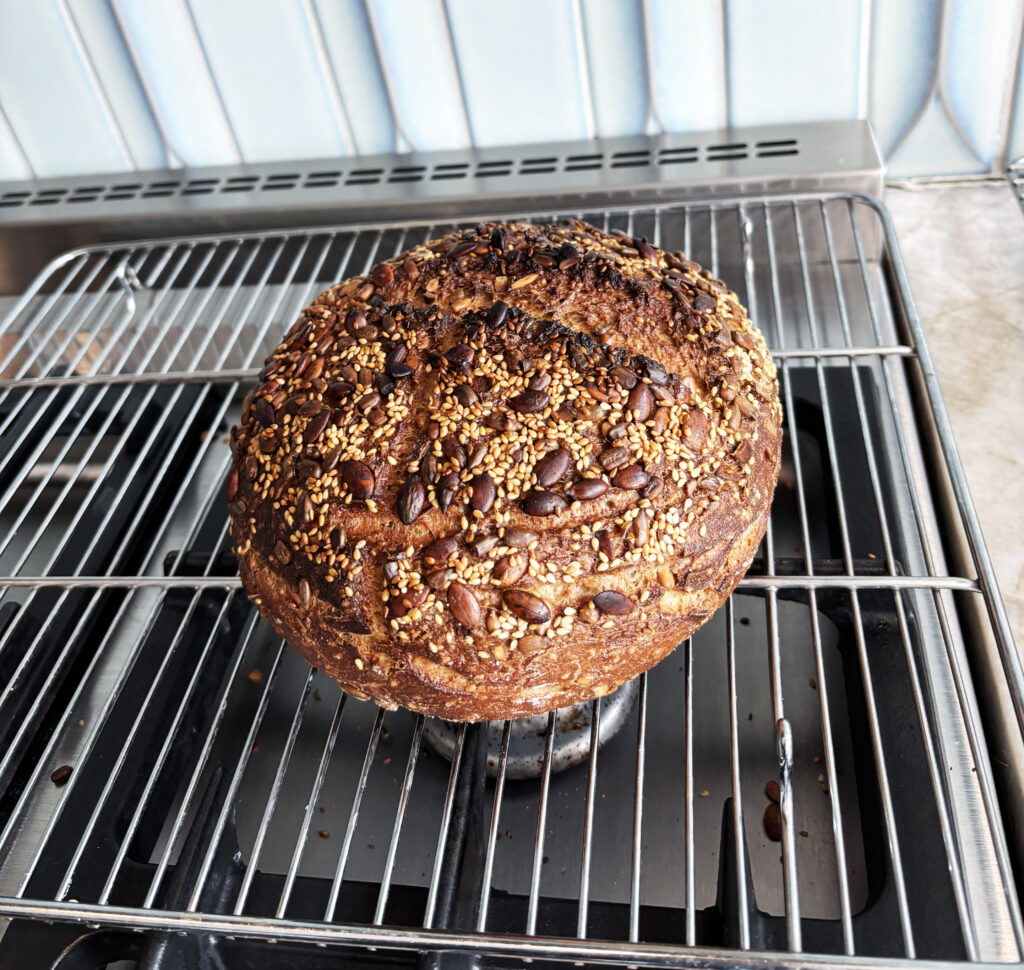
    Yesterday I felt good. I made a cheesecake for an event tonight and I baked a loaf of bread. There had been no bread in the house for a month. I puttered around the house and caught up on chores. It was a good day.

    This morning I had a thick slice of bread with Comté cheese for breakfast, along with my normal morning espresso. It was incredibly satisfying in a deep way, not just physically assuaging hunger, but also soothing some psychological longing. I am ready to move forward.

    Today I have time for an hour or two in the garden, then it is off to appointments, meetings, and social gatherings. This too will be a good day. I suspect a good day is a day I decide will be good. Each of us has that power, whatever our struggles may be.

    I hope today is a good day for each of you.

  • March in the Studio

    March saw me working in the studio most days, but not really doing sewing for myself.

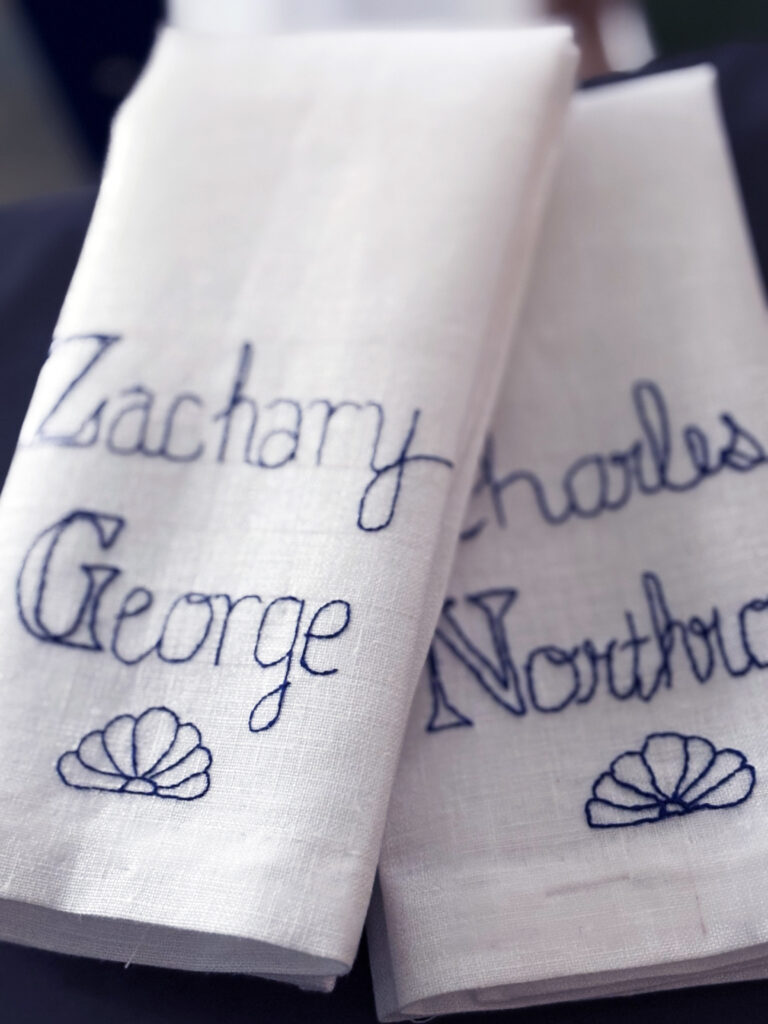
    There were two baptismal towels to be embroidered and made:

    Apologies for a not very sharp picture.

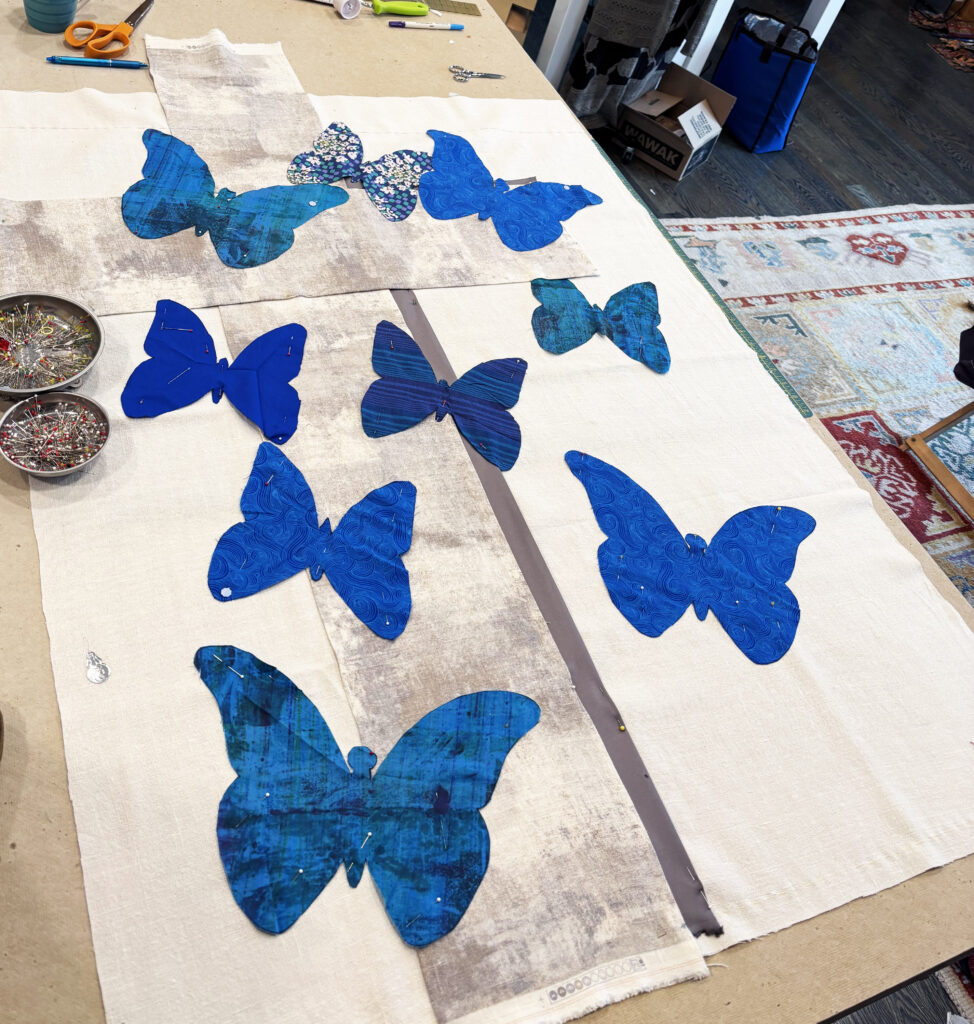
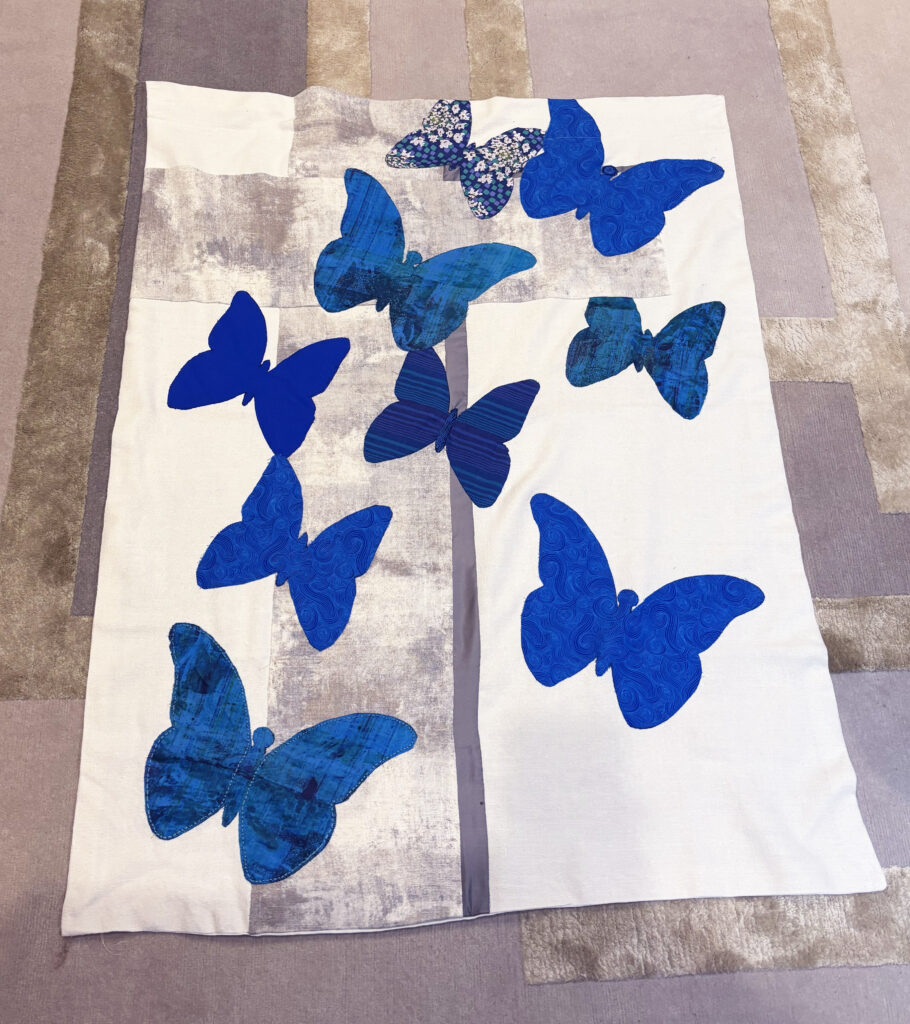
    And a bigger appliqué project I had been working on. Prior to March I had been design, planning and layout. Apparently this is not my skill set, and it took me a long time. Like my writing, I suppose I had to come up with too many ideas and winnow them down, then make the design to complex, and winnow it down again.

    Finally I was ready to work:

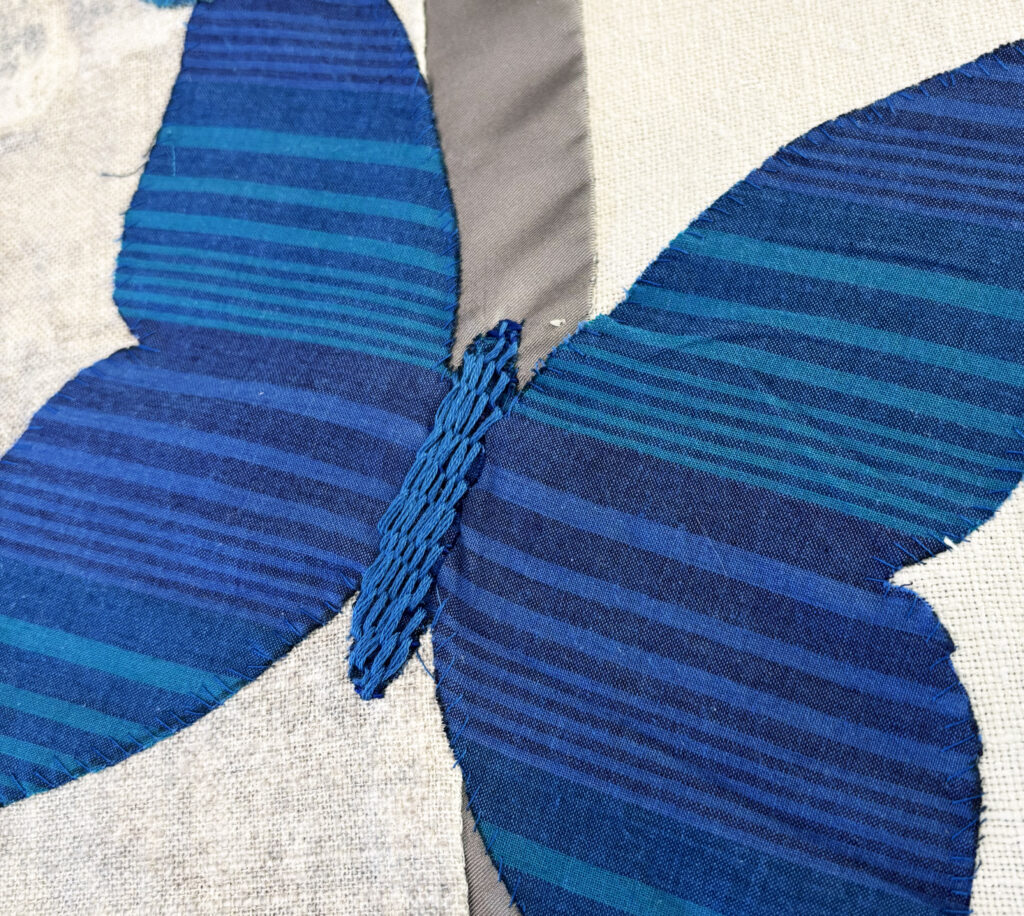
    Everything else was handwork, mostly simple hand appliqué. There were a few small decorative elements. Not too much, that was supposed to be a little special detail.

    I actually found the process of doing the work far more appealing than the design and layout phase. I am reminded how happily I can sit with a needle and thread (or yarn) in my hand. Had I not had a deadline, I would have even found the process relaxing. Had I not had a deadline, however, I probably would not have been doing the work.

    Ahh the contradictions inherent in being human.

    But I did finish, and before my deadline as well.

    I’m not sure I would do it again, but part of me enjoyed the process. I’m not very good at the whole process, but I suppose that is something, like writing, that requires constant practice. I’ve not been doing too well with the writing practice either of late. There is need for improvement, and the desire, so eventually I may pull it all together.

  • February Books, Part 2

    There are only three books remaining from my February reading list and my reading was much less emotionally charged. Hopefully then this will be a much shorter post.

    Two books were re-reads.

    I was a big Anne McCaffrey fan when I was a tween, teen and young adult. I think her first novel, Restoree, came out when I was ten or so, and I read the paperback when I was 11 or 12. I read all of the Pern novels multiple times. I was particularly attracted to her strong female characters at a time when science fiction rarely had complex strong intelligent female characters, and women were often portrayed as delicate ninnies screaming in the corner while men rescued them. That was never how I saw myself, even as a child, where even when very young I dreamt more about rescuing hapless princes, than being rescued.

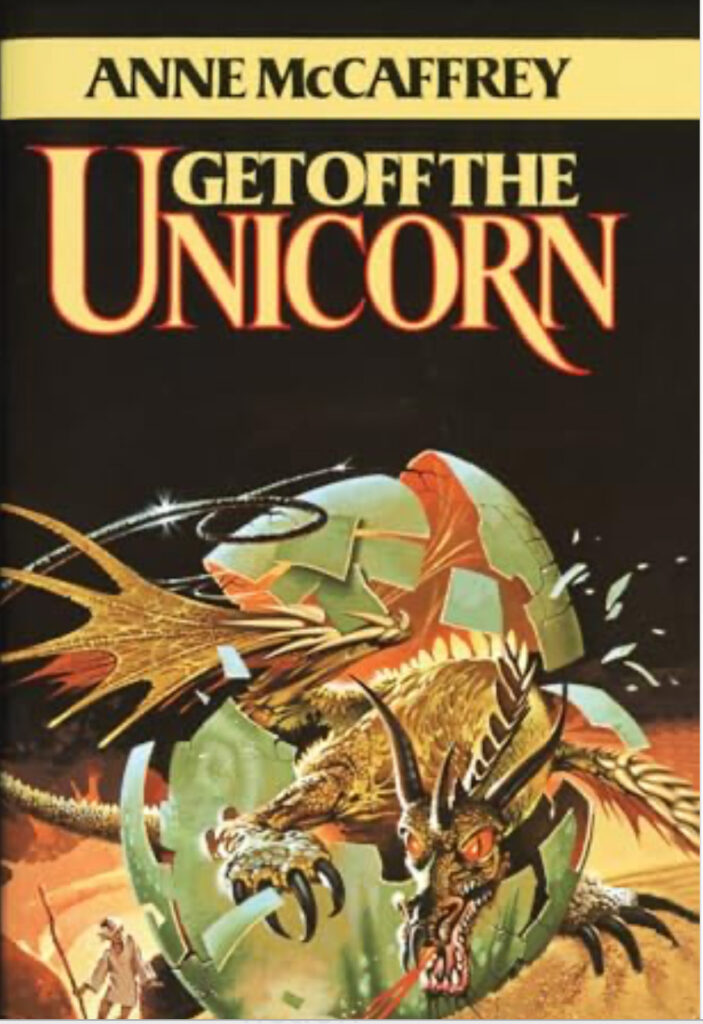
    But I gave all those books away a long time ago, mostly because they don’t always hold up well, and I want to hold on to the memories of what they meant to me as a young girl/woman, more than I want to reread them. I was surprised then when I found this book, Get Off the Unicorn, hiding in my pocket book shelves, and I decided to reread it.

    The book is a series of short stories based on her novels and stories and I enjoyed revisiting places and characters. I almost reconsidered rereading Pern, but have not yet committed to that. I probably won’t. And although this book was fun, there are sections that have not aged well. I’m glad to have reread it, because that allowed me to let it go. I do think McCaffrey made an important difference in the lives of a group of young women, as well as in science fiction and fantasy literature. As to rereading, I am, after all, rereading Harry Potter, and I never had as much respect for it as I did for Pern. (and HP is not filled with strong female characters. Professor McGonnegal is complex, and Hermione is smart, but is also often dismissed as annoyingly freakish, and is laughed at more than she is admired).

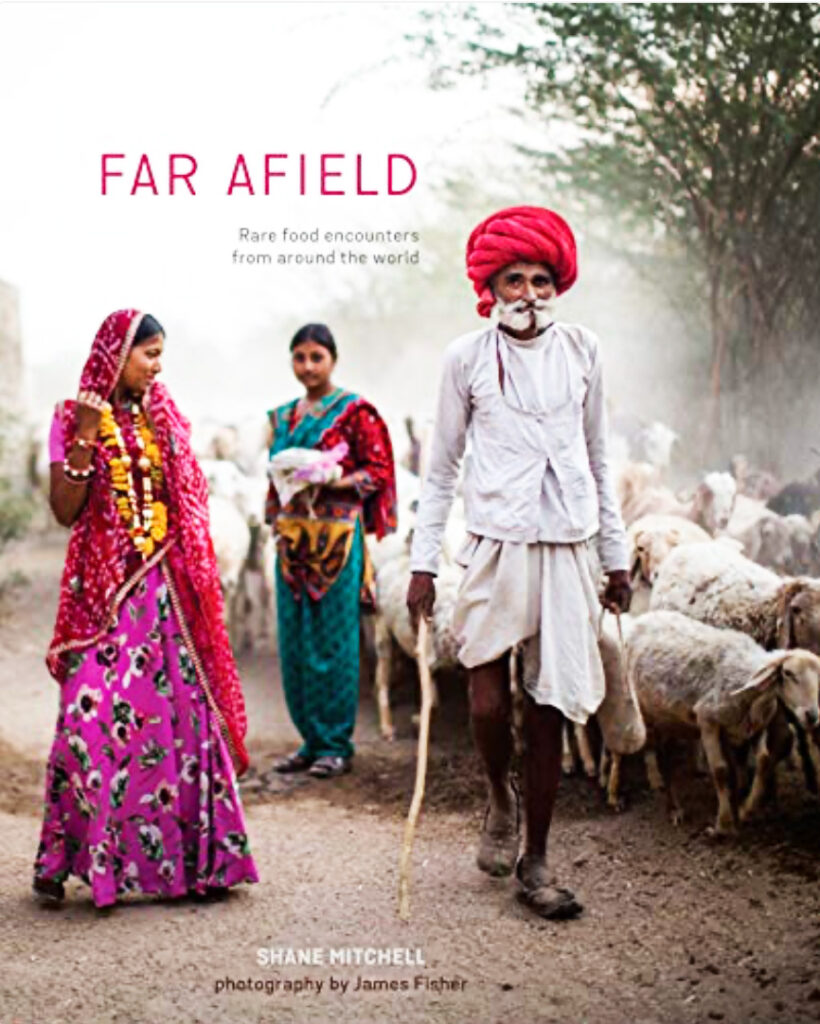
    I’ve owned Far Afield by Shane Mitchell since it was first published. I read it cover to cover then, and have dipped into the various essays over the years. I’ve cooked many of the recipes, although it is not so much a cookbook as it is a book about food and culture and the people who make the food. I was thrilled therefore when the Kitchen Arts and Letters cookbook club chose it for its February 2026 cookbook.

    I was thrilled to read the book again, and I planned to cook several of the dishes, many of which I had not visited for a few years. But February got out of hand and I didn’t actually have time to explore those recipes. I did spend a lot of time with the book, and I was happy to attend a zoom with Shane, who is as smart and thoughtful as I remember her from Vassar. (Where she intimidated me, because I was a shy girl who hadn’t yet learned to break away from the expectation that I would never be good enough. The fact that I remember her so strongly shows the impression she made on me, although she was ahead of me and we did not run in the same circles.) I am no longer intimidated, although I didn’t speak in that zoom, because I wasn’t actively cooking from the book, and others were. You know I will cook from and read the book again and again. And somehow at the moment it has inspired an interest in Somali cooking. We will see where that goes.

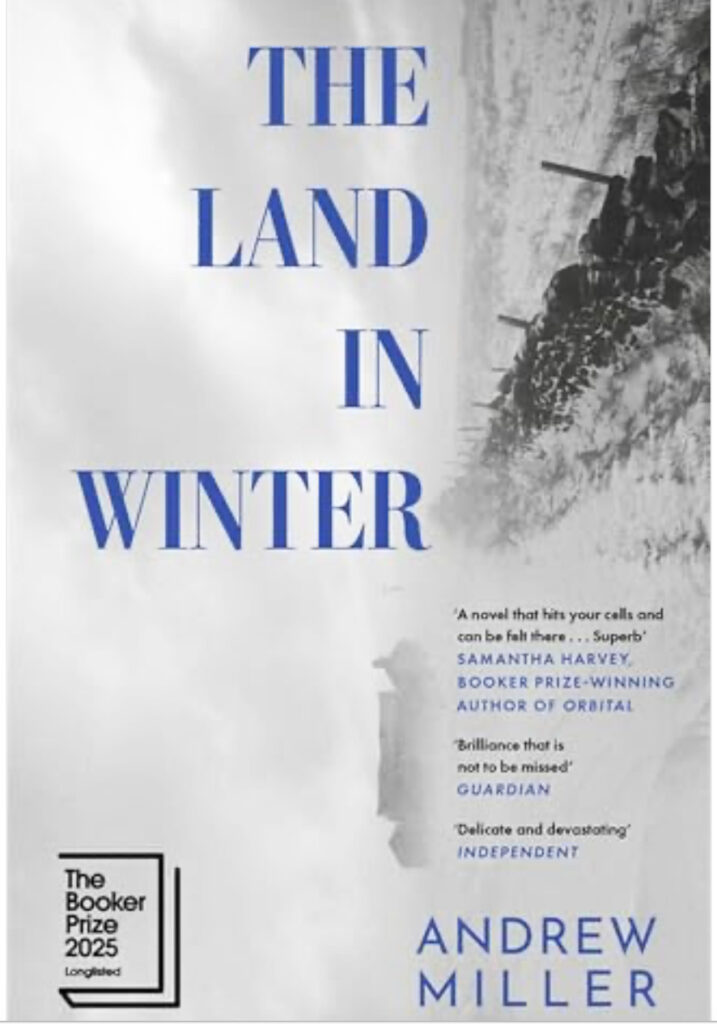
    The Land in Winter was the only new read in the month of February. It is a beautifully executed, and beautifully written work of historical fiction that takes place in the early 1960s in the West Country of England. Surprising to me that I have reached an age where my childhood is eligible to be classified as “historical” or even “antique”.

    I enjoyed the novel and the characters for the most part. I enjoyed the setting, the strong sense of place, and most of the characters, who were complex, different, and ultimately rather engaging in their humanity. The exception was Dr. Eric Perry who I thought was a terribly disgusting piece of work as a human. But alas pleasant and unpleasant people exist in the world and Eric is not the one who dies in the end. Overall I enjoyed the novel; I enjoyed the second part where there were some separate stories involving each of the characters, showing us more of who they were and what made them tick. But it is not a novel that is going to claim a permanent spot in my memory. More complex than genre fiction, both engaging and thought provoking, it remains nonetheless ephemeral.

  • Two Dresses

    I made two dresses in February, or mostly in February. Although I had planned to make them, it ended up being a last-minute, end of the moth project.

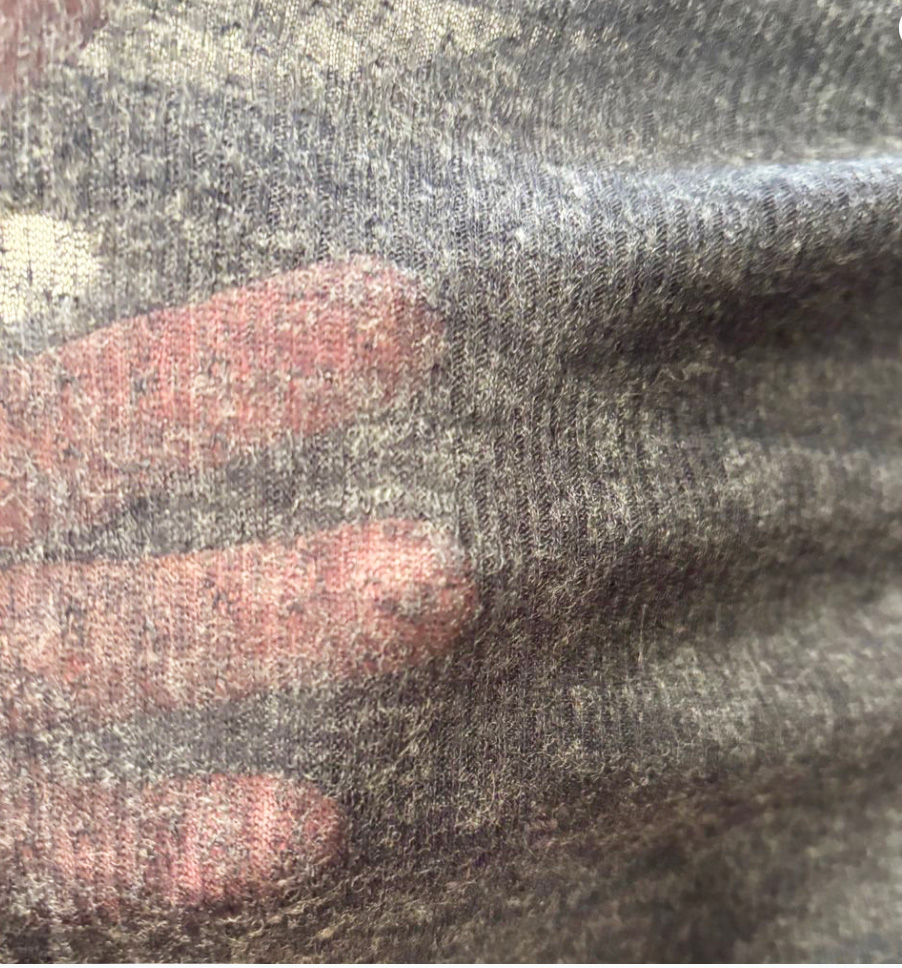
    I had this jersey:

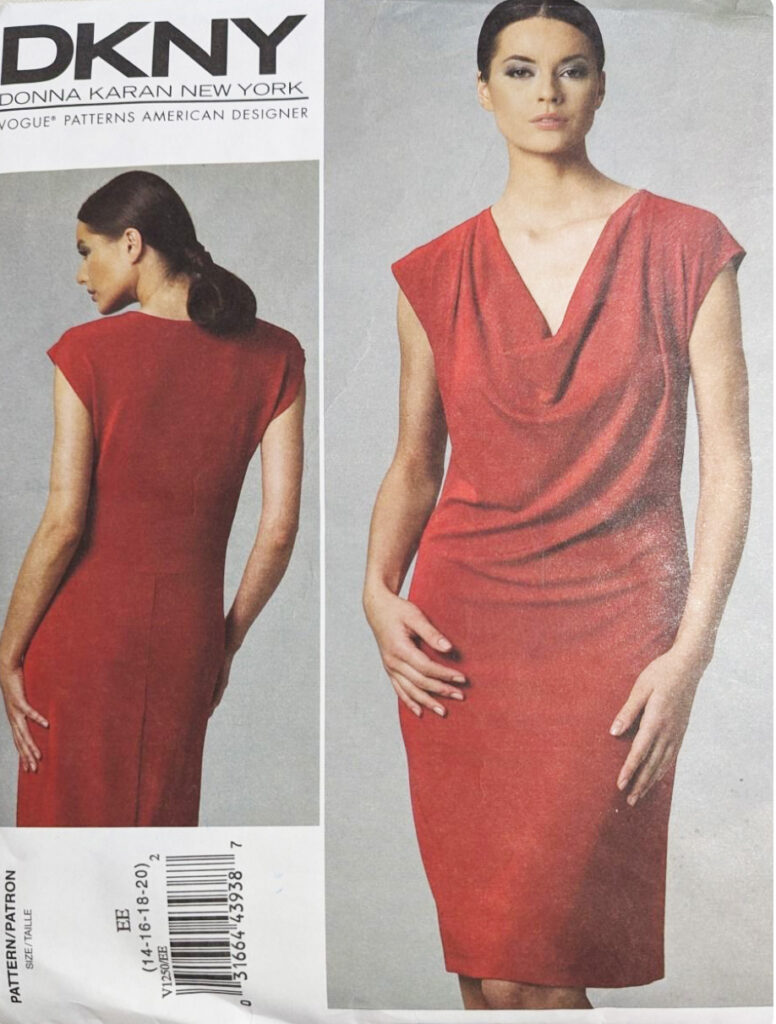
    And this Vogue pattern:

    I had planned to make this dress out of this jersey for some time, but, as usual, had kept putting it off until I found myself needing a dress for an event.

    I decided to make the dress on Friday, for a Saturday evening event (2/28). I wanted to make a long dress, and since I knew the fabric was quite sheer, I also wanted to line it. Luckily I had both the jersey above, and a large roll of black power dry in the stash, so I was set on that front.

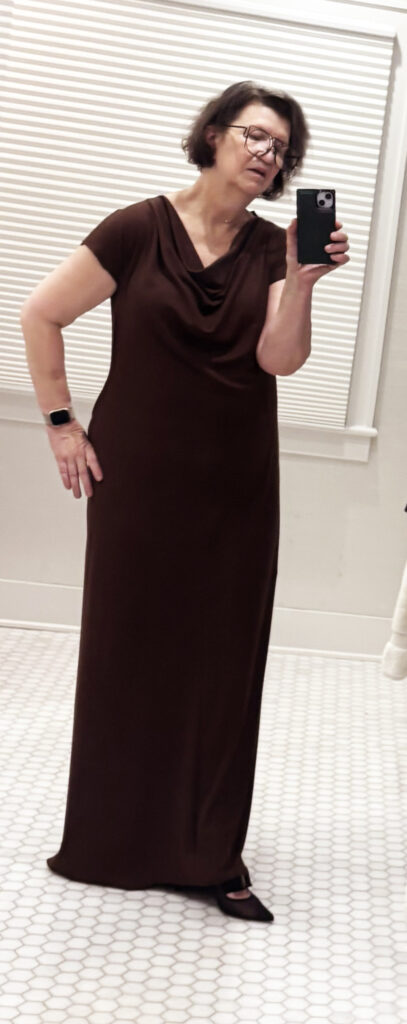
    I did think I needed a muslin. And I also knew I wanted a floor length dress. I also have a bolt of brown bamboo jersey in stash, purchased long ago, when I wore brown a lot more (in those days of “color me beautiful” in which I was often misdiagnosed due to health issues that affected my coloring). I saved the jersey to use as “muslins” for knit patterns, and it worked perfectly here.

    I traced off the pattern, lengthened it, and cut the jersey. The dress only contains two pieces so that was easy enough. And I was thrilled with the results:

    I absolutely loved the brown jersey version. Although this was meant to be a muslin, and I don’t usually intentionally make “wearable muslins” I wanted to wear this dress so I wore it around the house Friday evening, and again Saturday while I made up the actual dress. I decided that I would finish the brown version as well, all that remained was to turn under and finish the back neckline, and the hems. But I didn’t have any brown thread in house. (I had sewed the “muslin” using turquoise thread.)

    Then Saturday morning I started working on the actual dress.

    First I cut the power dry version, which was pretty straight forward. Laying out the micro rib tissue jersey was much more time consuming. This was partly because the fabric was so sheer, it was hard to keep it laid out flat, and also because of the ribbed texture, it kept wanting to pull in on itself. The trick was to get it to lay flat without letting it relax, pull off-grain, or stretch out. Laying out the fabric proved to be the most time consuming part of this dress.

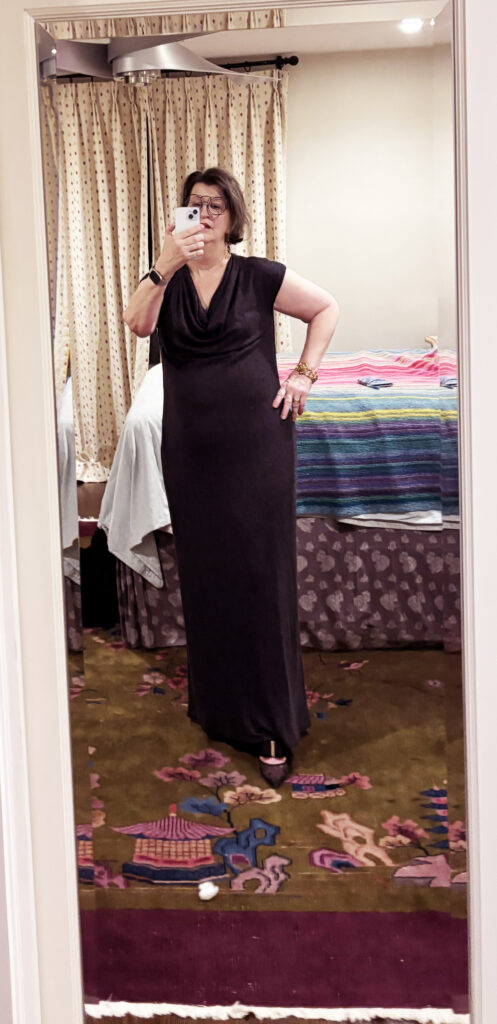
    I basically constructed two dresses and then attached them at the shoulders/armscyes. Then tried them on to determine the hem. The power dry had more vertical stretch than the modal jersey, so it took a couple of attempts before I got it right, but I did finish the dress in time. And I was happy with the results. The power dry added opacity and also tended to gently skim the body rather than cling, taming the rib on the micro-jersey, and giving the dress a nice drape.

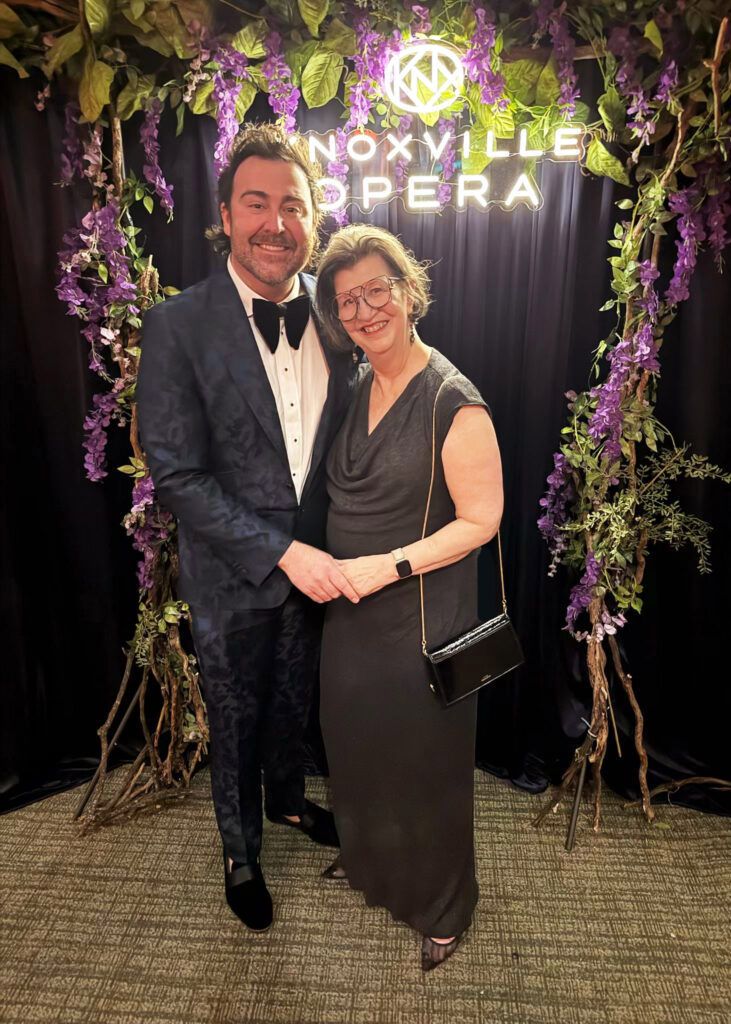
    I was very happy with the results, and I needed a basic evening dress that wasn’t quite as unique and individual as some of my other dresses. I am sure it will get its fair share of outings.

    The next week, while I was out shopping for a different project, I picked up a spool of brown thread and finished the brown dress as well. So far, I’ve only worn it swanning around the house in the evening, and I am quite happy with this dress in that setting. I can imagine wearing it out though with pretty gold sandals and a delicate necklace, or perhaps some funky wood beads, so who knows.

  • February Books: Retro Month, Part 1

    February found me mostly re-reading old favorites and not-so-favorites.

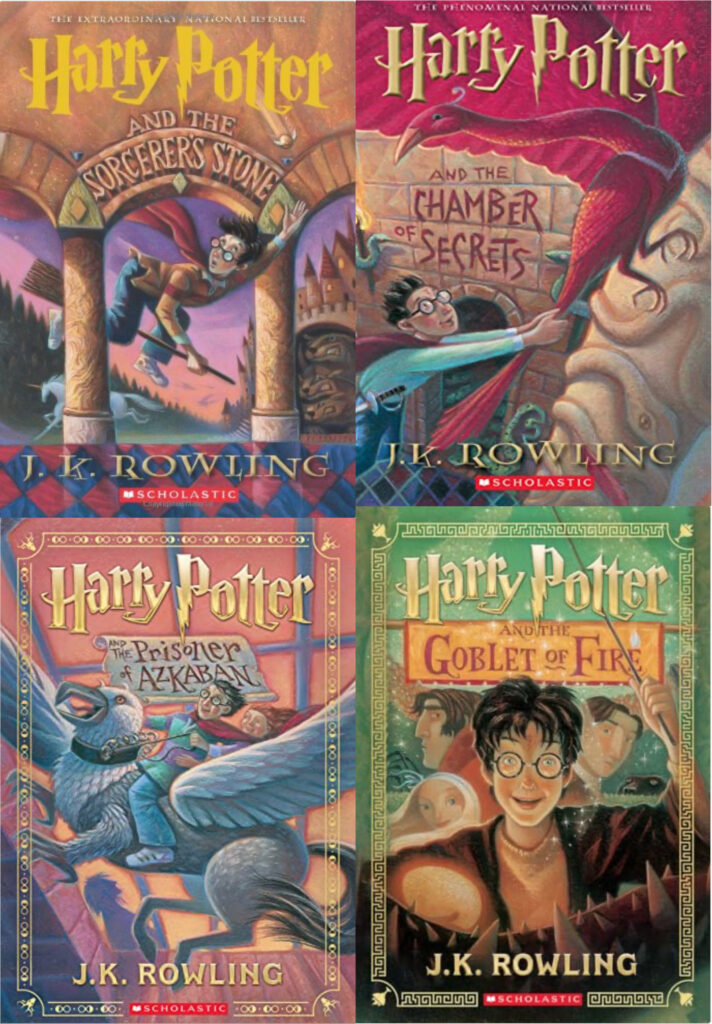
    I started with Harry Potter. I read the first four books, and found them engaging. This is, in many ways a surprising statement because I initially disliked the Harry Potter series, and have long felt like I might be the only person in America who thinks Harry Potter is overrated. Although I did enjoy reading the books, however, the second reading only confirmed my initial impressions..

    Why the reread?

    It seems like the time was past due. Everyone I know loves HP. Even members of my book club, all highly intelligent, educated women, think the HP books are great and inform their children about so much. I cannot deny that Harry Potter has shaped a generation, and whatever my perceptions may be, it seemed that such an influential series was worth a revisit.

    And yet, although I found the novels to be an engaging and easy read, my discomforts still outweigh the pleasures. This raises the question then, of what are my issues with Harry Potter?

    Initially, when the first book came out I was simply disappointed with the terrible writing. Yes, Rowling has a gift for setting a scene, and a gift for the grand story line, but the writing itself, the actual writing, is appalling. Short, choppy sentences devoid of nuance, or color. Book one is written at about a 3rd grade lexile level. It seems like the kind of thing I might have thought was cool, when I was 8 or 9. The use of language is certainly what I might have used at that age. As an adult I find it embarrassing.

    In the first book even the characters and the setting seem like caricatures, something that came out of the mind of a child rather than an adult. The characterizations do become more complex throughout the books, yes, but these are not books where characters are complex or nuanced in the way real humans are, meaning in all the grayscale that makes us human. Here, for the most part, everything is black and white.

    That in and of itself may not be a problem. The early Harry Potter novels are mainly geared toward children. The simplistic writing does make it very accessible, and perhaps contributes to its success, at least in America, where, purportedly, 54% of adults read at or below a 6th grade level. Rowling is British though, and I had hoped the Brits were doing better. The writing does improve a grade level or two, but anything higher is more due to content than actual literary merit. Children aren’t stretched by reading this, and although I could get involved in the story, reading the book as a thinking adult feels more like a delve into infantile fantasy.

    Which gets me to my other problems with the books. People tell me about how much HP exists in the realm of Tolkien, except that it does not. Rowling does, yes, reference Tolkien and many great myths and allegories that have shaped our Western Mind, but neither her world-building. (How I hate word as an aspect of literature, as if we can excuse bad writing because of good “world-building”. World building alone teaches us nothing, we do not grow, we merely escape into fantasy). Rowling’s world is not consistent, it is a bit of a mash-up of this and that.

    The world of Harry Potter is, in many ways, a shallow world. Rowling has taken the British class system and turned it into a world of Wizards and Muggles. Once you see it, the comparison is hard to ignore, even to Americans. The Wizards are smart and creative and the top of the pecking order, and the muggles are ignorant and rather bland. Whether this is class, or race, or political leaning, this judgmental us-them relationship permeates every book, just as it permeates the world in which we live. I cannot blame that on the books, not completely, but the books fully exist in this world. The wizards think they are better than muggles just because they are wizards, but they are really no more open minded or accepting of differences than the muggles they despise. Most of the muggles are portrayed as brutish and crass, uneducated and uninformed. Do you see parallels here? Hogwarts is just a gussied-up British boarding school with all its attendant issues.

    The problem is that the Harry Potter world is so familiar, that we take it for granted. Accepting this world is, in an insidious way, also accepting the cracks and faults of our own world. It is a very conservative world. Potter promotes tribalism (wizards vs muggles), classism and even slavery (house elves, muggles vs wizards, and even pure-blood vs mixed), and even anti-semitism.

    I know I have ventured into a hot topic here. The Goblins in Harry Potter are portrayed using every literature trope that has been used for Jews in Europe and the Western world for over a thousand years. Yes, even Tolkien fell into that trap in The Hobbit, but he did amend his portrayal once it was pointed out, in the Lord of the Rings. Claiming that you are just following literary tradition is not an excuse, and even if it were, it is pretty lazy one at that. We no longer read “Little Black Sambo”, but we don’t see our own blind spots when we read Harry Potter. To tell ourselves otherwise is simply self-justification.

    I suppose my problem with Harry Potter is that it seems fun and entertaining, and even morally uplifting, except that it is not. It is misleading. It is a grand story, and I think Rowling has enough talent that she could have made something more of it. But both Harry Potter himself, and Voldemort, are outside of this world even though the entire story revolves around them. The story has the “right” ending in that the bad is defeated and the good survives. Except that nothing changes in this world. And only Harry can defeat Voldemort, because Harry, for all that he seems like the average guy, also exists on the fringes of this world, partly due to the accident that killed his parents, as well as the way he was reared by his aunt and uncle. The story tells us of how exceptional people change the world, for good or evil, not normal people. The status quo, a world of selfish division continues on unchanged. It relegates the battle for good and evil to the grand exceptions, not to the everyday realities of life. Once Voldemort is vanquished, life goes on, unaffected and unchanged. Reading Harry Potter, I fear, does not lead anyone to want to change the world, but rather to settle more comfortably into the world as it is, flaws and all.

    If the Harry Potter series has shaped a world, and it has, I am worried. Not that there are not good role models and characters in the Harry Potter series because there are, and there is some moral depth, but there is far more moral conformism and acceptance of the status quo. I will probably finish rereading the series, but for now I need a break to soothe my soul.

  • On the Knitting Front

    I’ve finished two baby blankets, and started a new project for myself.

    But first the baby blankets.

    My brother and his wife are looking forward to the births of two new great-grandsons this spring. I decided to contribute blankets.

    Both blankets were knit with Lion Brand Mandela yarn, which I used to be able to buy locally but now have to purchase by mail order. Although I ordered the yarn in late December, it didn’t really arrive until January.

    The first blanket was knit using two skeins in the color Spirit, No. 212. I decided to knit beginning with the skein ending in the lighter color, with the darker color being in the middle. I really wasn’t sure of how this would work out, but in the end I was happy with the result. I used the pattern “My Favorite Baby Blanket” by Alicia DeHart.

    This blanket moved along pretty efficiently, I finished in early February, so it took me nearly a month, and I was happy with the result. I was also happy to that I enjoyed knitting this yarn and my thoughts were filled with dreams of knitting other blankets, or perhaps returning to prayer shawl knitting.

    For the second blanket, I chose two colors of the same yarn. This time I used #267 Doxy Doxy and #276 Moomba.

    I had planned to knit this blanket using a different pattern but I changed my mind at the last minute thinking it would be easier and faster to use the same pattern. I miscalculated. I had hoped to finish blanket 2 by the time I was in Texas for my mother’s 90th birthday on February 20th. That way I could leave both blankets with family. I knew this was unrealistic, as February was a very busy month, and yet I tend to harbor wild expectations for myself, imagining myself to be some kind of superwoman who bends the rules of time. Alas, not at all true.

    The blanket was progressing quickly and easily and I was enjoying the changes in the colors. And then l I hit a glitch. In the skeins I received, the band of bright yellow appeared on both skeins in the exact same place. I figured I could just get away with it, and so I kept knitting. But no. I felt an intense dislike for the growing patch of bright yellow, which was not even at the mid-point of the blanket. I had to rip.

    How often do I do this, move forward knowing full well I will end up ripping out? Too often. The other blanket pattern would have given me more leeway with manipulating the colors, so I was doubly pissed with myself, both for not sticking with my original plan, and for knitting when I knew I shouldn’t.

    I cut the yellow out of one skein, figuring I would add it back into the progression later on, which I did. The combination of yellow and white was not my favorite stripe sequence, and it still jumps out at me, but it is a minor point, and I can live with it. I ripped and reconfigured as much as I felt I could tolerate at the time. Still my knitting slowed until I reconciled myself to my own annoyance.

    I did finish the blanket however, and before the end of February, but not before I came home to Tennessee. Actually, it too took less than a month to knit, even with ripping and reuniting. February is a short month but the knitting felt endless. At least I am happy with the final blanket.

    I do think I will use this yarn again. And I might well use it for a prayer shawl or two. But at the moment I need some selfish knitting. so I’ve cast on for another project.

    This is also pretty mindless knitting. The yarn is Noro Ohajiki, the is pattern is simple, using “old shale” or “shell stitch”, which is easy to remember and as close to mindless while still being interesting that I can imagine at the moment. I’ve got. some other big projects underway in the studio and a couple of deadlines, So this is a deadline-free project.

  • First Daffodil

    Garbo and I walked outside this morning just as the sun was cresting the horizon. The air was filled with joyous birdsong. Then, as I rounded the corner of the front walk I saw my first daffodil of the season. Not the first daffodil, they have been all over the neighborhood, but the first daffodil blossoming in my yard.

    I was elated.

    I didn’t spend any time in the garden in 2025 due to back and leg muscle issues, a fall, and other things. In fact it has been over a year since I’ve been up to garden work, and it thrills me no end to see that anything survives my neglect.

    Oh, I came home from Texas in late February to find the camellias in bloom. They are still in bloom. I can count on them beginning in late February. And the hellebores have been out for a few weeks as well.

    But the first daffodils are harbingers of hope. I am behind. I am always behind but there is also always hope. Sometimes I just need to be reminded. The small joys are often the best joys anyway.

  • January Books

    Why. do I still have a love/hate relationship with book posts? I’ve been struggling with this one for a month, and I know the problem is all in my head. It has reached the point where I don’t think I can write anything unless I get this post out first. So here goes.

    I opened the month with Colwill Brown’s debut novel, We Pretty Pieces of Flesh, and my complicated feelings about this novel in particular are the reason I have not previously managed to write this post. As a debut novel, I think it is brilliant. The author’s technique of using written phonetics for South Yorkshire accents added a lot of color and brightness to what is otherwise a very sad, traumatic and dark novel, filled with violence, about girls growing up with few prospects, girls who, unlike the popular fictional trope, do not escape. I get that this specific place, and certainly this time — the 1990s, possibly early 2000s, does not correspond to my experience but I can still viscerally feel that anger and longing that fuels these girls — anger at being objectified, longing to be desired and loved. The wall of misogyny that surrounds these girls drives me to despair. Yes, it is specific to time and place, but it is also universal. I am fortunate to live in a highly educated privileged microcosm of society that sees only the fringes, and it is good to be reminded that in many ways my world is a small subset of what is experienced.

    I am glad I read this book. I do not want to read it again, which for me is a criticism. I am a person who thinks readers form relationships with good books. Not this book, not for me. It is ambitious, compelling even. I don’t need a happy ending. But on some level the novel failed to carry me along; the novel became boring, trite, accepting. This may be the state of the world; it is not what I want from my literature.

    Luckily for me, I adored Bryan Washington’s novel, Palaver. I found the story much more compelling and satisfying, if not perhaps quite as technically dazzling. But I do not actually read books for their technical qualities. Washington also takes risks here. The novel is the story of two characters, a mother and son, referred to throughout the book as “the mother” and “the son” even though every other character in the novel has a name. The pair have a difficult relationship, and they have not been in contact for a number of years, not until the mother feels compelled to visit the son in Tokyo. They have trouble connecting, not only with each other here, but I increasinlgly think, as I read the novel, with themselves. Washington uses their inner musings, as well as their interactions with others (named) and with food, to explore their relationship. They are like two ships, two people who, despite their blood relationship, seem to have no shared culture or even language in which to communicate. I get the impression that this disconnection is not what drives this novel, but rather the way that we bridge the gaps between us. Thus the use of two separate spheres of influence, two unnamed characters and the way their circles overlap, as they learn to know each other, and in a very real sense themselves. In the end our two protagonists begin to grow into a new relationship, beyond the parent/child relationship which has defined much of the novel. It is an interesting path, a good one, and one that often does not develop. It is hard to see our parents, and our children, as the people they are, apart from the parent/child relationship. I think Washington explores this process really well. I initially read Palaver last November, and think it stands up well to rereading, revealing more with continued acquaintance

    I needed the relative “lightness” of Palaver, because at the same time I was continuing to work my way through Gertrude Stein Writings: 1903 – 1932, which I finished late in the month. I can’t say that I enjoyed everything in this book, but I am glad I read it. Many of the specific works were rereads, but not all of them. I actually read QED, The Autobiography of Alice B Toklas, and several of the shorter works in December, and aside from stating that I still feel, as I did in college, that the Autobiography is the least interesting thing Stein wrote. I can see why it brought her fame. I think I appreciated Tender Buttons more today than I did in my 20s, mostly because I’ve learned to just let the language set its own pace in my heart, and stop fretting over what it might “mean” and, as a corollary, whether I am smart enough to understand it. I also now think “Melachantha” is the strongest and most powerful part of Three Women. To write a story from the perspective of a black woman was ground breaking enough, even if Stein was not black. But by doing so, this highly educated and ambitious Jewish lesbian woman was able to explore what it means to be separate, and different, and on the fringes of society. I think I still have a lot to learn from Gertrude Stein.

    I ended the month by reading Han Kang’s 2025 novel We Do Not Part. As expected I was drawn in by Kang’s intensely poetic prose, its strong humanity, and her masterful use of metaphor. If you have not read any of Kang’s previous novels, I think this one might be the best starting place. Kang she explores not only Korea’s dark history and the terrible things humans inflict upon each other, but also the humanity of people, and how simple acts of human care, kindness, and shared suffering also keep love alive. Kang’s novels are not for those who do not want to bear witness, who insist on believing that humanity is better than it is, but she also shows us the beauty in sharing our past, in shared connection, and how we can be stronger, and perhaps even more loving, than we might ever have thought.