I go through phases of more practical and functional cooking and then phases of play, when I explore some cookbook and recipes otherwise unfamiliar.
In March I was cooking from Kusina by Woldy Reyes, a vegetarian cookbook inspired by the author’s Filipino heritage.
There was some necessary prep work:
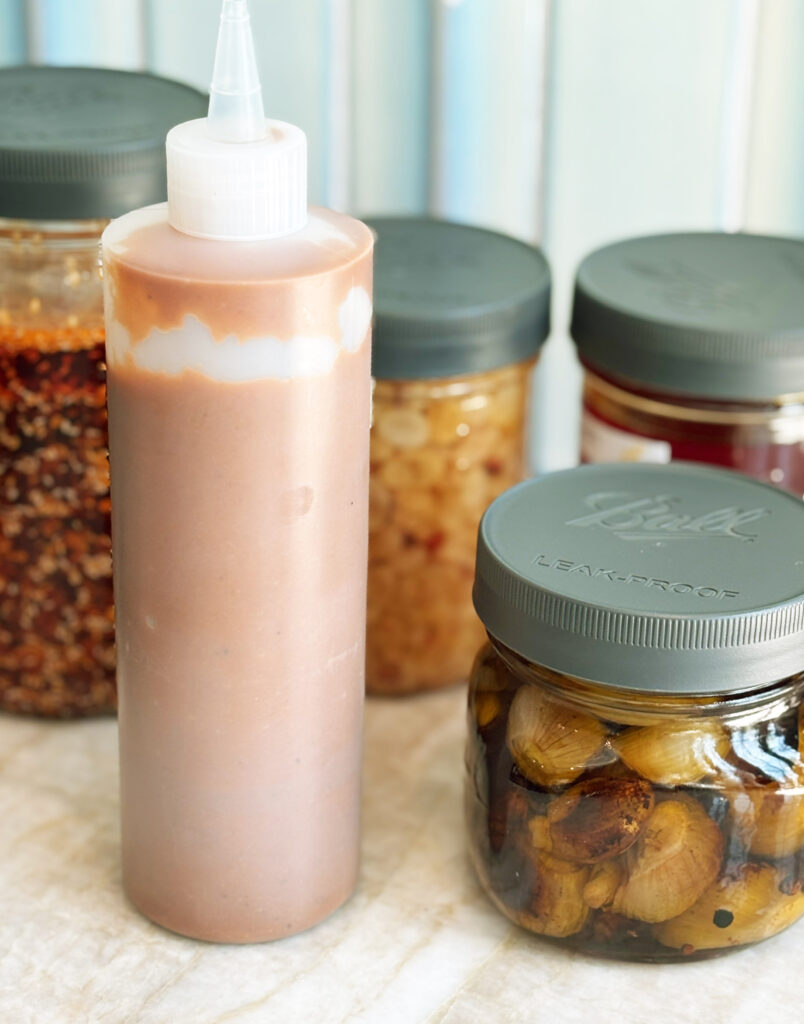
I started with some Annatto oil (jar at back right) which was needed for the banana ketchup (front left in the squeeze bottle). The annatto oil was from Memories of Philippine Kitchens, by Amy Besa and Rory Dorotan. I’ve cooked from this book before, and the annatto oil is useful in many ways. Woldy Reyes has a recipe for gussying up commercial banana ketchup, but I started making my own some time ago when I couldn’t find a version I liked and didn’t taste too sweet/chemically in local stores. This may be why Reyes gussies his up. My own recipe works off a base I found in the Adobo Road Cookbook by Marvin Gapultos, which was the first Filipino cookbook I bought, many years ago. That recipe has been modified by ideas found in Snoop Dog’s Goon with a Spoon cookbook, and ideas from Filipino food blogs (use of the annatto oil). From Reyes’ book I will probably change the base recipe again, using chili paste for heat rather than the finely chopped jalapeños I have used in the past. Banana ketchup is a sweet/spicy condiment that I actually use more than tomato ketchup, or at least more than commercial tomato ketchup. When I bother to make my own tomato ketchup, that might take first place for use.
Did you know American’s used to eat a wide variety of ketchups, made from a variety of ingredients? That was before Heinz began mass-producing the tomato ketchup we know today, after which market forces, rather than expanding our options, actually narrowed our palate.
Also in the picture above are chili oil, pickled golden raisins, and confit shallots. The pickled golden raisins are bright, tart and sweet and completely different than middle eastern pickled golden raisins I’ve made previously. The confit shallots are also probably something that will frequently appear in my fridge. Reyes chili oil however is not my favorite version of chili oil, but I will use it up. There seems to always be a need for chili oil.
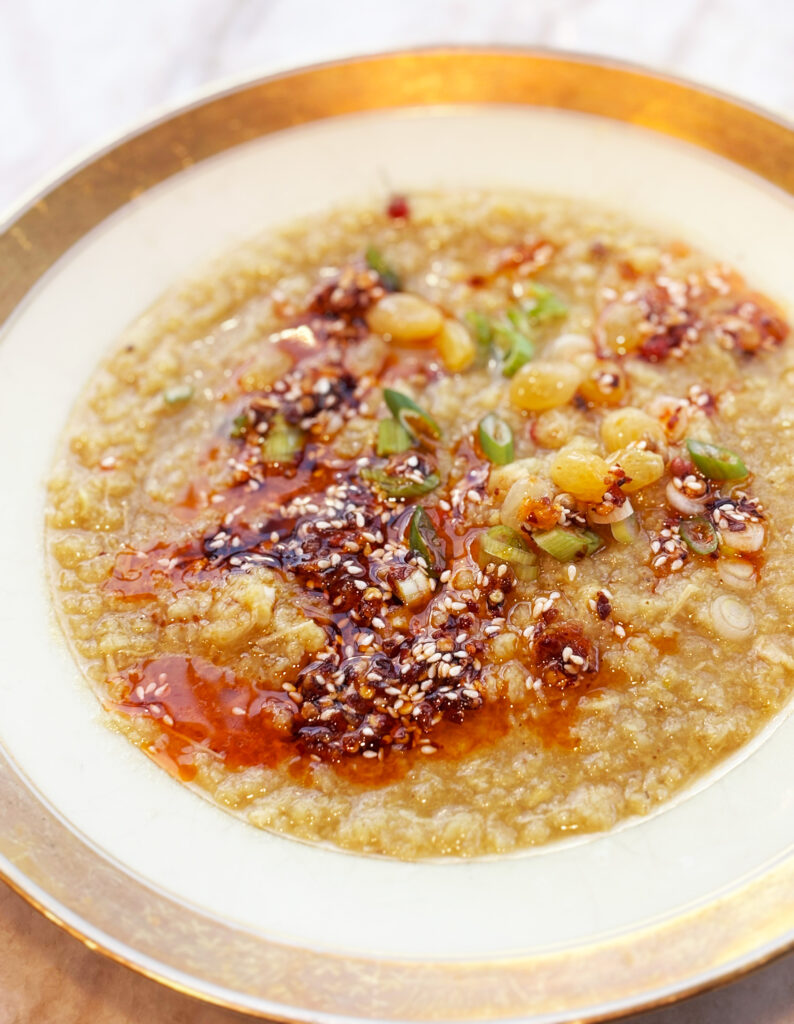
Speaking of those pickled golden raisins. They were fabulous on a bowl of Lugaw, which seems to be something of a filipino version of congee. I prefer my house congee, but I like the idea of the combination of chili oil (whatever version I have on hand) and the sweet/tart raisins as condiments.
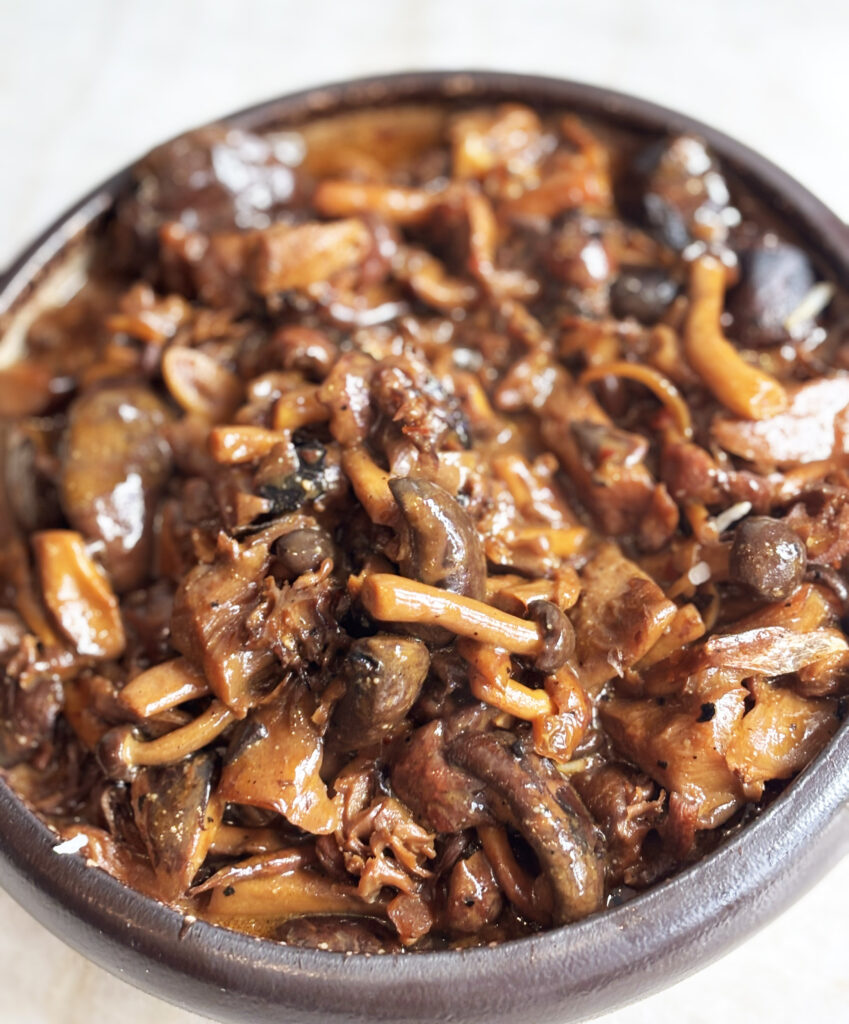
This is a Mushroom Adobo. It is vegetarian and I used a mix of king oyster, grey oyster, shiitake and cremini mushrooms which gave the dish a complex flavor. What was surprising was the use of coconut milk, which I found gave the dish a fabulous richness and complexity, perhaps a bit softer than more traditional adobos. Reyes says this is best immediately, but I actually liked it better the next day when it was perhaps not as bracing but the flavors had melded into something utterly compelling.
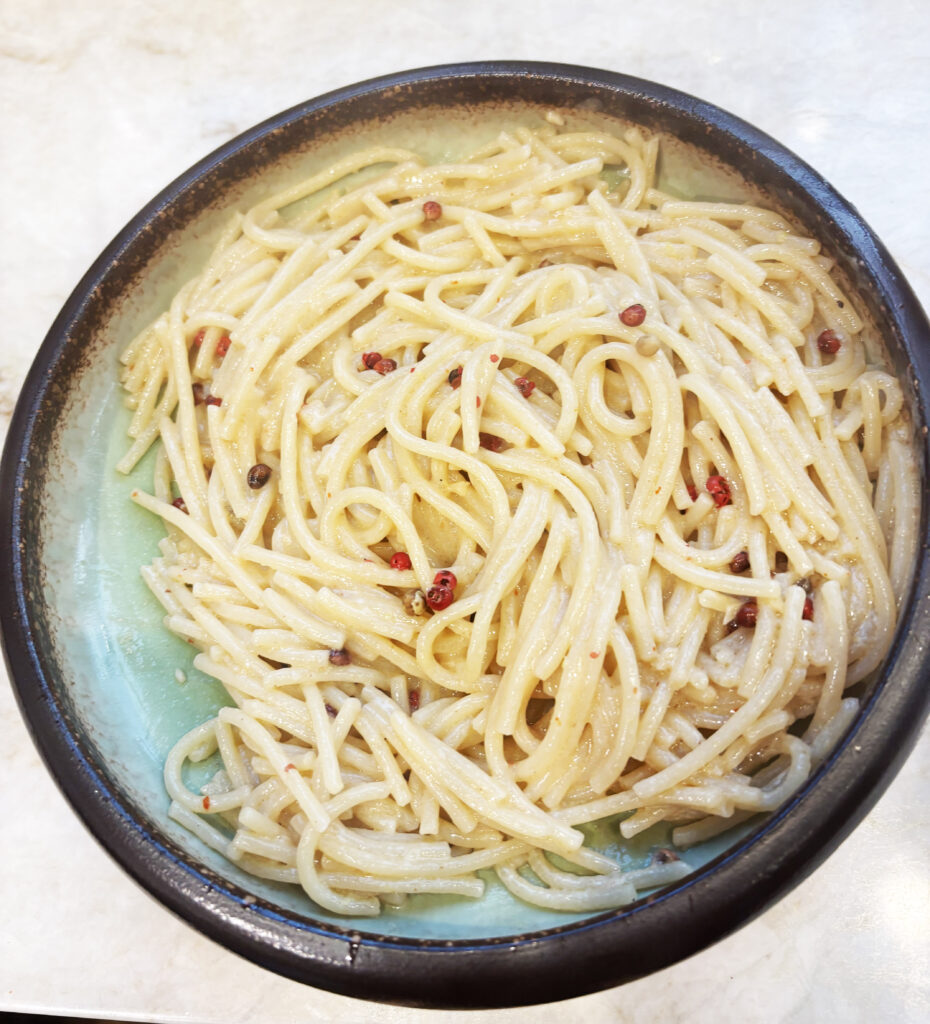
Above is a photo of Miso Coconut Pancit, a noodle dishes that uses Bagoong. I used gluten-free spaghetti here, and Reyes’ comment that he would call this “filipino Alfredo” is apt. The coconut milk and bagoong give this a creamy, subtle yet umami-rich flavor that I found very appealing. I don’t usually think “subtle” in terms of filipino food, at least that has not been my experience, but what do I know. I love the bright fruity pop of the pink peppercorns here. In fact, I used more pink peppercorns in March than I have in the previous two years.
Bagoong itself is usually made with shrimp and it has a deeply funky, salty, umami flavor. This vegetarian version does as well. It makes a large batch so I tried freezing the extras in small cubes. That was perhaps a mistake as it is rich in oil and getting them out of the freezer trays was a mess. Next time I would freeze it in small jars which I did not have to decant. Some of the oil did separate out, but not much. The recipe did call for a lot of oil. Many people in my cookbook club said it was too much oil and they cut the quantity in half because they had trouble getting it incorporated into the rest of the mixture. I had no real problem with that, the process felt much like making mayonnaise, although there were no eggs present. I’ve whipped olive oil into a cream before, so this was not much different. I think the texture was somewhere between a pesto (before you add the cheese) and a mayonnaise. I do think it would be a completely different condiment with less oil but I might try it sometime. This is excellent, and I am glad I have it, but I’m not sure I would use it frequently enough to just store it in the fridge, at least at this point. Who knows though, I might just go on another filipino food trek one of these days.
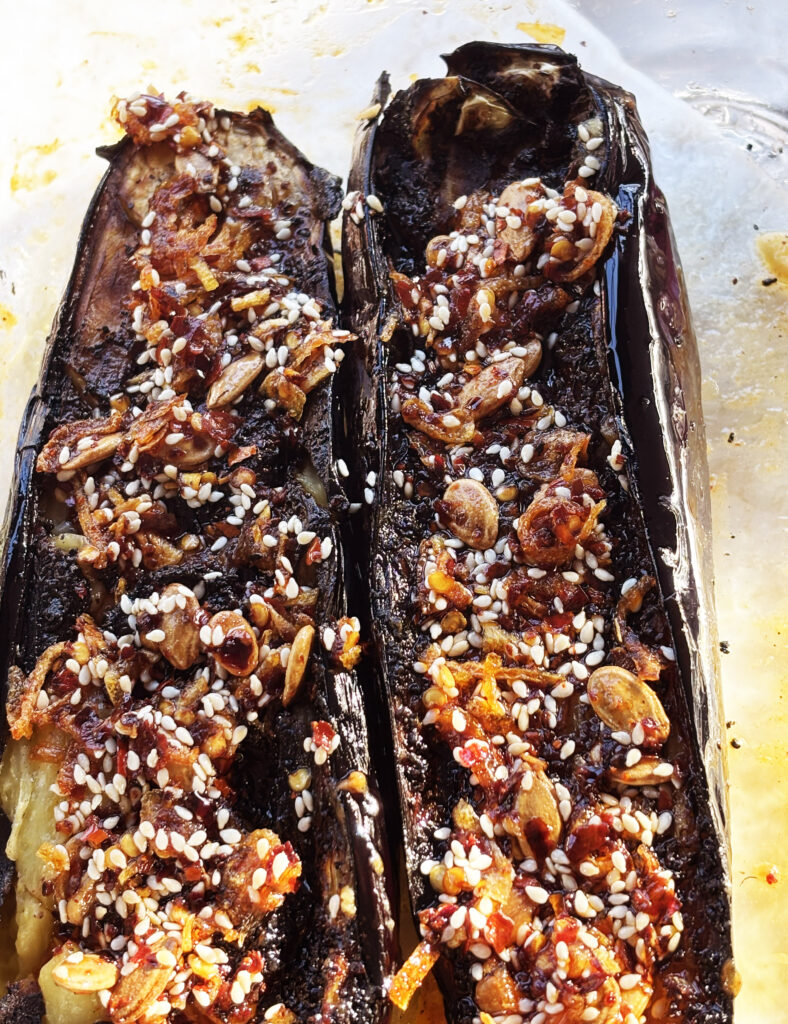
This dish, with eggplant and chili oil was my least favorite dish of the group although I don’t really think that was the fault of the recipe per se. My out of season eggplant was bitter. I used small globe eggplants from the grocery store, and I would have been better served to go to either the Asian or Indian markets, and purchased a different variety of eggplant, as they both tend to have outstanding produce, better than my local grocery stores by a wide margin.
As I mentioned earlier, I’m not particularly fond of Reyes’ chili oil either. Mixed with the bitter eggplant it did not shine. I turned the leftovers into a kind of fusion layered eggplant, ricotta, and ground lamb gratin that worked beautifully though.
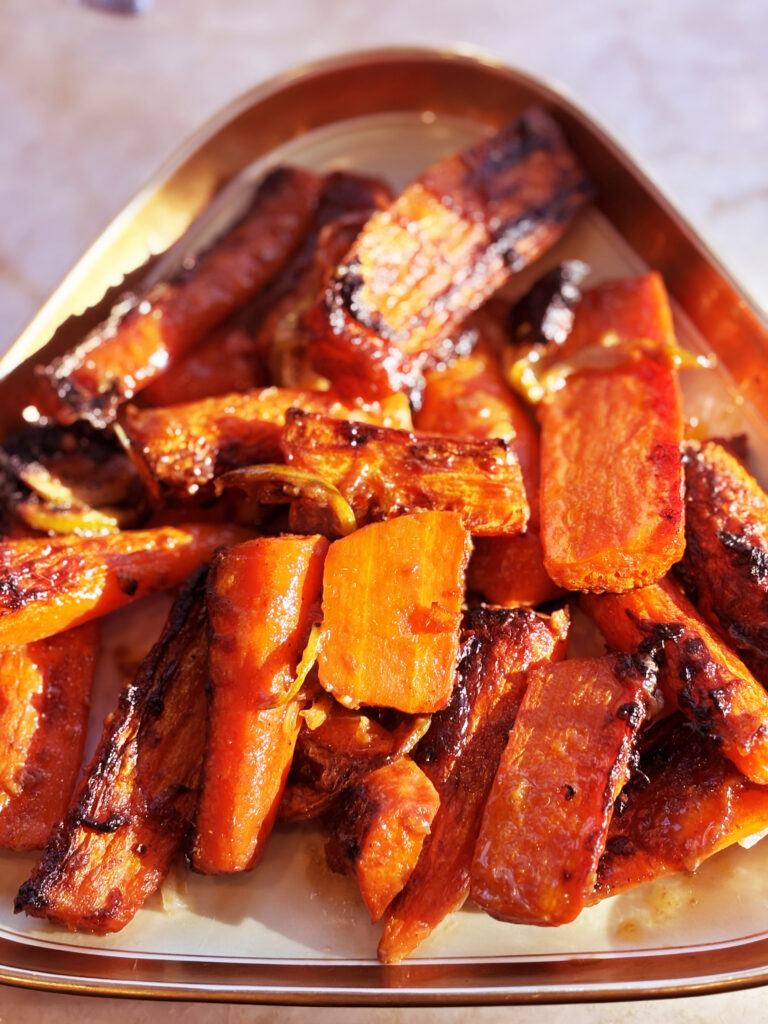
I love roasted carrots and these roasted carrots with banana ketchup and limes were no exception. The only was the issue is that the recipe states that one should slice the limes (whole unpeeled) very thinly, and they were charred beyond recognition before the carrots were even fully roasted. Next time I would roast the carrots about half-way through, and then stir in the sliced limes. I might be added sliced limes to other roasted vegetables as well.
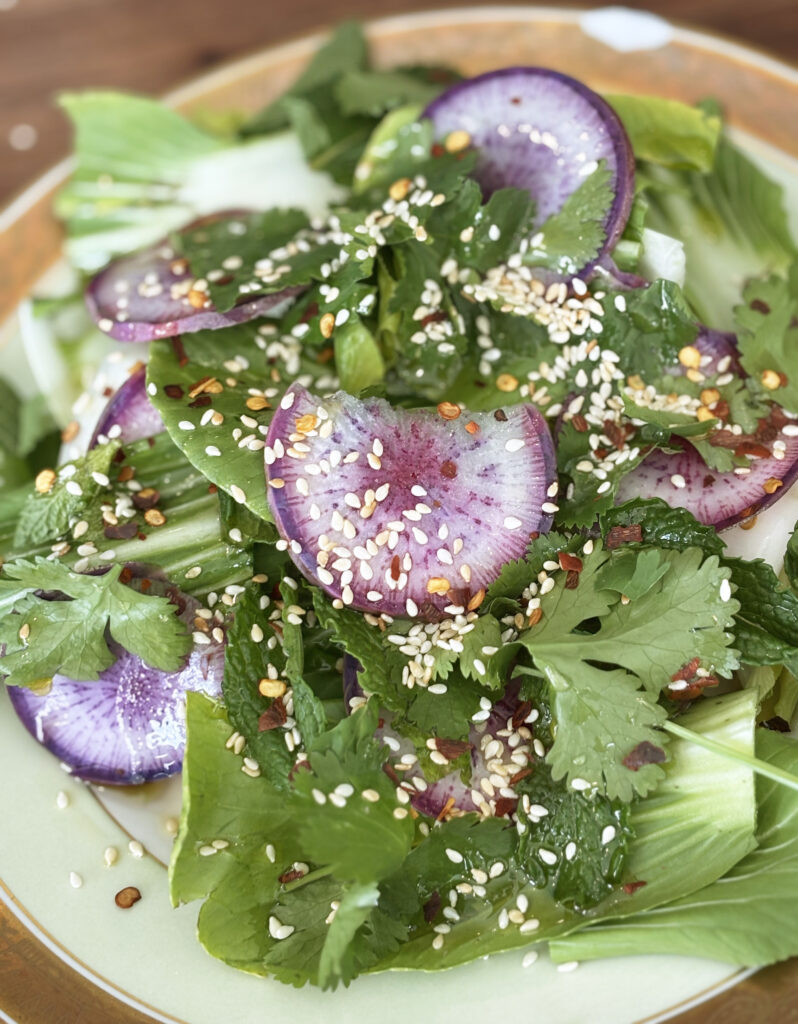
This was my favorite dish from the book. It is visually stunning and fabulously fresh and flavorful. The recipe called for purple daikon, but I rarely see them in the market. When I did find the purple daikon I had to make the salad. I would never have thought of the combination of bok choy, mint, cilantro and daikon in a salad but it was excellent. I will not forget it. The addition of pumpkin seeds and sesame seeds was perfect counterpoint, and although the dressing was good, I think this would work with any light vinaigrette that leans tart.
Overall this was a fun book to explore, and although I admittedly had doubts upon my first reading, I ended up loving it. I am surprised at how that happens sometimes, that a book I would have never chosen on my own become a favorite. At the same times occasionally books I am looking forward to disappoint. I suppose this is one of the reasons I adore my cookbook clubs, and time to play. I learn new things, my taste evolves, I suppose my entire perspective evolves.