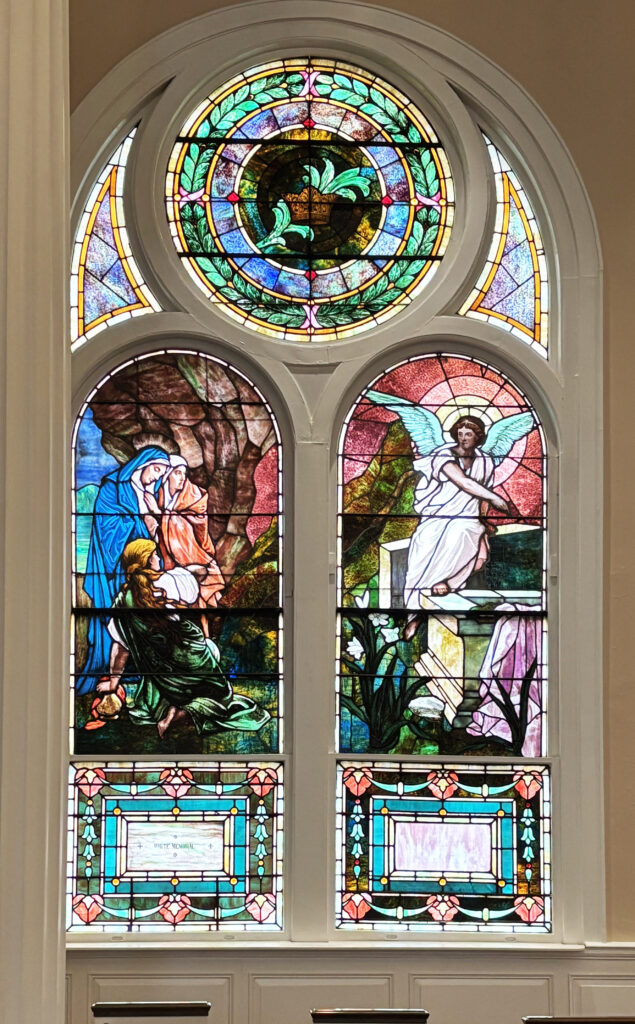
Last week I had the privilege of attending a program on the history of the stained glass windows at First Presbyterian Church Knoxville. The window above was designed by Flora Macdonald.
I like stained glass, but I don’t often think about stained glass. I used to own a little stained glass panel made by an early boyfriend. Somehow I don’t have that anymore; I hadn’t thought about it in years. George designed a custom door for our house in Hyde Park and it included stained glass windows inspired in part by the work of Frank Lloyd Wright, but the window design was all George. That door was beautiful, but it was in a previous house, in a previous life. I wonder who owns that house now, if that door is still there.
I tend to think stained glass windows and churches go together. Certainly there is a long, strong history of putting stained glass in churches. My own church has many stained glass windows although truthfully I don’t think about them much.
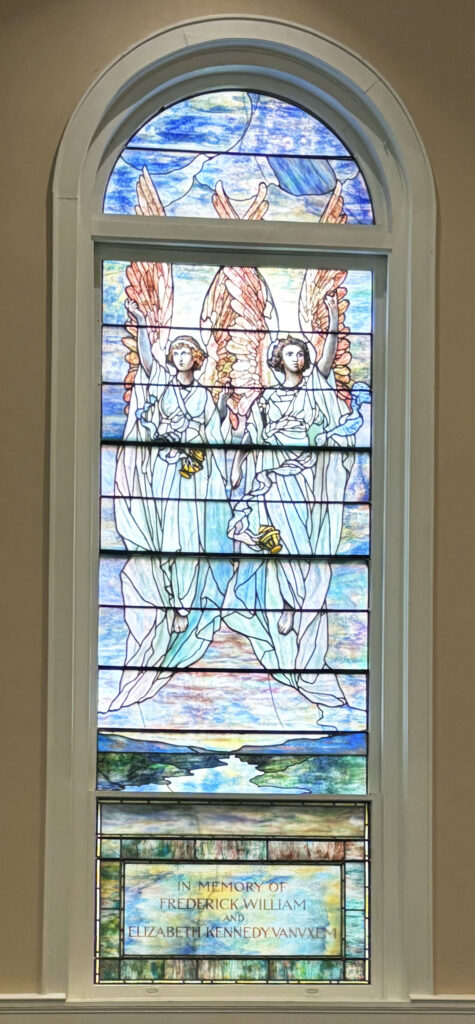
Because this isn’t my church, because I was attending a specific program, I actually looked at, and thought about, these windows. The windows span the church’s history, and there is a variety of styles, which I do find interesting because one of the subjects I constantly find fascinating is the subject about the ways humans interact and worship the divine. Churches often are, and this seems to apply to stained glass windows in particular, as much about ego and hubris as they are about faith and submission to God’s divine plan. This may not be the lesson the tour was intending to plant in my mind.
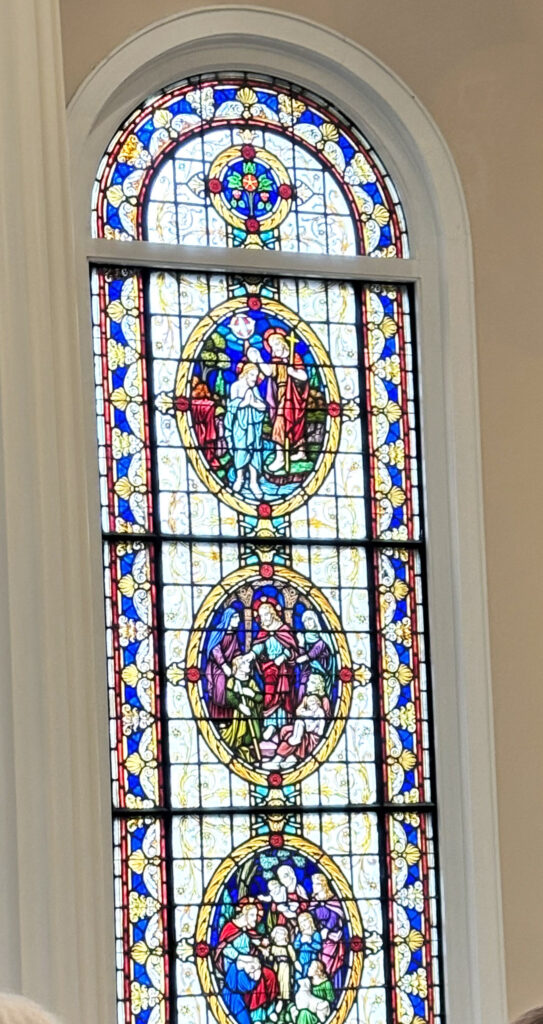
But what has remained with me is not so much the windows themselves, although they are beautiful, but the light. If I were just looking at the windows as art, I can admit to being drawn to the windows by MacDonald (top) and Tiffany (second photo) and not so much to the window above. But when I am thinking about light and how the light shapes the space, it is these windows, the ones like the third photo that really capture my attention because they allow light into the space and the light that enters harmonizes with the space nicely.
I like light in places of worship. Not necessarily glaring light, but light. Light that shifts and glows and reveals itself in ways that reminds me of the shifting ways that creation is revealed. Not all stained glass windows do that. I can’t really say much about these windows, as I saw them on one overcast day. Usually I have been in that church at nighttime, where the light through stained glass is irrelevant. I do know that the window that sparkled the most that day, the window filled a space with a welcoming glow, was in an alcove but not in the sanctuary itself. I did not take a picture, but I do not need a picture to remember how that light invited one to sit and tarry, to share a moment or a conversation.
I am quite happy I went on this tour. It was both special and mundane: windows in an ordinary church; windows filled with the history of that church, a very human history. I think the tour itself will stay in my mind for a while, as seem obvious since I am still thinking about these windows ten days later. I’m not thinking about the windows themselves although the windows are integral to the thoughts they engendered. I am thinking about light and darkness, appropriate now as we head into winter. I am thinking about faith, and pride, honor and doubt. I am thinking about hopes, dreams, ambitions and the consequences of every little ripple. I am thinking that as vast and important as all of the ideas seem to me in this moment, in this day, in this month, in this year even, they are all but a spec, a tiny mote, inconsequential in the universe itself.
These windows. This Universe. All contained. Simultaneously hidden and yet revealed in each and every moment.