Author: 459856pwpadmin

  • Standing

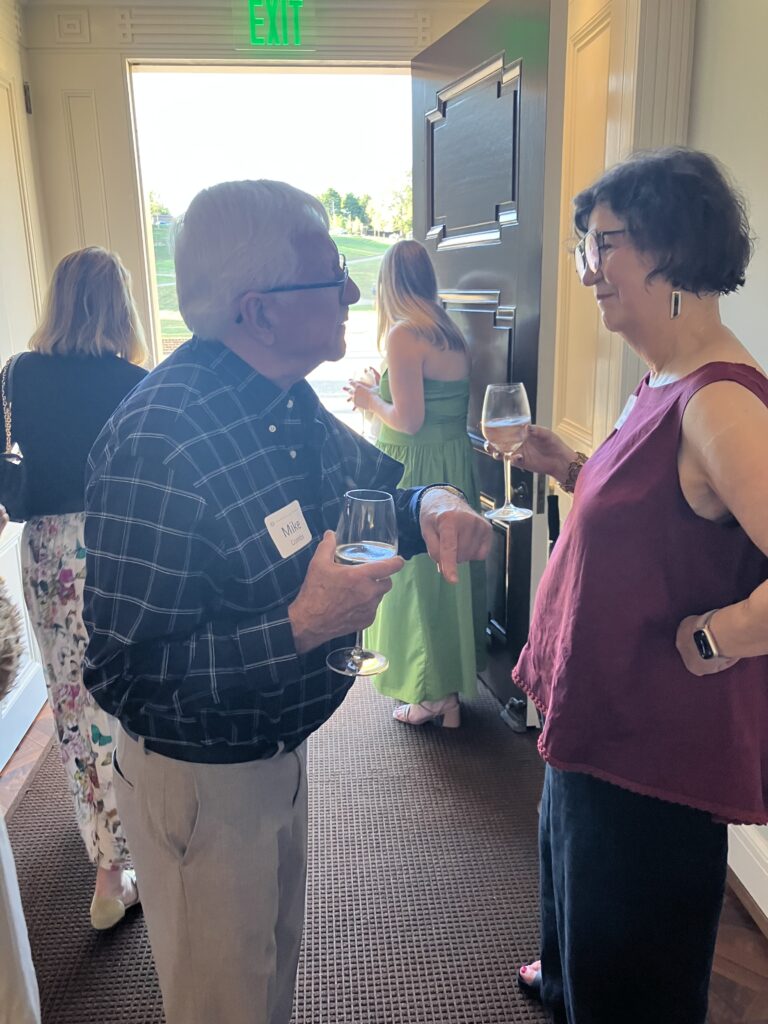
    A friend took this photo of me at a party Thursday evening.

    It has thrilled me to no end because I am standing straight. This feels like some kind of combination of a miracle and a profound achievement.

    Six months ago. I was not standing straight. I probably hadn’t been standing straight for a long time, but by that point, late April and early May, it had reached a point where even I could not ignore my own disability. I could not stand for more than 5 minutes, often no more than 2 or 3 minutes. I often had trouble walking. I knew I leaned forward, but I could no longer force myself to stand straight.

    I went to PT, beginning in early May, and I have been going ever since. It has been an ongoing challenge, and probably will be for some time. I learned that my right leg and hip muscles were so tight that I effectively had what I think of as a peg-leg dragging me around, doing it what it had to do. MY left side was very weak, as it had been hauled around, captive, for some time. All this developed over years, secondary to my completely fused back (T1 to L3-4 with a steel rod, L4-5 and L5-6 self fused). The body does what it has to do, until it needs help. And I can be a master of self-deception.

    As we loosened tight muscles and started to strengthen weak ones, my body felt like a battle ground, a mini-revolution in my own muscle, the stiff muscles did not want to relinquish control, the weak ones clamored to be heard. Sometimes I tilted less forward, sometimes I tilted left, or right, or some odd combination of the two. I began to realize that I was not as “normal” as I always assumed I was, and I was engaged not only in that physical battle on a muscular level, but in my own cognitive and emotional battle beset by ever-new reminders of how I did not move or appear to move in normal ways. The tree that has been buffeted and twisted by winds does not know that it is not straight like the other trees, it only perseveres, convinced of its own survival. In my heart I had always been a straight tree, and here I was learning I was anything but.

    Today, I still have a long way to go. My muscles are still tight. I am still learning to walk normally. But the photo above serves as a reminder, a talisman almost, of my progress. At Aunt Lillian’s funeral I stood for over an hour talking to people. At the above party I had already stood for well over an hour, when that photo was taken, and I was still straight. I stood another hour before I had to sit down. Slowly, I am walking more easily. Slowly, I can do more. Slowly I have less pain. I had always assumed that pain was a constant fact of life. Now it appears I can question that belief.

    Today, I am filled with hope. I CAN do this.

  • Welcome Autumn

    The autumn equinox occurred while I was playing bridge. I didn’t particularly notice any change although “officially” it was still summer when I left my house at mid day, and it was autumn when I returned.

    It has felt like autumn in my yard for some time now. These things don’t happen automatically after all, like the flipping of a switch.

    The light has been changing slowly, as it does, and I noticed a shift in the quality of the light, the angle, perhaps the wavelength, in August. Again this is normal, the light tends to lean more toward what I think of as Autumnal light before the pivot point, what we call the equinox, actually occurs. It has been different in each place I have lived, but here I can reliably expect that change in late August.

    As the light shifts the early morning birdsong changes as well. Then the scent in the air changes and a subtle note of earth, of humus, of decay begins to emerge. The garden smells different.

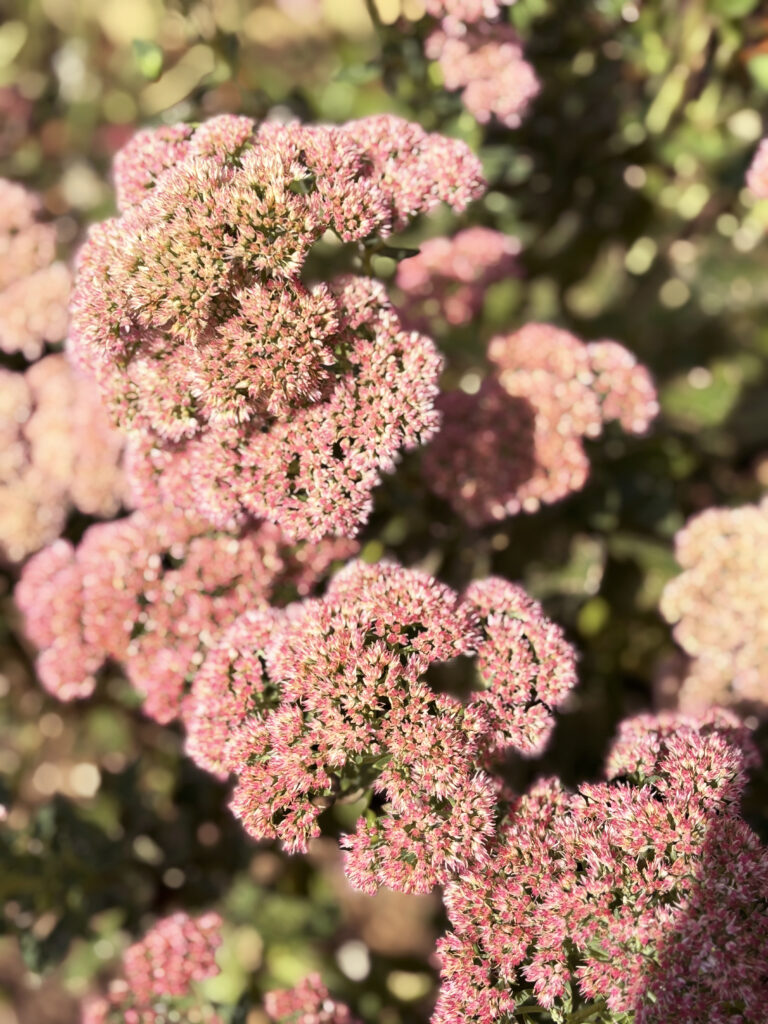
    There are still flowers of course. The autumnal blossoms like the sedum above make me smile. The summer annuals are still in bloom. I didn’t plant annuals this year, but they surround me on my walks, and as long as the temperatures remain warm they will continue to blossom. I know they too will fade soon enough.

    I love autumn. I love walking on autumn mornings. I love the sense of slowness, of waiting, that autumn brings. I love the promise of rest, of dormancy, of letting go. Yes, I even love the reminder of death. It seems that in our culture we try to deny the presence of death, to deny the need to rest, perhaps even to hibernate. But it is from death that life comes forth, and I love the cycle. Even though spring is filled with promise, I always feel that autumn is filled with repose and with hope.

  • Random Musings Late Saturday Morning

    What is about moving my blog address and hosting that makes me want to write? I realize it is not just that, as I have been wanting to resuscitate this blog for over a month, but life somehow intervened and I just couldn’t get past the objections I raised within my own head.

    Then, of course, Typepad said it was shutting down. And I was not in a place where I could deal with that, at least not emotionally or intellectually. I spend the beginning of September in San Antonio, where my aunt was dying. She was my father’s brother’s wife, but both my father and his brother have long since left this earth. I was happy to spend her last few days sitting with her, holding her hand, my hand on her shoulder, or knitting by the side of the bed. I was happy to be there for that time and for the funeral, but I was emotionally overwhelmed place. I couldn’t think about blogs, or in fact the embroidery I had taken with me due to an impending deadline.

    When I returned home the deadline loomed and it felt like I spent all my time either in meetings where I serve on boards or otherwise volunteer, or in my studio working on embroidery. There was no time for processing, and no mental bandwidth for taking on anything new.

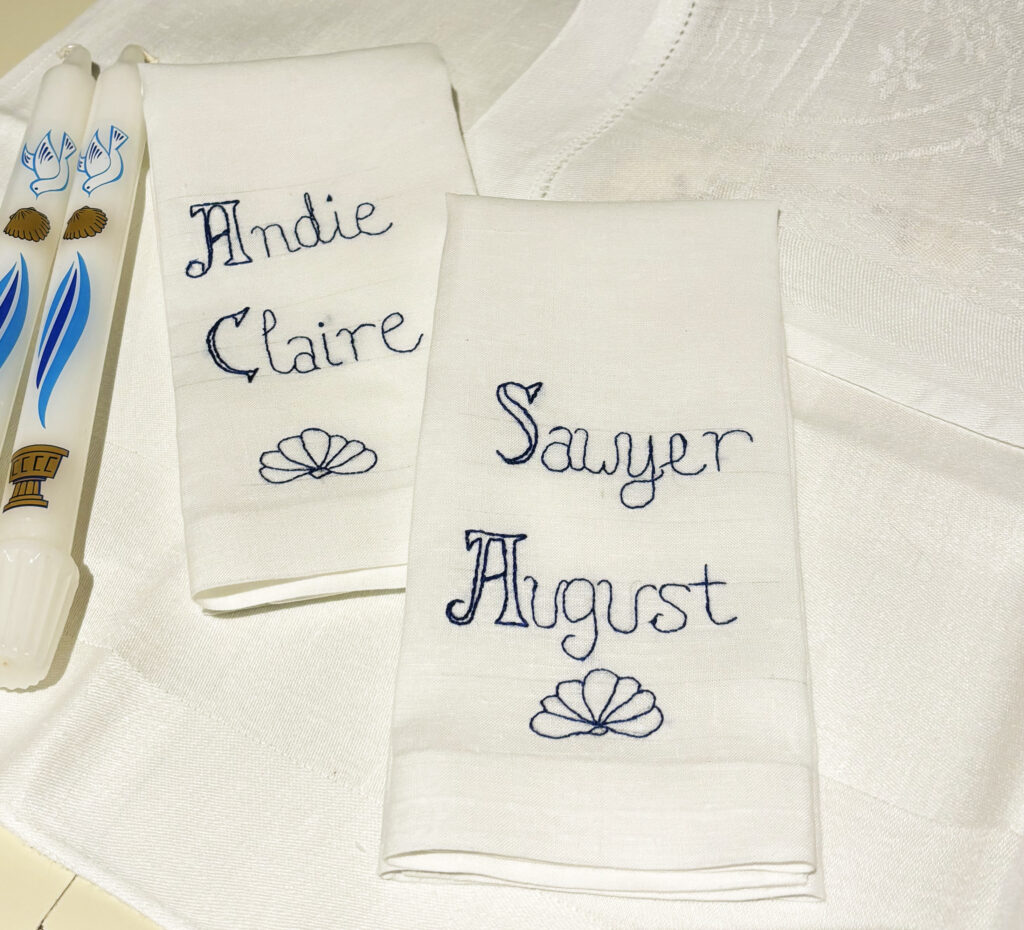
    After the baptismal towels were done I crashed but it was not enough. September was already the busiest month and I think I am still not so much ruled by coherent thinking but by my stress response.

    But not all has been stress. My cookbook club met and I was rejuvenated by an hour of wonderful conversation about food. The Collector’s Circle group for the Knoxville Museum of Art held their seasonal kick-off party and I was soothed by wonderful conversations with people I had not seen in some time.

    Last night I attended the symphony’s seasonal opening which included a lovely new work by Jennifer Higdon, a work I do not remember clearly enough but I remember enjoying. I acknowledge that my brain is currently at dangerous overflow levels but I know that I will remember this performance much more clearly when I have an opportunity to hear that work again — this is simply how my brain works.

    Last night the orchestra and the choral society also performed Beethoven’s Ninth Symphony, which is always an uplifting and happy work. Part of me didn’t want to go downtown; I was too tired. But I knew it would soothe and uplift me, and so it did. I was bouncing in my seat with the music lost as much in memory as the music itself. For once my critical faculties did not kick in, although I do actually look forward to Beethoven now. (Our previous music director’s renditions of Beethoven were an offense to my sensibilities) I was simply carried away by the music, by memories of a life filled with the music of Beethoven. With the soloists I heard my father singing to the Beethoven as he listened to it in my childhood home, I heard George joining in. At some point I may have sung parts of the alto line to myself. It was joyous.

    And here I am again this morning, reviewing, and archiving, old blog posts looking for lost photos. I’ve been able to find most of the missing pieces. So far there are two photos that appear to be gone forever, but I’ve gone through what, 400 out of 1700 posts. This task alone may take me the rest of the month. Yes, I wondered if someone could do all the work for me, but they couldn’t find that which was lost, and my budget at the moment is unfortunately very tight.

    Actually the process is stressful because I am afraid I won’t finish and that things will be lost. I am afraid that, even if I get the typepad file, I won’t be able to automatically update the picture storage and will have to do it manually, which will take a long time. And why am I stressed? Long ago I decided that things were only things, that words were only words, and that I am but a spec. Posterity does not care. Why should I? And yet at this moment I do care.

    But the process is also joyous. One thing I am rediscovering about those early posts, when I knew nothing about the internet or blogging and did not feel self-conscious about what I wrote, was how I just threw words out there, much like I am doing now. It may be silly, foolish, out of touch with the times. But that is the voice I wish to resurrect, a voice that is very much like my own interior voice.

    Today I found a post from 2006, where I wrote about a silly internet “test” I took. That one seems to have been something like “what math text would you be if your were a math text”. (As if anyone would care) The test determined that I would be a text on Algebraic Topology, which is odd because I am not a mathematician but I love Topology. Topology, like organic chemistry, is a subject that has always just made sense to me.

    This is what I wrote at that time (April 23, 2006)

    “what intrigues me about this one is that I love Topology.  I am not a mathematician, I was an English Major in college, although I later went on to work with computers and get an engineering degree.  However one of my college roommates was a math major and she had a lot of trouble with Topology.  One of the math tutors would come over to help her, we later became friends, and he always thought I should have become a mathematician, and once when she was having trouble with something that he couldn’t get across I just explained it to her.  I would listen to these talks and it all seemed so obvious to me.  In retrospect I see that this was probably maddening to my roommate, that the English major could figure out Topology and she couldn’t, but I didn’t mean it that way.  Topology, like Organic Chemistry (which I did take) was just one of the subjects that clicked with me right away and changed the way I looked at the world.”

    This resonates with me today because once again I am connected to the chain of memories — of my youth, yes, but also more recent memories. When I was in San Antonio I had a conversation with my brother the physicist who was telling me that he had been stymied by a conversation with a high school senior who wanted to know what real life uses there were for Calculus II. I couldn’t come up with an answer then because it was late, my aunt had just died, and I was exhausted. But I woke up with that question on my mind. I wondered if calculating the amount of fiberglass needed to cover a free-form roughly circular pool surface would be calc II. We did that once, George did it in his head although he claimed he was “bad at math”. He was right and the contractor was wrong. I’m not sure if that is calc II though. I also thought it was useful in calculating how much garden edging one would need to create a randomly undulating bed around a yard. I’m sure most people just guess and either buy too much or too little, but I do like to know exactly what I need before heading to the store. I have done those calculations.

    Later, on the plane home, I also wondered if calc II was useful in calculating present and future value of investments. And perhaps population spread in disease. But I suppose one could argue that none of these are “real life” for the average person. Although I think I’m pretty normal and I have made some of those calculations. I could also just be crazy.

    Anyway, these thoughts are all running around in my head this morning. I’m also not convinced I like the layout I chose for this blog, but that is something I can amend in the future. At least for now, I have a place to contain my random word dumps.

    Have a nice Saturday.


  • Transitions

    After twenty-five years at Typepad, my blog has a new home, and a new address, at WordPress.  This probably should have happened years ago.  But now it must as Typepad has thrown in the towel or is in the process of doing so.

    All blogs, including the prior ones have been Imported under name — restingmotion.com.  At the moment that only extends to text files but I have asked Typepad for the other media, and hopefully it will arrive in time and I will get it all uploaded.  That consists of thousands of files to be added to roughly 1700 blog posts.  I do however already know that there are photos that are not currently accessible through typepad, and some originals that I too seem to have misplaced.  At the moment I am painstakingly sorting through all posts to insure that I have copies of all photos in house so that, should they not get uploaded automatically anything that falls through the cracks (and I hope they are small cracks) will eventually find its way to my new home.  I have already managed to find a dozen missing links and files.

    Needless to say everything is very rough and crude at the moment.  I don’t really know how to use WordPress yet, and there is much to be done.  September and October were already overscheduled before I received the news of Typepad’s impending demise so progress may be slow.  Nonetheless, I will move forward.  

    Apologies for the disruptions and many thanks to any who stick with me through the upheaval.

  • A Little Sewing

    Just when I had made peace with the realization that I wasn’t going to do any sewing for myself this summer, what did I do with a couple of relatively free days?  I made myself a top.  It  was a spur of the moment decision when I found myself with a touch of free time, but not enough to work on bigger projects.

    A piece of red fabric that I was on the fence about was sitting on top of the “possibly donate” pile.  It was a really pretty shade of red, but I was not enamored of the fabric content, nor its lack of drape. I had recently unearthed a pattern for a trapeze-style top and, unbidden, an idea clicked.  The pattern is a tracing of a top  that I had picked up a thrift shop, not because I wanted to wear it but because I wanted to trace it off.  The original was a toasty camel color with armscye stains and damage at the hemline but  the general shape and the details were fabulous.

    I had just enough of the red fabric to eke out the main pattern pieces for what I fully anticipated would be a muslin. I eliminated facings, hem allowance, and as many seam allowances as I could (remember, muslin).  In the end, however, I loved the shape of the top and thought it was really pretty in this red fabric.  I regretted some of my shortcuts and set about to salvage the top.  Through some creative arranging and rearranging of scraps,  I managed to cut armscye and neck facings as well as a hem facing.  Because I had no seam allowance, and wanted to avoid visible stitching on the face of the garment, I fused the facing to the hem, raw edges exposed, and ran a line of stitching 1/4 inch from the edge.  The stitching was in place to both anchor and fabric together and avoid potential separation, but also as an aid in aligning some trim around the edge.  I found this really pretty brown and red braid languishing in my trim drawer  apparently waiting for this very project. The trim hid an error made when I was still in “muslin mode” and also finished the garment quite nicely.

    I cut a lot of corners and I’m not usually a fan of fusing garments, but I am happy that I made this work.  I think the fused hem facing and the weight of the trim, help hold the shape of the garment nicely even though I am not convinced this garment will hold up well over time.  Luckily I don’t think it will see a lot of wear as it is rather distinctive.  And the addition of the trim has given me some ideas of ways this garment may evolve if (when) problems do arise.

    I took the new top with me to Santa Fe last week, and wore it on our final evening at the opera, to see The Marriage of Figaro.

  • Playing with Paper Dolls

    When I was young I loved playing with paper dolls.  As I grew older, into my teens, I particularly loved those fashion paper dolls, where you had a variety of outfits to put on the model.  I loved playing with clothes and colors and style.  But I never really thought abut majoring in Home Economics, or becoming a buyer or designer or in any way having a career in fashion.  I liked plain paper dolls and the fancy exotic and historical ones.  I loved the ideas of mixing up styles.  But none of this played out really in my actual clothing.  I wore a Milwaukee brace from the age of 10 to 15.  My mom hated making my clothes and found fitting over the brace difficult.  In retrospect that could have played into why I was not encouraged to sew.  Paper dolls were a way to explore ideas I couldn’t explore in real life. I thought I didn’t have any style and never would.  The girl my parents always compared me to, wished I would be like, had style but I did not.  Everyone told me so — my parents, my godfather — everyone who mattered to that younger me.  But I don’t know where that came from: out of fear, or pity, or somewhere else.  I absorbed those words, but they may also have fueled my fascinations, Dressing paper dolls opened up worlds that were not my world.  Now of course I know that everyone has style in the broader sense, style is part of who we are, the way we present our external selves to the world.  Even the rejection of Style, the specific version of style in the narrow sense, is itself a form of style.  Every choice we make, every choice we refuse to make is a part of the style in which we present ourselves to the world.


    I still like playing with paper dolls, but my “paper doll” play in adulthood runs more into making collages from pictures cut out of magazines and catalogs.  When I was a child, I also loved poring over my mother’s Harpers Bazaar magazines.  I loved the pattern catalogs when we went to Hancocks fabrics even though I wasn’t the one sewing, and often my choices of fabric or pattern were not the ones I ended up wearing.  Even more, I loved my mom’s Japanese sewing magazines, Soen and Dressmaking.  Soen seemed more exotic and fascinating to me.  When I went away to college, fashion magazines offered an occasional escape from studies.  Once, after a Saturday spent in NYC, I bought a copy of the French fashion magazine L’Officiel to peruse on the train back to Poughkeepsie.  There was a photo shoot featuring models wearing ethereal evening dresses by Yves Saint Laurent paired with thick-soled basic canvas espadrilles, not the pretty lace up ones, but the thick fishermen-style ones.  It blew my mind.  I had never seen anything like that in West Texas.  I started cutting out pictures.  Eventually I started pasting the pictures onto pages and creating notebooks, although truthfully I didn’t really do that until much later, after I taught myself to sew, after I was married.


    Those notebooks filled with pictures of clothes and clothing details have resided on my shelves, mostly untouched, for some years now.  But recently I unpacked a box labeled “miscellaneous patterns” and found a stash of photo clippings mixed with knitting pattern leaflets and patterns cut from magazines.  I started looking at my collages, my “paper dolls”, and I realized there was a distinct style and continuity to my choices over the years.  Of course, there were a few things here and there that I could look at today and wonder what I had been thinking, but I could cover those little glitches up with new photos.  I’ve never been one who wants all of one designer, or one year, or one age or style, bundled together.  I started playing with pictures again.  And I wondered why I had stopped.

    I started sorting through the various files on my computer, because I haven’t really read fashion magazines much in years, but I have occasionally saved screenshots or made Pinterest boards.  Unfortunately I never look at those pictures once I’ve clipped them.  I am apparently a glue and paper girl.  Still.   The idea that I could print out those clipped images and paste them into books further expanded my brain.  I looked at my fabric collection differently.  I started sewing again.

    The photos of collages above are mostly old, more than 12 years old, many of the photos may be 20 or 30 years old.   My early explorations were probably not all that adventurous, shaped by very twentieth century ideals of style and elegance.  But I still find them inspiring.  There are lots of pages of women in suits.  I still like suits even though I don’t really wear them, and since menopause I still run hot.  The hardest part of retirement was not having a reason to wear suits anymore.  But there are also pictures of women whose style I admired, women who pushed boundaries, who mixed things up, who knew themselves.  I’m not sure I did, know myself that is.  But collaging is one part of the process, and I suspect knowing oneself is a lifetime journey.


    And part of that journey is that I clip ideas from a much wider range of sources now than I did.  I am inspired by a wider range of cultures and styles.  I am inspired by younger women, women who may wear things that I love on them but may or may not ever wear myself.   I like the idea that fashion and style is not a narrow line.  I say this even as I occasionally despair that quality and style and wearable elegance seems to be fading away. Fashion, in the big sense, seems to appeal less.  I clip pictures of things I could probably easily buy.  But it’s not about buying or consuming.  Perusing my notebooks makes me think about what I have and what I want to wear and why I want to wear it.  I’ve always been a person who thinks too much, who lives perhaps too much in her head.  But I can’t really dismiss that part of myself she is very much a part of what has made me the woman I am today.


    Even though I haven’t bought fashion magazines, or actually been all that inspired by high fashion in some time, I felt inspired to go out and buy a fashion magazine.  I wanted one of the semiannual issues that focus on the collections, and I found this Vogue France Collections Fall 2025/2026 at my local Barnes and Noble.

    It was disappointing.  I suppose I should have suspected that from the cover.  There are maybe three things I would clip from the whole issue.  Everything seems based on shock value or on the instant photographable moment, not beautiful things that could fit into a life, any life.   I don’t know if my issue is with the designers and the industry as a whole, or with the editors at Vogue France.  In some sense it doesn’t matter.  And the absence of Vogue in my life doesn’t  mean there aren’t things that inspire me.  Unfortunately most of those things are no longer at the high end of the market.  Fashion seems to have changed but we still need to wear clothes.  From my perspective, too many choices that aren’t really choices at all, poorly made clothes of cheap fabrics that fall apart and don’t last.  I want to wear only what feels right for me, and to wear it for years.  That is true if I am looking at a tee or a cocktail dress.  For me, looking at pictures helps focus me, inspire me to pull together the things that make me happy.  It slows the constant buzz of too much that seemingly swirls through the air, the electronic and social media backlog that is both annoyingly distracting and yet can also be far too narrow and confining.


    This picture is from a sewing pattern company, Sew Liberated, one of the models for the Arthur Pants.  I like this pattern; I like this shape’ and I love this photo of this model.  She looks happy, comfortable, and, to my eye, quite stylish.  I think the pants are very flattering in a modern way, a way that embraces the idea that we all come in different shapes and have different ideas of style, and look good in our own bodies, our own thoughts, our own choices.  This photo is going in one of my collages and I will probably also eventually make a pair of these pants.  I don’t have any patterns for barrel legged pants, although I have long loved them.  I had barrel legged, elastic waisted gardening pants in the late 1980’s and early 1990s.  The legs were cut much like this and I adored them.  They were worn to shreds and the company I purchased them from went out of business.  There truly is nothing new in the world, but there are tweaks and differences that make something feel more “now” and less dated.


    But this photo also reminds me that this is something my younger self, inculcated into a very restrictive and narrow-minded ideal of what was and was not attractive,  would never have worn.  Today this photo inspires me, and it also shores me up, helps me fight my own demons, demons that stem from those brace-wearing years of over half a century ago.  This summer I am moving better than I have in years and yet at the same time that 13 year old girl who didn’t fit the mold feels dangerously close.


    Playing collages has also helped focus on some things I don’t understand about judgements and stye and fashion.  My questions are not about why we care, or even why we make judgements, because the inclination to judge, to separate ourselves into groups of “like me” and “not like me” is probably to some extent hardwired for survival.  Instead I fret over is why we make judgements on such frivolous, silly, and culturally narrow bases in a world that is far broader and filled with more knowledge, ideas and experiences than ever before.    I feel thrilled and inspired by so many options that were not available to me when I was a girl.  We open windows onto worlds and then we slam them shut.  I do worry.


    Will my collages make any difference? No.  Will they help me refine my own understanding of the world and my own place in it?  Absolutely.  It is a small thing.  And yet it is generally by the small things that are lives are lived. We simply need to seize our own happiness.


  • Hello August! This and that in the Knitting Studio

    Hello Blog!

    July got away from me.  I had a few minor setbacks in terms of my ability to do things, nothing horribly serious but I felt like July was spent more in the latter part of the “two steps forward one step back” idiom in terms of my ongoing attempt to regain movement and flexibility.  There were days when I felt like I was more in “three steps back” mode, except that I know that isn’t true.  I’ve been in PT for three months, and I have made progress, but my body has spent more than 50 years stiffening itself up, and three months of PT is just a drop in the bucket.  I can admit I’ll never move normally, in fact I’m not even sure I know what that means.  I just want to move, and realistically, three months is minuscule compared to the previous 57 years, remembering that I was first put in a Milwaukee brace at age 10, the majority of my spine was fused at age 16, and the last couple of non-fused disks in my lumbar spine have probably finally self-fused in just the last couple of years.


    But that is not what this post is about.

    When I was up to shifting things about, I reconfigured the pressing station in the studio.   The rectangular pressing table was already there, I shifted it slightly and moved the ironing board from the laundry room, in the basement of the house, to the studio, which is above the garage.  I’ve not been doing routine ironing in the laundry room as there is a wiring issue, which I’ve put off correcting while I made some decisions regarding additional electrical work.  That ironing board is heavy, a vacuum board, and I was not using the vacuum feature in the laundry room but will use it in its new location.   Moving it was work however, and  it took me two days.  The first day I hauled it up out of the basement, across the deck and into the garage.  The second day I wrestled the board up the stairs to the studio, which are steeper than the older stairs in the house. Then two days after I got the ironing board moved and my pressing station reconfigured, my 20-some-odd year-old Naomoto gravity feed iron gave up the ghost.  The new iron arrived this past week, and I’ve been catching up on ironing ever since.


    Other than catching up with ironing, an ongoing process, especially in summer, when I tend to live in linen, I’ve been working on knitting projects.  Those have also fallen into a sort of “two steps forward, one step back” pattern.  I knitted two new garments, one of which is still blocking, but both of which I love, and spent some time fiddling with three less than satisfactory older projects.

    .

    My first project was a tee, which I called adrift at sea, knit in a silk and linen yarn by Anzula called Vera.  I originally purchased the Anzula for another project but did not like the yarn in that pattern.  Instead, I used a pattern called Driftwood Tee by Mercedes Tarasovich from the summer 2014 Interweave Knits.   The pattern is still available from Interweave.  I basically made the pattern as written except that I wanted a deeper scoop so I altered the front neckline.  I am very happy with the results.

    I have just finished a second tee, but details of that will be in a future post.  In the meantime, I’ve been fiddling about with other things.

    Last fall I finished a fluffy coral sweater that was languishing in the UFO pile.  This was a simple front cable pullover in a cotton/wool blend yarn from GGH that has since been discontinued.  The original pattern called for finishing the sweater with a simple crochet edge at the neckline, and this is what I did.  Although I loved wearing the sweater, I hated the way the neckline looked.  I always wore it with a scarf or shawl wrapped around my neck.  One day last month, I simply broke down,  ripped out the neckline, and reknit it in ribbing.  Now I am much happier with the sweater and am looking forward to the advent of cooler weather and snuggly sweater season.  Given how much I wore this sweater in the house last winter, I predict it will see much wear in its improved state.

    Continuing in this fit of reform zeal I next picked up two other projects that had been plaguing me:  a ruana knit in two shades of Lang Cashmere Light, and a linen shell knit this past spring but never fully finished as I was exasperated with all my finishing attempts.    The ruana was a simple project.  I had already decided I would prefer it as a poncho, so I simply seamed the sides.  As I think about it further, I might also want to add a cozy collar at the neckline, but I first need to pull out the odd ball box and see if I have enough yarn.  No rush on this, as the ruana is perfectly wearable now, and cold weather is probably still months off.  I am content to wait.


    The small, green, white and turquoise piece on top of my shawl is Anni, by Gina Röckenwagner, and it is far more problematic.  I loved knitting this, and I love the fabric created, but I’m not convinced that the Juniper Moon Zooey is one of my favorite yarns.  Even worse, I have been completely frustrated by the process of finishing this sweater.  I can’t seem to pick up and create a neckline that makes me really happy, although I now, after 4 attempts, have a neckline that just edges (barely) into “good enough”.  Seaming has been an even bigger headache, and I have not been able to seam the pieces in a way that looks at all professional or properly finished.   I finally gave myself permission to toss the unfinished project and remaining yarn into the UFO pile.  I do have a few ideas about how to save it, including frogging the whole thing and reknitting it with some minor adjustments to the pattern, but at this point I am too emotional about the whole experience to approach it any kind of clear-headed manner.  Best to wait.

    Last but not least, I ordered Marie Wallin’s Fairisle 10 kit, the Tree of Life Throw.  I’ve been itching to do some stranded knitting for a while now, but I don’t have a lot of need for stranded sweaters since I’ve moved south.  This blanket will be a labor of love and a long term project.  I have never planned on keeping up with the knit along.  I worked on my swatch during July and got gauge on the third attempt. Even the process of swatching has been relaxing and fun, helping my fingers become reacquainted with a forgotten skill.  It has been a good decade since I’ve done stranded knitting.  The knitalong has already started but I don’t plan to actually begin until mid to late August, after some travel.  You’ll be seeing this off an on for a long while to come.  In the meantime I absolutely adore the range of colors, which you can see at the top of this post. Just looking at them makes me smile. .


  • Five Things That Made Me Happy Over My Birthday Weekend. And a Picture

    Back Deck 3.0  Until this past week, the deck had been a weight around my neck, an unfurnished waste land that reminded me every day of all the things I had not done, and empty void that fed my doubts and really accomplished nothing except to fuel my doubts.  Last week however, instead of pulling weeds, I spent some time scrubbing built up pollen, mildew and various seasonal stains off the outdoor furniture.  Then I moved the furniture that has been here and there and everywhere, most recently on the slate patio, to the deck, the space on the deck that had once held the outdoor dining table, but that too was relocated (deck 2.0).  I’d been looking at deck furniture for years, but nothing clicked.  Then, at a friend’s house, I realized I had been asking the wrong question.  I had the furniture I wanted for the deck, I just had it in the wrong place.  

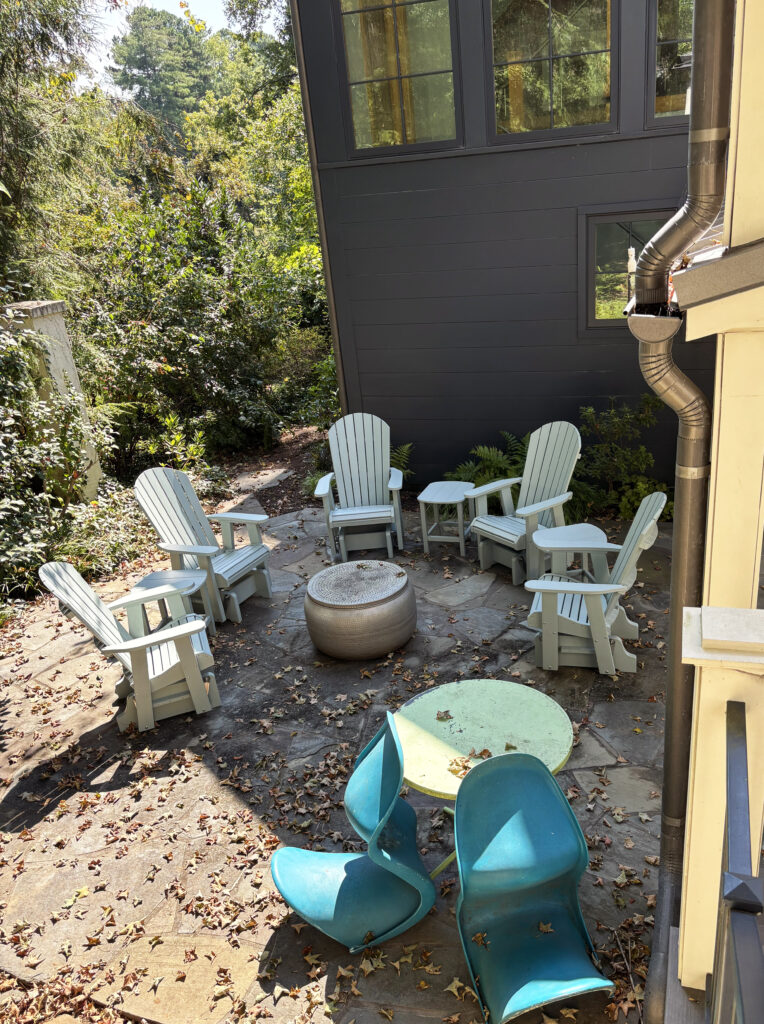
     Another corner of the deck.  These chairs have been here a couple of years.  The pillows were meant for the furniture above, but didn’t work there and make this corner more cozy.   The brick pieces came with me from Hyde Park, were rescued from the original Vassar Brothers Hospital when it was torn down, and moved by me to this location last summer.  I sat in these chairs enjoying my birthday breakfast, looking out at a deck that no longer looked like a barren wasteland of empty promises.


    Savory Pastry: I made an onion tart, with local onions, cream and eggs.  Creamier than a quiche, more custardy, it was light and delicious.  I didn’t have the right size tart pan for the recipe though, so I actually made several smaller tarts, in a mixture of sizes, some more successful than others.  I enjoyed working with pie pastry, I enjoyed the process of making the tarts.   This particular tart was too shallow; the deeper ones, with more filling, are more appealing. But again these are minor details.   I feel inspired to go through the boxes of baking supplies which have been languishing, unopened, since George died in 2012.  


    Farmers Market Saturdays.  I have always loved farmers market days.  It is more than just shopping for me.  I like to wander around once, then come back and make my choices, although sometimes I just have to grab things when I see them.  I love talking to the farmers and makers.  I love the process of imagining what I can make.  I love coming home and planning, dreaming of food and future meals either alone or with friends.  Market days are imagination days, creative days, and this year especially, when I do not have my own garden, they are all the more necessary.  I miss my vegetable garden, even as I know I don’t yet know how to work out the details of resurrecting it.  That will come in time.   In the meantime I still have the market, always have the market.  I never had a large garden.  I’ve never wanted to not go to the market.  I want my Saturdays to revolve around this, what is local, what is here.  For me, life has always, at least as long as I remember, revolved around food.  What we eat, how and why we eat it, is a large part of what makes us human, and what brings us together as a community, connects us to each other and the world in which we live.  Increasingly I reject the commodification of food because it feels like the commodification of life, and we are all more than that.


    This week at the market I was cautious.  I avoided buying too many peaches even though I dream of making peach butter.  I knew I didn’t (don’t still) have the energy to make peach butter now, but I might one week.  I did buy shishito peppers because I don’t have peppers in my non-existent garden. I blistered them in a hot skillet early the next morning, and they sit on the counter, there for the taking and noshing.  

    Macarons:   On my way out of the market I bought a chocolate lavender macaron and I ate it while I cooled down in my car.  Pure bliss.


    Limelight Hydrangeas:   The limelight hydrangeas are just beginning to open.  Really, is there anything more to say?


    And I promised a picture.  

    This is what 67 looks like, looking forward to a sixty-eighth year filled with hope.  I feel hopeful, like my current self is more in touch with both the promise of my youthful self and the acceptance of limitations of my older self than she has been in a while.  Odd talking about myself as an other, or even a group of others.  Well, none of us are mono-dimensional after all.  I am a universe of cells and ideas and thoughts and dreams.   


  • Summer Garden Update

    The garden was beautiful this spring, bursting with flowers.  But did I take pictures? No.  Did I write? No.  I was still too busy beating myself up over all the things I had not yet done, and was not doing, to truly celebrate the beauty of all I have accomplished.  

     That is not really the best place to be, berating oneself for perceived failures.  Sometimes my inner voice, that persistent echo of years of early training in the school of “not good enough”, gets the better of me.  I know this voice is a false idol, something that attempts to lure me away from what is truly important in life.  But sometimes I succumb. 

    As an antidote of sorts, I am posting pictures of the late June Garden. The June garden lacks the riot of color seen in early spring, and it is more overgrown with weeds, but at least those weeds are green.  I am learning to accept that my dreams are far bigger than my energy levels, and, thankfully, Mother Nature will happily fill the gap.  Better weeds than dead lifeless soil.  What is a weed anyway but an arbitrary designation, a plant that is growing where a human does not want it?  Although I have to work to pull them out, those weeds help the soil, help build an ecosystem and haven for smaller creatures, and will eventually become compost.

    Two summers ago, the bed to the south and east of the hydrangeas above (two above photos) were empty, mostly home to grassy weeds.   There are still some creeping grassy weeds in there, but it is not nearly as big a problem, and more importantly the perennials, which I felt I spent much of last summer just keeping alive, are thriving now.  There are even some echinacea, even though rabbits consistently ate them to the ground before they ever grew tall last summer. Apparently a few of them survived long enough to nourish roots.  This too gives me hope.

    That bed has evolved, some plants I planted there have not thrived and have already been moved, others did better than expected and have led me to rethink the ways I will be expanding and finishing out the beds around the upper circle.  That is one of the good  things about gardening, as frustrating as it is. Gardens are centering, calming, and also humbling. I am constantly reminded that control itself, as much as I yearn for it, is a myth, a false construct.  My garden will show me the way, slow as I might be to absorb its lessons.

    This is one of the first beds I planted in the garden after moving back into the house and it remains one of my favorites.   There are two narrow beds like this, flanking steps up to the circle lawn.  I had envisioned matching beds, but that hasn’t worked quite according to my plan. The beds are similar, balanced, but not symmetrical or mirror-images. The light at the far east end of the two beds is far different from the light on the western end.  I have to think about these beds more as a continuum or scale rather than as separate symmetrical static objects.

    Progress is also being made on the shady side of the garden, but that tends to be more spotty.  Some areas have thrived, others are more hit and miss; once again, a constant learning experience.  

    The chaste tree (with the purple blossoms) struggled the first 5 years of its life.  Planted in 2018, it was battered, tipped over, and twisted by winds in storms.  I wondered if it would survive, and then last summer it finally got its bearings and started to thrive, filling out like crazy just as I was giving up hope. The wattle fence around the small front yard, which was, for me, a defining feature, has fallen down.  Knoxville has gotten even rainier than when I moved here, and although I’ve been in contact with the man who made it, getting it repaired or replaced has proven problematic.  I am pondering alternatives, or if I even need a fence.  That is something that is not going to be resolved this year, and inaction itself may prove to be the solution.    It seems nothing is ever finished.  No, that statement is both correct and incorrect.  The goals are always moving, and very often the initially perceived finish line is but a bend in the road, leading us on to new ideas, new realities, new growth.

    Much of the back is still wild and wooly, with more weed than garden, although I have made progress there as well.  My vegetable garden is inactive this season.  Last year I lost it to the bunnies, deer, heat, and inattention as I tried to make progress up front. I’m still thinking about long term plans, and focusing on what I can accomplish more immediately instead.  Isn’t this always the way?  At some point I felt as if I had hit a wall, and then suddenly one small change and whole new vistas and ideas open up.  I am hopeful again, although I am still looking at the garden as part of a 10-year plan.  Well, it is always a 10-year plan, even though I started it 5 years ago; why don’t admit it is part of my life plan.  As long as I am here, my life and the space I occupy in that life is a work in progress.


    There are always more things that I dream of doing than I can do.  In fact I it seems I can accomplish merely a fraction of what I plan.  That has been the curse of this garden in some ways.  I took on a grand plan, and life threw in too many hiccups.  My body rebelled.  I hoped to do more this past spring, but,  this past spring  the act of simply standing up straight and moving proved to be bigger challenge.  I was, in fact struggling far more than I was willing to admit, and chaos was piling up around me.  I’m still working on that, but I’m making progress.  I am gaining strength and mobility, which gives me hope and fuels my dreams further. I’m still far too pig-headed to admit defeat.  Dreams are good.  Plans are good.  Hope is even better.  The same for accepting limitations. It is not so much what you do, what your are given, or even what happens, either good or bad, that is important in life, but what you make of the life you live.  The important thing is who you are, not what you do, although one may well inform the other.


    Sometimes the best thing to do is to sit in the garden with a cup of tea or a glass of wine, admiring the garden, admiring the frolicking of birds, squirrels, and even rabbits. When I sit I realize how my failure to keep up to my own plan has created this haven.  I glance benignly at the weeds, thinking:  “Perhaps I’ll pull you another day”.  

  • Playing with My Food, 250601

    When I first opened Kristina Cho’s Book, Chinese Enough, one of the first things I wanted to make was Kohlrabi and Radish Salad with Chili Crunch.   It was not the first thing I made from this book, although it is the first dish I will write about in this post.

    What attracted me to this dish?  First of all,  love kohlrabi, and very nice kohlrabi is often available at my local Asian Market, Sunrise Supermart.   I don’t recall eating kohlrabi much growing up, but it is common in German and Austrian cooking, and it was the favorite vegetable of my late husband, who was born in Austria.   I also love Chinkiang Vinegar, which is one variety of Chinese black vinegar. It is made from fermented glutinous rice, and although there are many bottles and brands that add wheat, it is not difficult to find Chinkiang Vinegar with no wheat added, at least if one has a good Chinese or Asian market nearby and is willing to spend time reading labels.  But having celiac disease taught me that taking time to read labels is a good idea, and I have come to embrace that idea on a broader scale, meaning I like knowing exactly what is going into my food..  

    But let’s return to that salad. First I made the chili crunch. I’ve made nearly every chili crunch from nearly every cookbook I own which has oe, and this was good but I am not certain it is my favorite. I would have liked more heat, but that was my fault as I was out of hot red pepper flakes when I made it and was too lazy to run to the store. I used mildish Korean gochugaru instead. Were I to make this again, I would use hot Chinese chiles.

    Although the recipe called for watermelon radishes, I was planning to use regular radishes, simply because I don’t often find watermelon radishes. However fate was on my side and I found some in the farmer’s market that week. They proved to be the weak part in an otherwise lovely salad. I admit to knowing little about watermelon radishes and I suspect these were too large and not particularly tender. Even thought I sliced the reddish very thinly on a mandolin, they were more woody than crisp.

    I loved the flavors of the salad; it was bright, tart from the vinegar, but with a slightly funky, nutty, oily heat that did not dominate but softened and rounded out the flavors of the vegetables.  However, due to the radishes, I realized I was unlikely to finish the salad, despite the fact that the author says it keeps five days.

     Then I had a thought.  


    I had some leftover roast chicken in the fridge and a partial bottle of heavy cream.  I wondered if I could turn the kohlrabi/radish salad into a kind of gratin with the leftover chicken.  I knew kohlrabi bakes well; I’ve made kohlrabi gratins.  Radishes of all varieties steam well, so it seemed logical that it would also work in a gratin, so I proceeded.  First I drained the vegetables because the vinegar would not help.  I had about 6 cups of thinly sliced vegetables, and about 3 cups of shredded chicken.  I also had two medium-sized russet potatoes in the pantry, and since I was about to go out of town I thought I would use those as well.


    I dabbed the bottom of the gratin dish with a small amount of butter, layered the peeled and thinly sliced potatoes as a base and then alternated layers of chicken and vegetables.  I grated a small chunk of havarti I rescued from the fridge on top, then poured the heavy cream over it all and baked it until the cheese was brown, the liquid was thick and bubbling and the potatoes were cooked through.


    Although it was not a beautiful dish, it was delicious. I expected it to be good, how could it not be? But it was far greater than the sum of its parts — more complex and more enticing than I had hoped.  Due to the high volume of radish and kohlrabi, the dish was lighter than many gratins, but it was still substantial.  The vegetables cooked down but were still tender and toothsome, with a fresh, fruity, crisp-soft, and yet still slightly starchy consistency that was very appealing. The color of the radishes faded substantially, but they also colored the dish a very faint pink.  The potatoes didn’t add much, but I felt virtuous for not leaving them behind.  What started out as an impromptu “mess” of a fridge clean-out, turned into a dish that I would make intentionally, not just as to use up leftovers.


    I’d been in “play” mode in the kitchen for a few months, but this dish kind of tripped the pause button.  I actually made two small gratins and froze one.  It makes me so happy when something virtuous also ends up tasting sublime.  And these happy accidents send my mind wandering along the many ways that food has shaped human development and culture.  I perhaps never would have thought of making a gratin with radishes, cream, and chili crunch, but it worked beautifully.  


    That is the thing, for me anyway, about cooking and exploring new cookbooks.  I find it fun.  Both reading a cookbook, and cooking from it, expands not only my palate and my skills, but my imagination as well.   I may not be in the mood to cook, but I’m still in the mood to write about cooking. What I love is not just learning new dishes, but the process of inspiration that leads me to discover and think about food in new (to me) ways.