Category: Books

  • A Bit of a disappointment

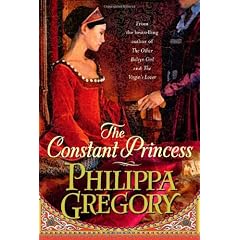
    I finished Phillipa Gregory’s new book of fiction on Tudor England, The Constant Princess.  It was a very enjoyable read, Ms. Gregory is a good storyteller, and it had enough imagined historical detail and political intrigue to keep me pedaling away on my exercise bicycle.  The fact that I read it as a bicycle book, despite the weight of the hardcover, was a good choice, as I don’t believe it is up to the standards of her previous books and I would have gotten quite frustrated with it without the distraction of being strapped into an exercise bicycle.  The historical detail in these books is always loosely tied into known historical fact, and often quite imagined.  I am well aware that they are fiction and not accurate.  Usually, the story, and the character development are wonderful though and this carries one through, not so much in this book.  Many characters are lose stereotypes, barely sketched out, pops for the main character, who comes across as somewhat shadowy as well. The previous books have also given a more engaging view of the complexities of court intrigue and politics in the period.    A bit of a disappointment really. 

    An escapist novel is always a wonderful thing but this one disappoints.  A good historical novel, although fiction, engages the reader in alternative world and at the same time encourages the reader, or has always encouraged me at least, to want to learn more, to explore the actual history learn the facts about a time and person.  This book does not accomplish that aim.  It is quickly forgotten.

    The next book is promising to be far more fulfilling.  I started reading Joan Didion’s The Year of Magical Thinking  today and was entranced.  Poignantly and beautifully written, and yet very forward driving.   I have trouble stopping and the book is difficult to put down.  Still I will force myself only to read this on the bike.


  • A Gift of the Magi

    I have loved the idea of Twelfth Night since I was a small child living in Spain.  We have not always celebrated but my father did indulge me a little in this.  When I became an adult I decided to indulge myself. We have, when the calendar allows, had a party and Reyes Cake, but generally we have a quieter celebration and put out our shoes for the Wise Men along with offerings of sustenance for man and camel.  Later today the Christmas decorations will finally be taken down and the holiday will be officially over.

    Of course part of the childhood thrill was the gifts that came from the wise men, but in truth I liked the idea of Christmas and gifts being slightly separated.  You would not know that now from the piles of wonderment that existed under our tree on Christmas morning.  In the days of my youth I would get big, ripe, Rio Grande Valley oranges, a real prize before fresh food was flown daily around the world and the miracle of UPS and FedEx could bring ripe citrus to any door.  Today I awoke to find that this had been left behind:

    Sample

    It is nice to know that my numerous hints did not go unheeded.

    I have been curled up with my nose buried deep in its pages this morning.  It is bright and entertaining, a far cry from the dull gray skies that await outside.  I think that is the worst thing about winter here.  I don’t mind the snow.  I don’t mind the cold.  But I hate the dull somber grayness of it all.  Only three days of gray in a row now and I am ready to crawl back under the warm down comforter and hibernate.

    Many of the photos are quite outré, but are also filled with inspiration.  This is definitely a biased sample of modern talent.  Still there are designers and ideas which I might never have encountered.  I will leave you with a brief collage:

    Samplesample

  • Writing Between the Lines

    Neverletmego
    I finished Never Let Me Go , perhaps not the best way to begin New Year’s Eve revelry, but a perfect ending to a year, a perfect setting to a new beginning.    The book, told in it’s placid way, is unsettling even from the beginning, before the reader even has a sense of why it is unsettling.  Vague references keep cropping up, the most mundane and ordinary things are described in such luminous detail so as to seem out of touch with this world.   The tensions, the vague sense of growing awareness, almost as if the readers are experiencing the same childhood mystery of the protagonists, the “knowing without knowing” that is described in the book, creeps into the reader’s psyche.  It is a book beautiful and terrifying, horrible and heartbreaking, filled with great humanity while at the same time reminding us what a fragile thing that humanity is.

    The book is tender and touching: One becomes wrapped up the lives of these characters, the protagonists of this story, who are not really the protagonists at all.  This book is not about what it appears to be about. It professes to be about three friends, and on this level it is touching and poignant.  But truly this is a book about innuendo, about reading between the lines, about the little details of our lives and the things we don’t want to know  It is a book about life and what we take for granted, about what we accept and what we keep hidden; it is about the banalities of the small things and how we can be so wrapped up in our secure private worlds that we never see or contemplate the big picture.  Indeed this is a book caught up in small things.  Big issues are never addressed, and yet they are present.  It is also about the nature of humanity and the soul and the nature of evil and conscience.  The skill of this author is that he has written a novel of great beauty which is really an allegory for a bigger and more terrifying thing.  He leads us into thought without our really being aware of where we are going until it is too late to escape.

    Although the characters in the book are clones, created to be used as organ donors for ordinary people, the book is not really about the dangers of science, or morality or religion.  It is a call to conscience however, a call to responsibility, a reminder that evil can creep in the most unassuming of ways.

    Perhaps equally as disturbing, to me at least, as the idea that this novel is about a world in which clones “students” they are called, are raised in isolated rural schools apart from society, isolated in knowledge, limited in their interactions with others, is the idea that they accept their fate so unconditionally.   The protagonists are fully developed characters, as caring, warm, and human as any person we might meet, and yet they blindly and accept their fate like sheep or cattle, herded to their hospitals to make their “donations”.  It is sad and frightening that they so willingly accept their fate, and it is also profoundly disturbing that the society of caring humanity which they serve also accepts their fate so blindly, removing itself from any recognition of what is being done in its name.

    Kathy’s question, near the end of the book “Why should we not have souls?” echoes through my mind.  It will continue to do so for quite some time.

  • Books, coming and going

    With the holiday guests and general hoopla, much has been out of its normal routine around the Dooney household of late.  We are starting to get back into a normal schedule though.  The washing machine has resumed its labors and I have gotten back to the gym twice this week instead of my normal four-times weekly schedule.  There is still hope as the week is not yet over.

    Mom brought a series of books with her, some of which have been properly dispensed with:

    I read A CRY IN THE NIGHT by Mary Higgins Clark on the bicycle this week.  It was a fairly fast moving, shallow but entertaining read that was quickly forgotten. It took about an hour and a half of bicycle time- perfect for that category of books I call “bicycle books”, fast moving enough to keep one pedaling on the damned exercise equipment but not really requiring thought which might cause one to slow down.  Most of these books are not particularly well written,  they move quickly, there is little character development, and the plot and writing are heavily stereotyped and cliched.   Still they entertain me through a necessary evil.  Beautifully written fiction does not work as well, as I, at least, tend to stop pedaling during a particularly lovely passage, or when the story line requires me to put the book aside and contemplate something.  The exercise bicycle is the perfect vehicle for a whole class of popular fiction that can be entertaining but I find I would never really get through if I just sat down and tried to read them. 

    I am also reading NEVER LET ME GO by Kazuo Ishiguro, which is an excellent novel, beautifully written, beautiful prose, great story line, good plot, character development and everything.  Ishiguro is one of the rare writers who writes beautifully and writes well and I love reading this novel.  It is very touching and poignant, while at the same time being somewhat unsettling and, as one gets further into it, darkly horrifying.  It is not always easy to read on the bicycle, which is why I switched to the popular trash mentioned above for the bicycle.

    Also noteworthy in books is that I managed to pawn off SON OF A WITCH by Gregory Maguire to Miriam, who is interested in reading it as a fun entertainment.  She really enjoyed WICKED, as did my mom, but I am probably the only person in America who found it boring, tedious, and difficult to get through. 

    Although I thought WICKED started off well, and I was looking forward to it, I felt the character development and the sense of the plot fell off as the book progressed and the later part of the book, involving the wizard and Dorothy and the whole “Wicked Witch” scenario, was never completely developed; it was rather rushed and pasted together, as if the author spent too much time on early childhood foundations and then found he had run out of time.  Despite Elphalba’s lengthy ruminations, her motivations were never adequately explained.  What started out as promising character development became rushed in the end.  Elphalba’s adult activities, how she conceived them, and why they went wrong were seriously glossed over.  What seemed to be a book aimed at breaking the stereotype of the wicked witch, ended up lapsing into even more stereotypes.  Generally I found the cynicism, satire, and wit entertaining but not fully developed, as if cleverness was enough..  I found this so frustrating that I kept abandoning the book, although I did eventually finish it.  It was certainly not the worst book I have ever read, but it was incredibly frustrating.

    At any rate, I skimmed through SON OF A WITCH and it may be entertaining, but I am not convinced it will not fall prey to the same faults as its predecessor.  Better, in my mind, to pass it on.

  • A great novel

    Middlesex

    Jeffrey Eugenides opens his novel, Middlesex, with great brio:   “I was born twice: first, as a baby girl, on a remarkably smogless Detroit day in January of 1960; and then again, as a teenage boy, in an emergency room near Petoskey, Michigan, in August of 1974.” He proceeds to give the reader an excellent novel combining modern genetic theory with epic narratives of Greek tragedy and comedy, combined into a never boring, insightful, often humorous view of mid 20th century middle America, gender issues, science, and human fallibility.

    The plot is ambitious with outlandish twists that flirt dangerously close to that fine line between belief and disbelief.   As I mentioned the novel is serious and fun, and it combines opera and tragedy in epic proportions in a complex structure that never quite topples over.  This truly is a masterful novel and a wonderful story that does stay with the reader for a while, primarily for Eugenides great skill in rendering adolescent angst and confusion, reminding the reader of their own periods of uncertainty, and making Cal (Callie’s) story so moving and endearing.  Cal is completely believable and fully developed.  The plots and the central thesis are well maintained throughout despite a labyrinthine plot worthy of the Minotaur.  This novel is so much more than the story of a hermaphrodite finding his place in the world. It works on so many metaphorical levels, playing up the trauma of growing up from the innocense of childhood to face the almost deoncstructed nature of modern American society, and also echoing the confusion of first and second generation Americans trying to negotiate their way through and find their place in American culture.

    An excellent, excellent novel

  • Who’s on Top? and Why

    I finally read Guns, Germs, and Steel by Jared Diamond.  When the book first came out it had not been on my reading list even though several acquaintances recommended it.  Since then I have seen it referenced in many other books and felt I finally had to get around to reading it.  I am glad I did.  Although in many ways there is no new research or information in the book, Diamond does take information that I had come across before and analyze it in a different way.  Whether or not his theory is correct, he has made me look at history and human development in a new way and in that sense his book is successful. 

    Before reading the book I had encountered various criticisms, one of the most frequent being that Diamond reduces all of human history to geography without giving any weight to cultural, political, and religious differences between peoples.  To a certain extent this is true, but it is in fact a gross simplification and misreading.  I am not sure, after reading this book that Diamond would say that these differences do not matter, but that they really do not affect his major premise.

    The book is focused more on the differences in human development from our primitive state to our modern state, and why those changes developed primarily among peoples on the Eurasian continent rather than among those elsewhere.  It is most definitely not concerned with the reasons that, once the march of technology had begun, it was Europe as opposed to Asia or the Middle East that conquered the rest of the world.  This book is not, for the most part interested in historical development during the time of recorded history, but how we got to that time. In that sense, this book is not really a study of history but more of a work of cultural environmentalism or environmental anthropology.

    Looked at in that narrow sense, which is actually the broader time span of human history, but probably the least interesting in terms of modern historical development, Diamond probably makes a reasonable point when he asserts that the differences that lead up to the development of modern human history can be broken down into four basic factors:

        1.     Availability of potential plants and animals for domestication, leading humans to settle down into static communities rather than nomadic bands. 
        2.      The orientation of continental axis to facilitate the spread of agriculture and information across the same or similar latitude.
        3.    Transfer of knowledge between groups of people, again made easier by differences of weather and terrain.
        4.    Population size, which is again based on the first premise as settled groups of people who can feed themselves are more inclined to larger populations than nomadic bands who must search for food.

    The book contains a wealth of materials supporting these theses and it is for the most part excellently presented.  The book is not at all a difficult read, at times downright chatty, and this could be described as a strong point (readable) or weak point as these chatty conversational sections tend to reveal more of Diamond’s biases and often lapse into cliches.  In fact what I believe makes the book so successful is that it is for the most part readable and has managed to take the theory of geographic determinacy to a much wider audience.  As I said previously, the information presented is not new, I have encountered most of the facts before, and even the theory behind it is not new either.  But the book presents the facts and a rather grand overreaching theory in a new, mostly cohesive, way  that has obviously reached many and caught public attention at a time when it was receptive to this information, even if not always in agreement.

    Lastly I want to address the issue of political correctness which has certainly been leveled at Diamond.  Yes the book has a bias.  It is true it does not give a full rounded view of human history, but that is not really its aim.  Yes it argues that the differences in the development of society, at least until the beginnings of the modern age of statehood and technology, were completely rooted in outside factors, not issues of intelligence or race.  In fact Diamond argues that all peoples and races are essentially equal intelligence and who ended up on top at least started out as a question of geography.  In fact some of his arguments about intelligence and society could be easily taken up by proponents of either side of the race/intelligence debate.

    Aside from making the reader think about human development, society, and how we got here, assuming that in darkest prehistory we all started out equal on an unequal playing field, the book also reminds us that we are still not that different from our more “primitive” ancestors and reminds us that human history if full of the violent and brutish overpowering the naive, uninformed, and non-violent. He reminds us that true genius is a rare thing in human history and accidents of human geography, human development, cultural development and technology all shape whether innovations are accepted and incorporated into a culture or lost.  Having a larger population increases the chance of innovation, as does technology itself, but only the structure and veneer of society itself keeps us from falling back on our natures.  Human societies that forget these basic lessons do so at their own peril. 

    Although it is not Diamond’s point, the lions are always at the gate. 

  • Rain and Samuel Johnson

    It is the fate of those who toil at the lower employments of life, to be rather driven by the fear of evil, than attracted by the prospect of good; to be exposed to censure, without hope of praise; to be disgraced by miscarriage, or punished for neglect, where success would have been without applause, and diligence without reward.


    Samuel Johnson
                                                                    Preface to A Dictionary of the English Language


    I love getting packages and two have arrived today:

    SamueljohnsonFirst, this book, Johnson on the English Language, arrived today.  It is volume 18 of the Yale works of Johnson, of which I possess not one of the prior volumes, and of which, apparently, three earlier volumes have not yet been published.  Still, I am excited.  I might have to get the others, I always wanted a works of Johnson – I suppose I cannot escape that English Major part of my myself no matter how hard I try.  I must try however, or channel my inner carpenter, because the bookcase situation is severely wanting and there is no space.

    I have already dipped into the book, reading bits of Johnson here and there.  It is a wet and dreary day, the 7th in a series of wet and dreary days and I am feeling a general sense of apathy and laziness settling in.  I would not have thought I suffered from SADD but the continued rain has certainly dampened my spirits, much the way the misery of February often affects my energies and ambitions.  There is some small consolation in watching the flood of water pouring down the driveway, driven quickly through the drain I put through the middle of the Iris Bed.  No more pooling of water on the lawn, no more washing away of hard-earned fertile soil.   Still, one can only watch the flowing of an artificial stream across the blacktop for so long before the gray settles back into mind and body. 

    The other package was my order of Nepresso coffee pods for the Nepresso coffee maker that Mom got me for my birthday.  Now I can happily look forward to an afternoon curled up with Johnson and some nice strong coffee or espresso.  I can think of no happier way to while away this terribly dreary afternoon. 

    But first, the driving cajun beat of Beausoleil and a good run on the treadmill await.

  • Fun Reading

    I have been caught up in reading historical fiction the past few weeks, mostly at the gym, as I have been limiting my fiction binges to the exercise bicycle, but even so, I have done little other reading.  I am still working my way slowly through the November Atlantic Monthly for example, even though I have had it over a week. I have been working my way through Mary McCarthy essays at bedtime, but so slowly that I think I have been on the same essay for a week now, after starting off at great speed and reading one or two essays a night.  All things come in waves I suppose.

    The fiction was fun – a good read as opposed to good writing, but every now and then that is all that is necessary, just to involve oneself in a story and get lost for a little while.  I know I tend to get too wrapped up in the stories I read, always have, probably at this point, assuming I am half-way through my life and haven’t yet mended my ways, always will.

    I got too wrapped up in television as a child as well.  I know it worried my parents at times – I would dream about things I saw on tv – and I still have to be careful not to get wrapped up in silly television programs.  To achieve that I tend to avoid them.  I suppose this is a character flaw I inherited from my father who was always more of a dreamer than a doer.  When I was young I wanted to act and I don’t think I was all that bad at it, strange as it may seem, being shy may not have been a hindrance.  I have always found it easier to pretend to be something else than to be myself in front of other people.  I don’t play those games anymore, although I did in my youth, and I got myself in trouble a couple of times with people reading more into the role I was playing than I ever intended.  I suppose that I now come off as more standoffish than anything else, although not intentionally, because I am still not totally comfortable with myself.

    Back to the topic at hand:  I have always had a weakness for historical fiction, especially about the Tudor and Elizabethan periods.  I am sure this colored my choice of 16th and 17th century literature in college even though more recent literature was much more popular. 

    The two novels I have been reading, The Other Bolyn Girl and The Virgin’s Lover, both by Phillipa Gregory have been highly entertaining and have fleshed out characterizations based, at least loosely, on historical fact.  At any rate the stories have been tied in to historical fact enough that they do not seem completely off base, and the story line is strong enough and they are well enough told tales to keep one involved.  They also do not sin too much by indulging in the modern tendency to make historical characters think and act like modern people with our mores and values.  That, it seems to me, has always been the thing people have the most time understanding about history, that people of a different time cannot be judged for not thinking like people of today.

    I have always been able to read popular fiction and enjoy it and still appreciate more literary fiction, although many people I know seem to fall in one camp or the other:  the “popular fiction” crowd and the “literature” crowd.  I have always maintained that an even a mediocre novel is more entertaining than a mediocre television show or movie.   But I am not completely indiscriminate, I can follow a good story line, but if the writing is too terrible I just can’t get through it, and some marginal tales I probably skim more than actually read as the text is not worth savoring.  Still, there have been some popular novels in recent years, and some popular writers, who have completely lost me and I wonder how people read them.  I suppose other think the same of me sometimes.  If this were not the case, probably far fewer books would be sold.

  • Reading Achebe

    The irises were transferred to the new flower bed between rain showers.  I also got 10 of the 24 poppies planted.  The remaining poppies and about 3 dozen daffodils will be planted tomorrow morning before we go to Pittsfield.  Perhpas there will be photos tomorrow.

    We indulged in a little late afternoon swim and cocktail hour  and it was a lovely change.  Instead of working on my sewing or knitting, I read the Chinua Achebe book I picked up in Red Hook on Thursday.  It was very interesting and made me rethink my impressions of many books I had read peviously by Achebe, Tutuola, Naipul, Gordimer and Conrad.  I might have to indulge in some re-reading as well.

  • McCarthy and McEwan

    Simultaneously reading Saturday  by Ian McEwan and No Country for Old Men  by Cormac Mccarthy is proving to be an apt comparison.  I did not intend to read them at the same time but when the Mccarthy arrived today I couldn’t help but dip in.  Soon I was hooked.  Mccarthy’s prose is almost the opposite of McEwans, spare, harsh almost as opposed to McEwans gorgeous lines.  But both writers write beautifully and evocatively, drawing you into their worlds.

    These worlds are quite opposite, but yet…..

    The novels are not as different as they might seem. 

    More to come.