Over the course of the last two weeks the Knoxville Symphony has held four concerts; I have attended all of them. The fifth concert is tonight, the opener for the pops series, and I will be there as well. It has been a very strong opening, and I have thoroughly enjoyed every concert, and, unusually for me, my niggling little critical voice, although not absent, has been relatively quiet. I thought I should catch you up on the two concerts I have not yet mentioned.
I will begin with the most recent concert, the Concert Master Series at the Knoxville Museum of Art, which I attended on Wednesday night. The program was titled “Spanish Vices” and it was absolutely lovely, although really only the first half of the program was Spanish, in terms of either theme or composer.
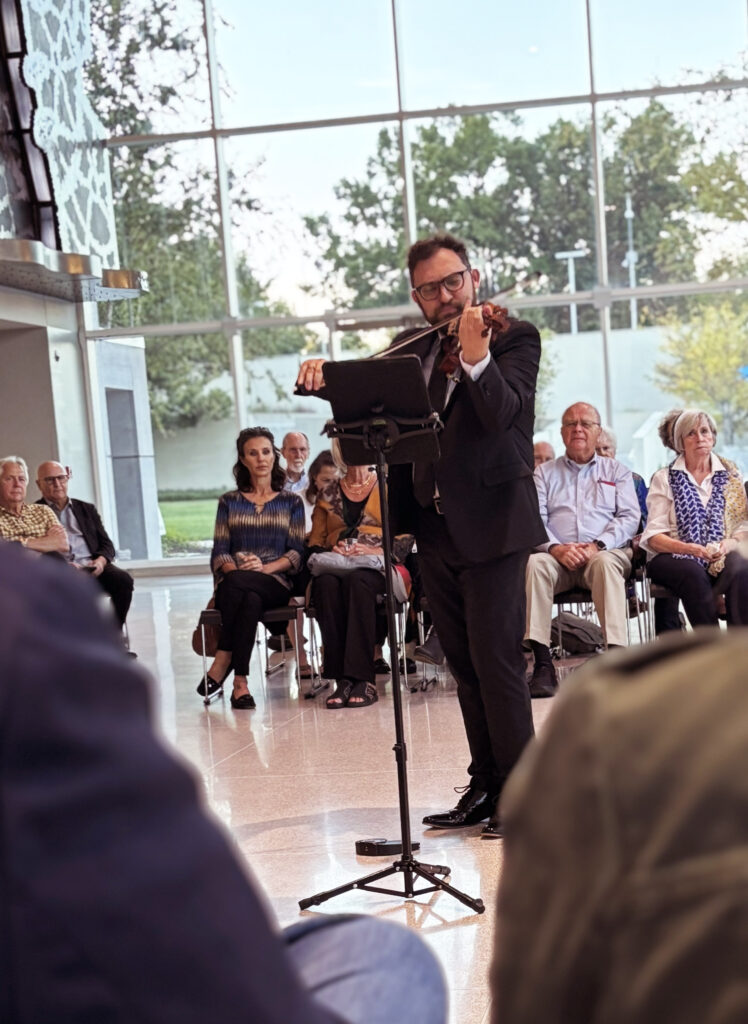
The first half of the program consisted of four works for violin and piano, four pieces that explored themes of sensuality and romance. The concert opened with John Williams arrangement of Tango for Una Cabeza from the film, Scent of a Woman. It was a great opener, lush and familiar and certainly set the mood for the music to follow.
The next work, Pablo de Sarasate’s “Introduction and Tarantella” led the audience deeper into the realms of romance. The first part of the work, “Introduction” is just that, an introduction. It feels both lush and almost courtly, yet filled with promise. I imagine a first meeting in a beautiful garden, constrained perhaps by convention, by the gentle art of first impressions and introductions, but a meeting that is the beginning of a mad romance. This is, of course, followed up by the wildly passionate, and complex Tarantella, an intricate weaving of sensuality and no small measure of intrigue. As one of the hairs on Shaun’s bow came loose and was floating about in wild gyrations, he artfully plucked it from the air and flicked it away, as if brushing of an errant whisp from a spider’s web, only enhancing the sense of passion and pursuit.
The Sarasate was followed by two additional pieces, Manuel de Falla’s Spanish Dance from “La Vida Breve”, and Chiquinha Gonzaga’s Corta Jaca, engaging the audience in a further exploration of the vagaries of love, seduction, and art.
In the second half of the concert Devan Jaquez joined Shaub and Class for two trios: Bohuslav Martinu’s Sonata for Flute, Violin and Piano and Nino Rota’s Trio for Flute, Violin and Piano.
I adored the Martinú, not surprisingly as I am a big fan of Martinu’s music, despite relatively rarely hearing it in performance. On Wednesday evening I felt that Shaun and Jaquez captured the precise balance I find in Martinú between lyricism and a precisely delineated underlying tensions. Martinu artfully balances distinct rhythmic passages with notes of jazz and dance or folk music in a way that is both infectiously joyful while yet at the same time acknowledging underlying rhythmic discordancies. During the first movement I was almost dancing out of my seat. The second movement, a pastoral Adagio in 3/4 time had me wishing to curl up with a blanket, simply washed with the music. That cheeky blend of lyricism with competing tensions of jazz and folk influences returned for the third movement. The fourth movement is more difficult. In one sense it seems to be a pastiche of several smaller movements, none with any real bearing on what has come before or after. There is a discordant piano solo, some lilting passages here and there, several virtuosic moments, and an apparent lack of obvious connection. George always thought this movement was an add on that could have been dispensed with completely, but it always reminds me of alternate possibilities, of the road not taken, and in that sense enhances the entire experience. Is there a correct answer? I doubt it.
The final piece was by Nino Rota, and it was lovely. I probably did not pay enough attention. I find Rota enjoyable but not fully engaging and at the end of the concert, following the fabulous Martinu, I didn’t have the will to tune in with greater intellectual vigor. I felt the flute had a delightful role in the piece, nicely explored by Jaquez, but I also felt the piano was perhaps a bit too heavy. Regardless, it was a lovely evening.
Which brings me to concert number 3, the previous Wednesday. This was the noon performance by the Principal String Quartet and the Principal Woodwind Quintet. This was the unusual, for me, concert where I knew absolutely nothing about any of the works performed, nor for the most part, the composers. I had heard of Juan Crisóstomo Arriaga, although I could not put my finger on any works that I may have hard. We heard the first string quartet. The other two composers, Eurico Carrapatoso, and Karl Pilss, were completely unfamiliar. I thoroughly enjoyed all of the music and think I will need to make an effort and further listening. This is one of the things I love about this series, the musicians pick music they love and/or want to play, and the joy of each performance is contagious.
All in all this has been a spectacular kick-off to the Knoxville Symphony’s 90th season. I am sure I wlll love tonight’s concert, “Soft Rock of the 70s and 80s” but I probably won’t write about it further. I am looking forward to what promises to be an exciting year.